Clear Sky Science · en
DUSP5 suppresses esophageal squamous cell carcinoma by counteracting macrophage-derived AREG-ERK1/2 signaling and disrupting an oncogenic ERK1/2-ELK1-DUSP5 feedback circuitry
Why this cancer study matters
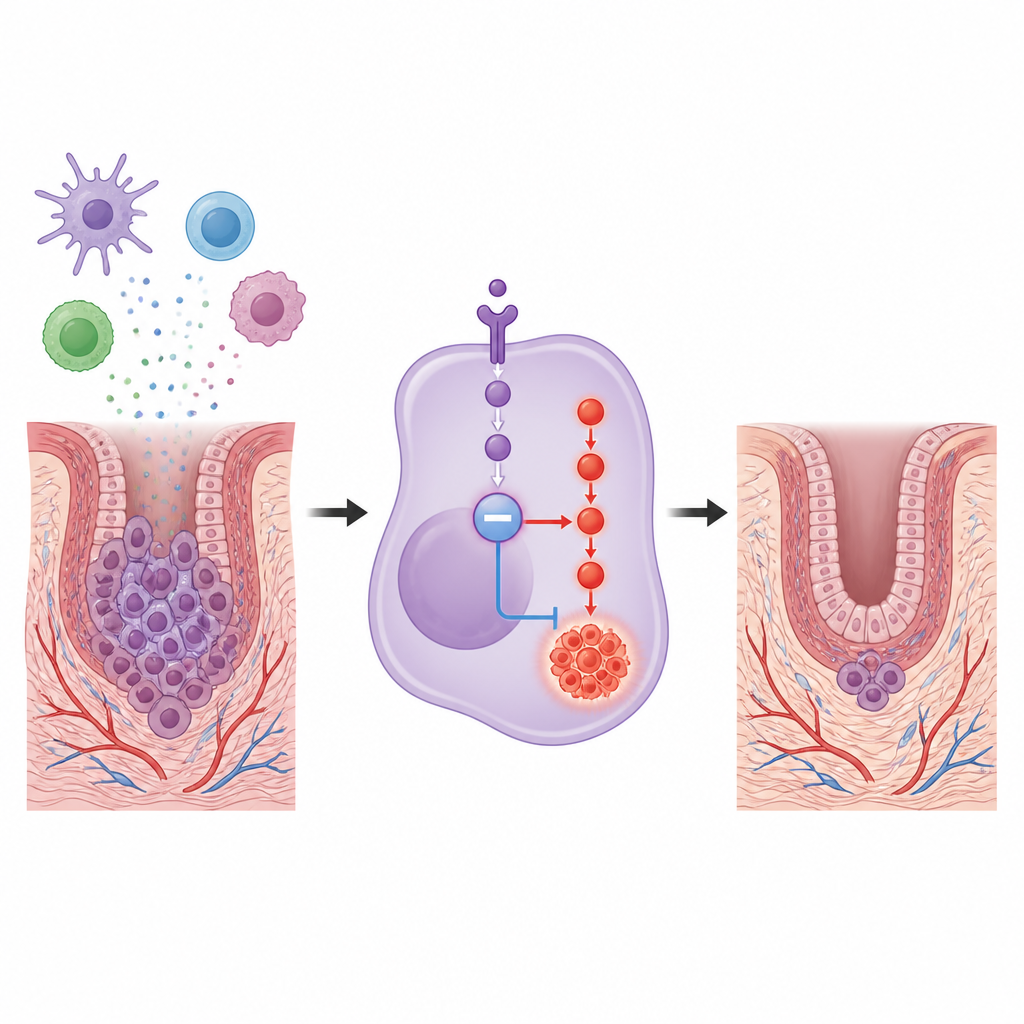
Esophageal squamous cell carcinoma is a deadly throat cancer that often spreads early and resists treatment. This study uncovers how a natural “brake” inside cells, together with nearby immune cells, can either slow or fuel this cancer. Understanding this hidden control system could point to new ways to predict how a tumor will behave and to design more precise therapies.
A closer look at a stubborn cancer
Esophageal squamous cell carcinoma arises in the lining of the esophagus, the tube that carries food to the stomach. Many patients are diagnosed late, when the cancer has already invaded deeply or spread to other organs, making surgery and standard treatments less effective. The authors used modern genetic tools to study thousands of individual cells from patient tumors, asking which cell types are present, how they talk to each other, and which molecular switches control growth, spread, and response to therapy.
Immune cells that feed the fire
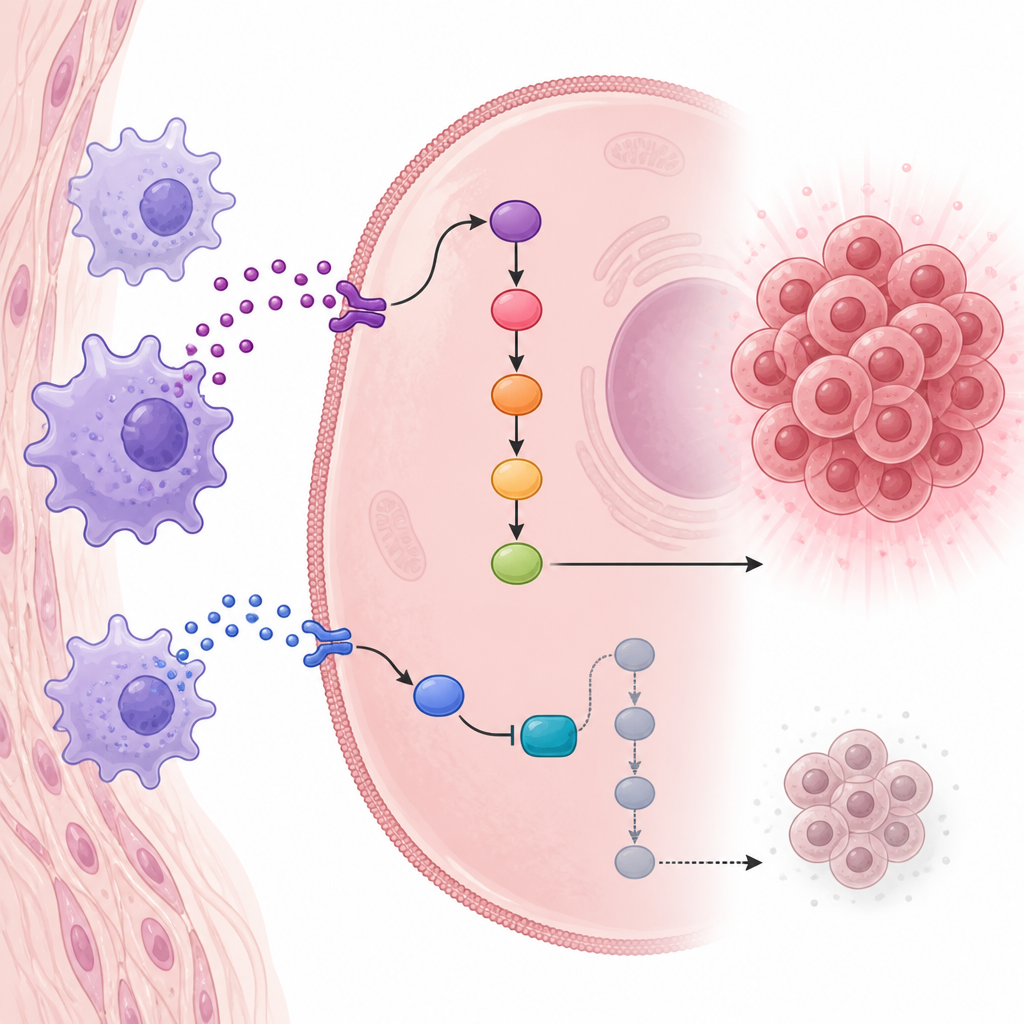
By applying single cell RNA sequencing, the team built a detailed map of all major cell populations inside these tumors, including cancer cells, immune cells, blood vessel cells, and supporting fibroblasts. They focused on myeloid cells, a branch of the immune system that includes macrophages. Among several macrophage subgroups, they identified a distinctive population marked by a gene called APOC. These macrophages sit close to tumor cells and send growth signals through a protein called amphiregulin, which activates a receptor on cancer cells and switches on an internal chain of molecules known collectively as ERK signaling. That signal encourages tumor cells to grow, survive, and invade while also shaping the local immune environment.
The cell’s own brake on growth signals
Inside tumor cells, one key check on ERK signaling is an enzyme called DUSP5. It normally acts as a brake by chemically switching off ERK proteins once they have done their job. The researchers found that DUSP5 levels were much lower in esophageal cancer tissues and cancer cell lines than in normal esophageal cells. When they forced cancer cells to make more DUSP5 in the lab, the cells divided more slowly, aged and died more readily, and were less able to move and invade through surrounding tissue. In mice, tumors grown from DUSP5 rich cells were smaller and produced fewer lung metastases, and the cancer cells showed fewer signs of the shape shifting process that usually helps them spread.
A vicious cycle that locks in aggressive behavior
The study also uncovered how tumor cells can turn this brake off. When ERK is active, it switches on another protein called ELK1 that moves into the cell nucleus and alters gene activity. The authors showed that active ELK1 binds directly to the stretch of DNA that controls DUSP5 and shuts it down. This creates a loop: immune cell signals turn on ERK, ERK activates ELK1, and ELK1 silences DUSP5, which would otherwise turn ERK off. Experiments with chemical tools that boost ERK or ELK1 activity erased the protective effects of DUSP5, restoring rapid growth, invasion, and spread. In a mouse model where DUSP5 was completely removed, cancers were more numerous and aggressive, but blocking ERK signaling in these animals reversed much of this effect.
What this means for patients
By linking tumor friendly macrophages, the ERK signaling chain, the ELK1 switch, and the DUSP5 brake into one connected system, this work shows how esophageal tumors can maintain a self reinforcing state of high growth and invasiveness. The authors found that patients whose tumors had low DUSP5 and high ERK and ELK1 activity tended to have more advanced disease and poorer survival. While more work is needed before these findings reach the clinic, the DUSP5 ERK ELK1 axis and the macrophages that drive it may offer new biomarkers to gauge risk, as well as targets for drugs that restore the cell’s natural braking system and make current treatments more effective.
Citation: Huang, X., Xu, W., You, R. et al. DUSP5 suppresses esophageal squamous cell carcinoma by counteracting macrophage-derived AREG-ERK1/2 signaling and disrupting an oncogenic ERK1/2-ELK1-DUSP5 feedback circuitry. Cell Death Dis 17, 498 (2026). https://doi.org/10.1038/s41419-026-08641-0
Keywords: esophageal cancer, tumor microenvironment, macrophages, ERK signaling, DUSP5