Clear Sky Science · en
N6-methyladenosine–mediated up-regulation of ARRB2 regulates intrahepatic cholangiocarcinoma malignant progression and pemigatinib resistance through MAPK and Hippo signaling pathways
Why this cancer story matters
Intrahepatic cholangiocarcinoma is a cancer of the small bile ducts inside the liver, and it is both hard to detect early and difficult to treat. A newer drug called pemigatinib can help some patients whose tumors carry a specific genetic change, but many cancers eventually stop responding. This study asks a practical question that matters to patients and doctors alike: what makes these liver bile duct tumors become resistant to pemigatinib, and can that weakness be turned into a new way to treat them?
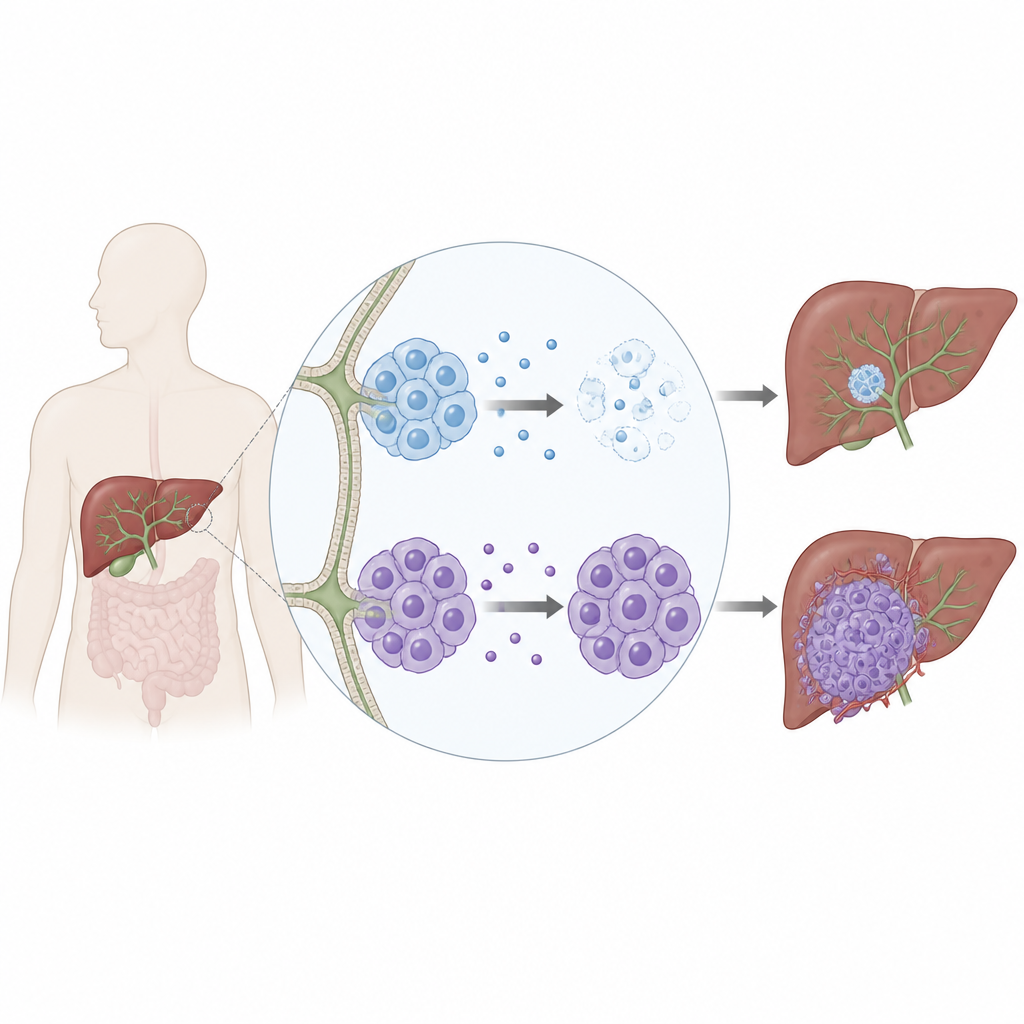
A closer look at bile duct cancer and its main drug
The researchers focused on intrahepatic cholangiocarcinoma, which is now the second most common primary liver cancer worldwide. Surgery can cure only a minority of patients because the disease is often found late. Targeted drugs that block a growth switch called FGFR2, including pemigatinib, have brought new hope for people with advanced disease. Yet many tumors initially sensitive to pemigatinib later begin to grow again, and there are no reliable tests in the clinic to predict who will benefit for long. Understanding why resistance appears is key to designing smarter treatment plans and combination therapies.
Finding a key helper in resistant tumor cells
To mimic what happens in patients, the team gradually exposed two human bile duct cancer cell lines to increasing doses of pemigatinib until the cells could grow despite the drug. These resistant cells were then compared with their original, drug-sensitive counterparts. The scientists profiled thousands of genes at once and discovered that one gene, called ARRB2, stood out as the most strongly increased in both resistant cell types. When they reduced ARRB2 levels using genetic tools, the cancer cells became far more vulnerable to pemigatinib again in dishes and in mouse models. In live animals, blocking ARRB2 sharply reduced tumor growth and made pemigatinib far more effective, suggesting that ARRB2 acts like a central helper that allows cancer cells to shrug off the drug.
How the cancer boosts this helper molecule
The study then explored how tumor cells manage to raise ARRB2 levels. The answer lay in a chemical decoration on messenger RNA called m6A, which subtly tunes how strongly genes are used without changing the underlying DNA. The researchers found that overall m6A marks were higher in bile duct cancer cells than in normal bile duct cells. A writer enzyme named METTL3 and a reader protein called YTHDF1 were both elevated in patient samples and cell lines. Together, these two proteins increased the stability and translation of the ARRB2 message, allowing the cancer to build up more ARRB2 protein. Detailed experiments pinpointed a specific site on the ARRB2 message where this mark mattered most. Patients whose tumors showed high levels of ARRB2, METTL3, or YTHDF1 tended to have more advanced disease and shorter survival, linking this hidden RNA chemistry directly to real-world outcomes.
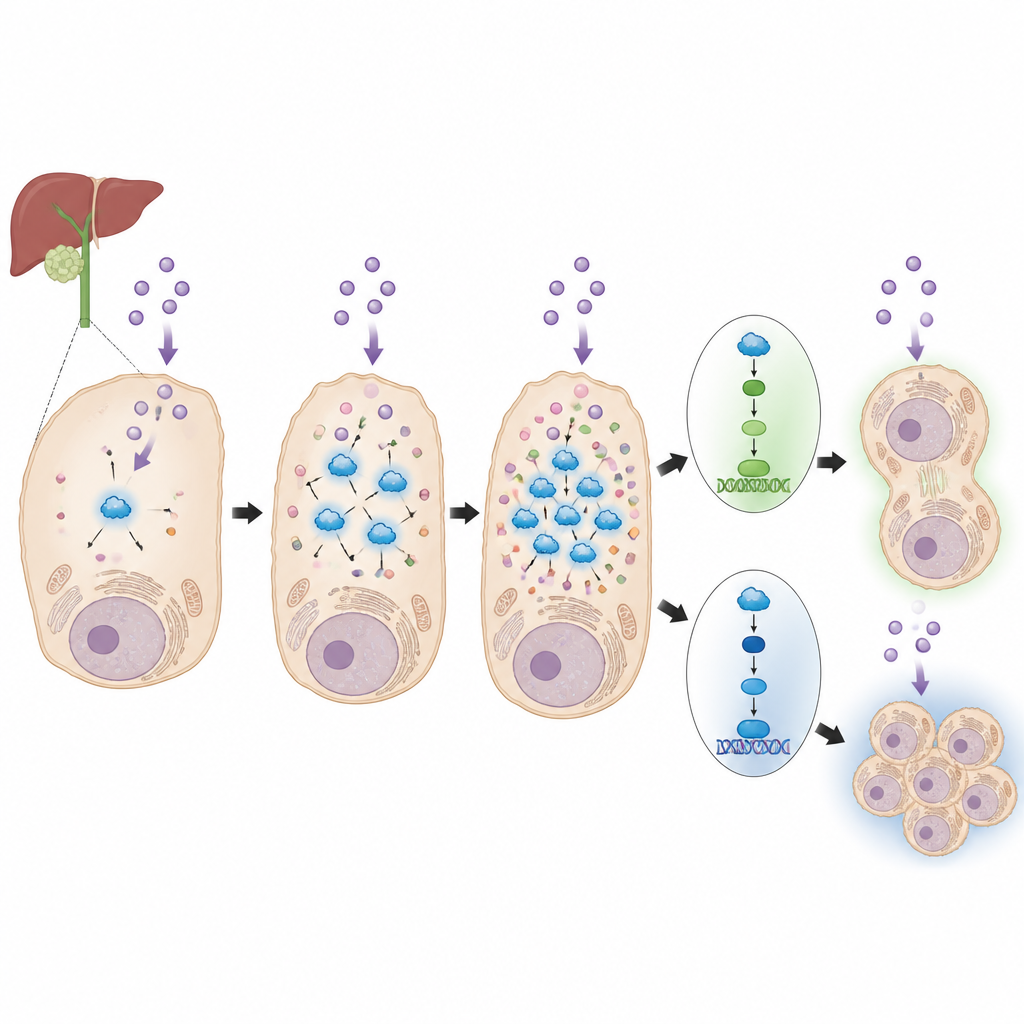
How ARRB2 rewires growth signals inside cells
Once inside the cancer cell, ARRB2 acts as a scaffold that organizes major growth and survival signals. The researchers found that extra ARRB2 activates two key control circuits: the MAPK pathway, which includes a chain of proteins known as Raf, MEK, and ERK, and the Hippo pathway, which normally restrains growth through a regulator called YAP. When ARRB2 levels are high, YAP moves into the nucleus more easily and turns on genes that drive cell division, while the Raf–MEK–ERK chain becomes more active and helps cells keep growing even when FGFR2 is blocked by pemigatinib. Using inhibitors that directly target YAP or c-Raf, the team could further weaken resistant cells and restore sensitivity to pemigatinib, showing that these pathways are not just bystanders but central to the resistant behavior.
What this means for future treatment
For people facing intrahepatic cholangiocarcinoma, these findings suggest that ARRB2 and its RNA regulators could serve as warning lights and new targets. Measuring ARRB2, METTL3, and YTHDF1 in tumor samples might help doctors estimate how aggressive a cancer is and how long pemigatinib is likely to work. At the same time, drugs that dampen ARRB2 itself, or that block the Raf–MEK–ERK or YAP routes it controls, could be paired with pemigatinib to delay or overcome resistance. While more work is needed before such strategies reach the clinic, this study maps a clear chain of events from subtle RNA changes to runaway growth signals, offering a concrete path toward more durable treatments for bile duct cancer.
Citation: Chen, H., Wang, X., Zhu, W. et al. N6-methyladenosine–mediated up-regulation of ARRB2 regulates intrahepatic cholangiocarcinoma malignant progression and pemigatinib resistance through MAPK and Hippo signaling pathways. Cell Death Dis 17, 508 (2026). https://doi.org/10.1038/s41419-026-08574-8
Keywords: intrahepatic cholangiocarcinoma, pemigatinib resistance, ARRB2, MAPK signaling, Hippo YAP pathway