Clear Sky Science · en
The deubiquitinase activity of CYLD is required for B cell differentiation
How a tiny cell tool keeps our defenses in balance
Our immune system depends on B cells, the antibody-producing cells that remember past infections and vaccines. This study asks a simple but important question: what happens when a single molecular tool inside early B cells stops working? The answer helps explain how our bodies build a healthy B cell army, and may illuminate why some people develop immune weakness or blood cancers.
The cell mechanic called CYLD
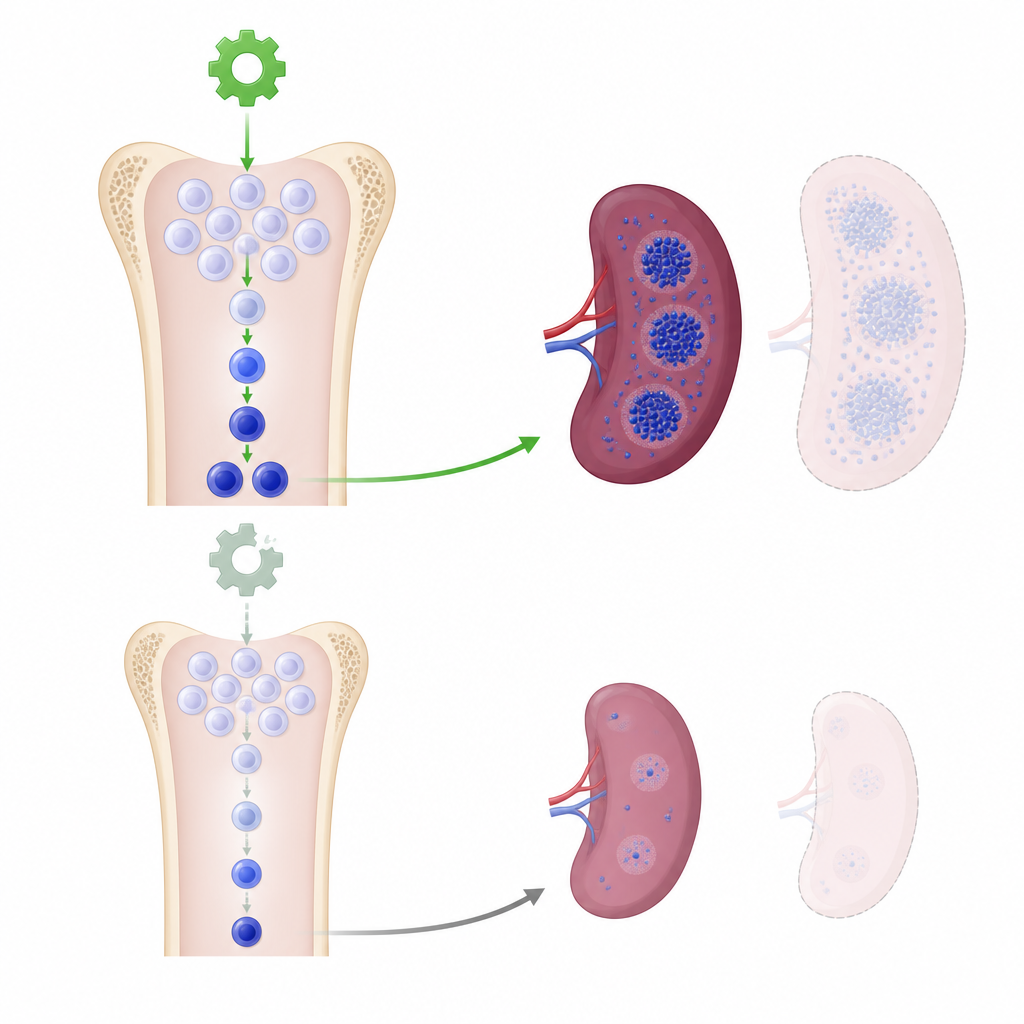
Inside many cells lives a protein called CYLD that works like a molecular mechanic, taking small chemical tags off other proteins to keep key signals from running out of control. Earlier work showed that broken CYLD is linked to several cancers and to abnormal growth in immune tissues, but its exact job in B cells was unclear. To focus on this question, the researchers engineered mice in which CYLD’s cutting activity was switched off only in B cells, and from the very first steps of their development in the bone marrow.
Blocked growth of young B cells
The team examined the bone marrow of these mice and found a striking bottleneck. The earliest B cell precursors piled up, but very few progressed to the next stages or became fully mature cells. In healthy mice, early, intermediate, and mature B cells appeared in a smooth sequence. In the CYLD-deficient mice, that sequence broke down right after an early phase called the Pro B cell stage. Detailed cell staining and single-cell RNA sequencing revealed that the normal “assembly line” of B cell development was scrambled, with many cells stuck in an in-between state and only a small trickle reaching maturity.
Shrunken spleens and weak antibody responses
The spleen, a major hub where mature B cells live and respond to invaders, also showed clear changes. CYLD-deficient mice had smaller spleens with far fewer B cells, and the normal zones that organize B cells were thinned or distorted. When the scientists isolated B cells and tried to stimulate them in a dish, the CYLD-deficient cells behaved oddly: they sometimes multiplied without outside triggers but failed to expand properly when given standard alarm signals. In living mice, these defects translated into weak antibody responses. After vaccination with both T cell–dependent and T cell–independent model antigens, control animals produced strong waves of protective antibodies, while CYLD-deficient animals made little or no long-lasting antibody of the IgG types that are crucial for robust immunity.
A broken link in a key growth signal
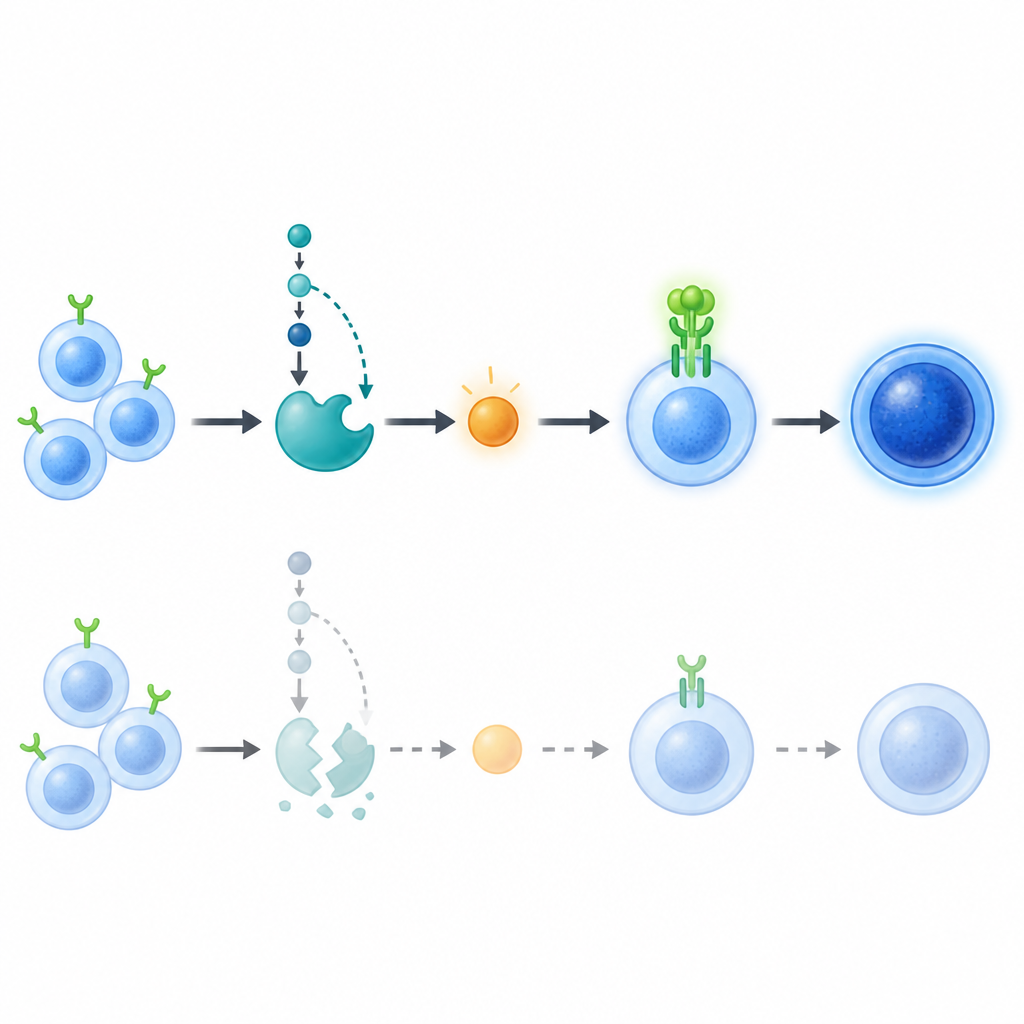
To understand why early B cells stalled, the researchers turned to gene activity patterns. Their analyses pointed to a signaling route controlled by the molecule IL-7, which normally tells young B cells in the bone marrow to survive, divide, and move forward in their development. In normal mice, the IL-7 receptor on B cells and a guiding transcription factor called FOXO1 rose sharply as cells moved from the Pro B to the next stage. In CYLD-deficient mice, FOXO1 stayed low, the IL-7 receptor failed to increase as it should, and the cells no longer responded to IL-7 in culture. Downstream survival and DNA-rearranging genes that depend on this signal were also misregulated, reinforcing the idea that the IL-7 pathway could not do its job without CYLD’s activity.
Why this matters for immune health
Together, these findings show that the cutting activity of CYLD is not an optional fine-tuner but a core requirement for building a normal B cell repertoire. Without it, early B cells cannot properly hear the IL-7 growth signal, their development stalls, lymphoid organs become depleted, and antibody responses are blunted. Although the exact protein targets that CYLD edits in this pathway remain to be identified, the work highlights a crucial safeguard step in immune cell formation. Understanding this link may open new ways to think about immune deficiencies and B cell–driven cancers, where either too few or too many B cells can put health at risk.
Citation: Pseftogas, A., Bordini, J., Gavriilidis, G. et al. The deubiquitinase activity of CYLD is required for B cell differentiation. Cell Death Dis 17, 496 (2026). https://doi.org/10.1038/s41419-026-08555-x
Keywords: B cell development, CYLD, IL-7 signaling, immune deficiency, lymphopoiesis