Clear Sky Science · en
Deficient extravillous trophoblast invasion caused by impaired sialylation–Siglec-7 interaction contributes to recurrent pregnancy loss
Why Tiny Sugar Coats Matter for Pregnancy
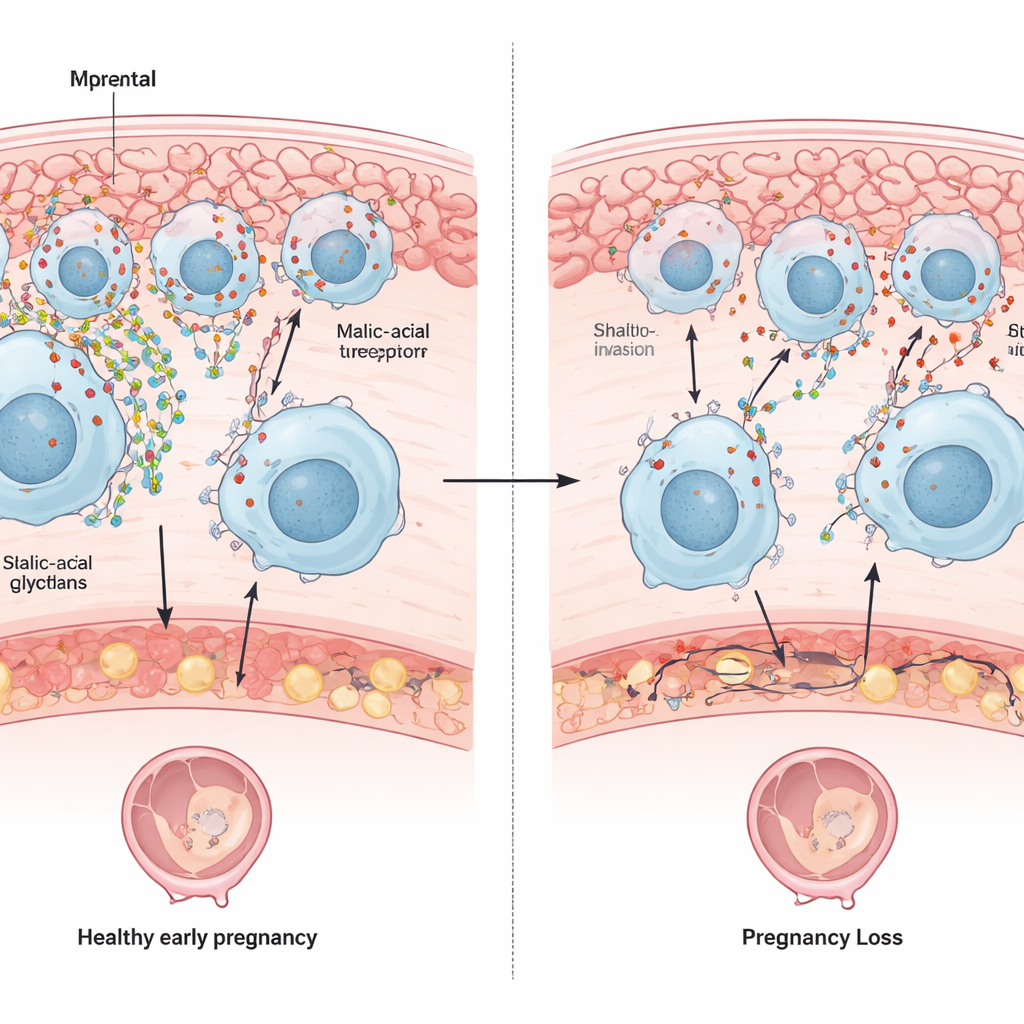
Early pregnancy is a remarkable feat of cooperation between two genetically distinct beings: mother and fetus. For a pregnancy to establish successfully, a special set of fetal cells must burrow into the wall of the uterus while nearby maternal immune cells stay calm enough to let this happen. This study reveals that a delicate “sugar code” on the surface of fetal cells helps maintain that truce—and that when this code is disrupted, it may contribute to recurrent pregnancy loss, a devastating condition in which women experience multiple miscarriages.
The Meeting Point Between Mother and Baby
At the center of this work are extravillous trophoblasts, fetal cells that leave the early placenta and invade the mother’s uterine lining to build the blood supply needed for the growing embryo. They interact closely with decidual natural killer (dNK) cells, a type of immune cell that normally helps remodel blood vessels and promotes tolerance. Using single-cell RNA sequencing—essentially a cell-by-cell gene activity map—the researchers compared tissue from women with normal pregnancies and women with recurrent pregnancy loss. They found that in the loss group, trophoblasts showed lower activity of several enzymes that add sialic acids, a family of sugar molecules, to proteins on the cell surface. At the same time, a subset of dNK cells carrying a receptor called Siglec-7 was more abundant and displayed a more inflammatory gene program.
A Broken Sugar Signal Between Cells
The team next asked what this loss of surface sugars actually means for cell communication. They showed that two key enzymes, ST3GAL4 and especially ST6GALNAC6, were reduced in trophoblast tissues from recurrent loss patients, and that the outer surfaces of these cells indeed carried fewer sialic-acid decorations. In parallel, Siglec-7 levels on dNK cells were increased, suggesting that the immune side was attempting—unsuccessfully—to compensate. By isolating and analyzing membrane proteins from trophoblasts, they identified several candidates, including CD276, CD151, ITGA2 and LAMP1, whose sialic-acid “coats” were heavily reduced when sugars were experimentally stripped away. These proteins are involved in cell movement and attachment to the surrounding matrix, making them prime suspects in controlling how deeply trophoblasts can invade the uterine wall.
How the Signal Drives Invasion
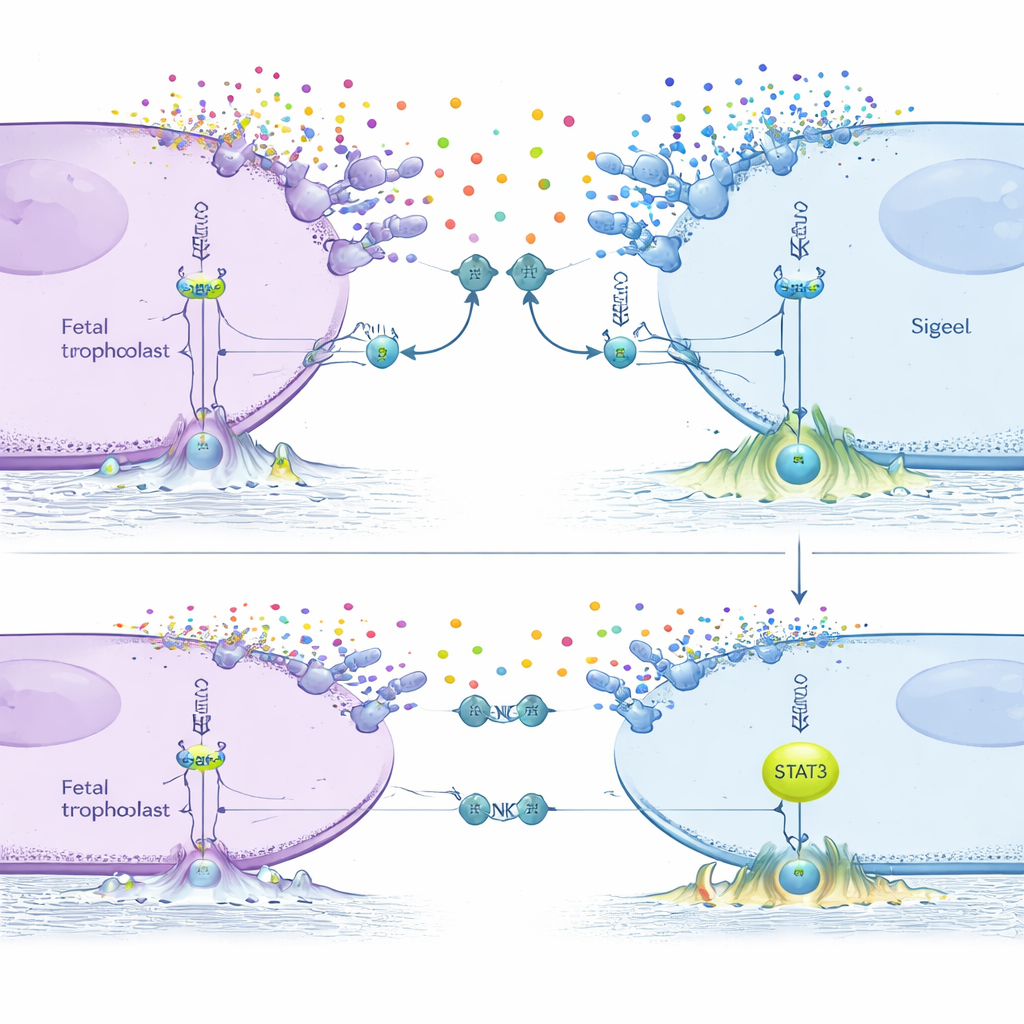
To connect these molecular changes to actual behavior, the researchers set up coculture systems where trophoblast-like cells faced off against Siglec-7–positive or –negative NK cells. When the sugars on trophoblasts were removed with an enzyme, their ability to migrate and invade was sharply reduced—but only in the presence of Siglec-7–bearing NK cells. This pointed to a specific handshake: sialic acids on trophoblast proteins engaging Siglec-7 on NK cells. Further experiments showed that this handshake triggers NK cells to release interleukin-8 (IL-8), a signaling molecule that, in this context, encourages trophoblast movement. IL-8 then activates a protein inside trophoblasts called STAT3, which turns on genes that support invasion and the expression of key membrane proteins. Without the sugar–Siglec-7 contact, IL-8 release drops, STAT3 activation wanes, and the cells become sluggish.
Rebuilding the Barrier With a Chip
To test whether restoring this sugar code could rescue faulty invasion, the team used a sophisticated “implantation-on-a-chip” device that mimics the early maternal–fetal interface in three dimensions. They placed human trophoblast cells from recurrent loss patients on one side of a gel mimicking the uterine wall, with NK cells embedded within. When they supplied an active form of the sialylation enzyme ST6GALNAC6, trophoblasts regained much of their invasive capacity, especially when Siglec-7–positive NK cells were present. Another enzyme, ST3GAL4, had smaller effects. These findings suggest that re-establishing the correct pattern of terminal sialic acids can re-engage Siglec-7, restore IL-8–STAT3 signaling, and partially normalize trophoblast behavior in a controlled, human-based model.
What This Means for Understanding Miscarriage
Altogether, the study proposes a clear chain of events: specific sugar molecules on fetal trophoblasts bind to Siglec-7 receptors on maternal NK cells, prompting the release of IL-8, which activates STAT3 inside trophoblasts and drives their invasion into the uterine wall. In recurrent pregnancy loss, this sugar coating is diminished, the handshake weakens, IL-8 and STAT3 signaling fall, and invasion becomes insufficient—undermining the foundations of a healthy placenta. By pinpointing the ST6GALNAC6–sialic acid–Siglec-7–IL-8–STAT3 axis as a critical control point, the work suggests that carefully targeted “glyco-therapy” to restore proper sialylation might one day offer new options for women facing repeated miscarriages.
Citation: Zhang, L., Feng, Y., Wu, P. et al. Deficient extravillous trophoblast invasion caused by impaired sialylation–Siglec-7 interaction contributes to recurrent pregnancy loss. Cell Death Dis 17, 291 (2026). https://doi.org/10.1038/s41419-026-08503-9
Keywords: recurrent pregnancy loss, maternal fetal interface, trophoblast invasion, immune tolerance, glycosylation