Clear Sky Science · en
H3K9me2 is a determinant for the mitosis-to-meiosis transition in female germ cells
Why this matters for future fertility
Every egg or sperm cell in a mammal begins life as a simple dividing cell that has not yet decided its final identity. At a certain moment, these cells must switch from ordinary cell division to the special kind called meiosis, which creates eggs and sperm. This paper uncovers how a tiny chemical tag on DNA-packaging proteins helps female germ cells in mice make that life-defining switch. Understanding this switch could improve approaches to treating infertility and to growing germ cells from stem cells in the lab.
A key moment in the life of germ cells
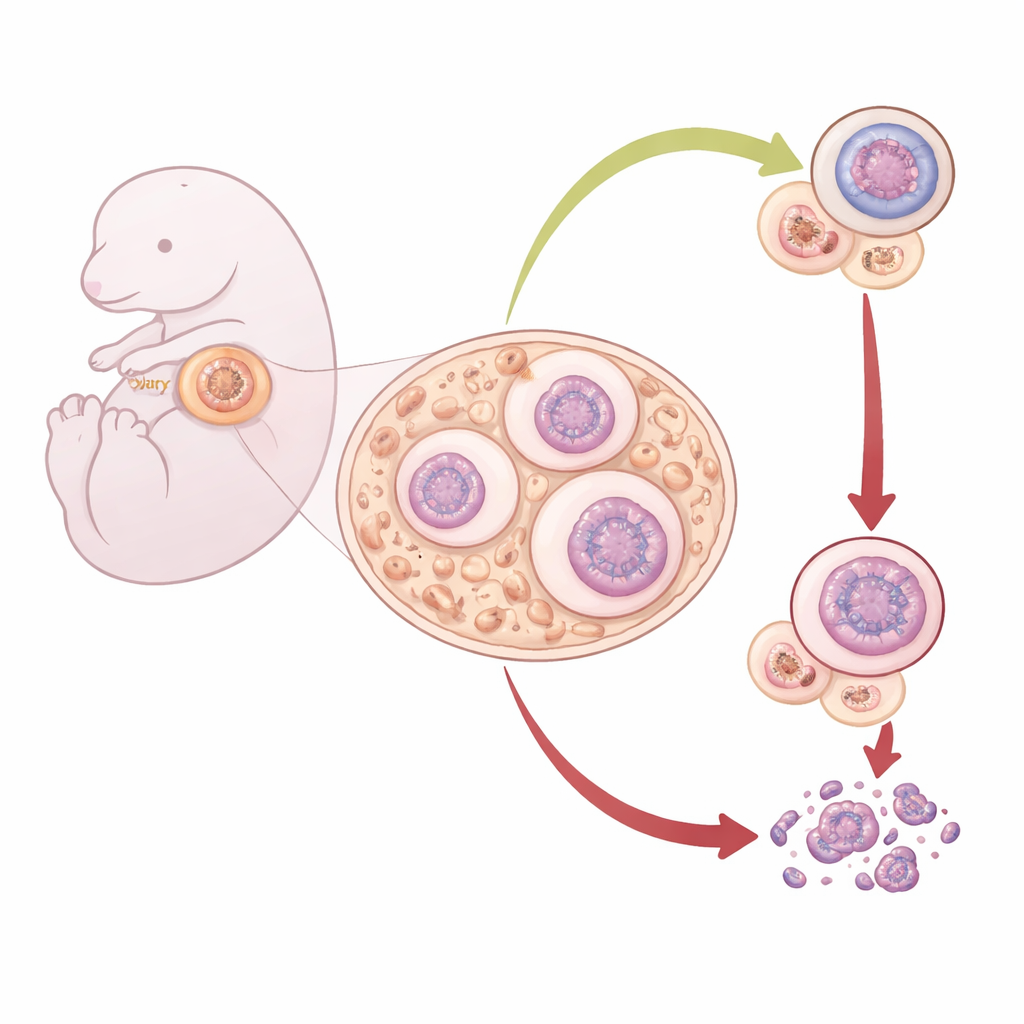
Before becoming eggs, primordial germ cells in the fetal ovary divide like typical body cells and carry a flexible, stem-cell-like program known as pluripotency. Around day 13.5 of mouse embryonic development, these cells must shut down pluripotency and enter meiosis. The authors focused on a chemical mark called H3K9me2, which sits on histone proteins that help fold DNA into chromatin. They found that in female germ cells, the level of H3K9me2 rises sharply just as the cells are meant to start meiosis, while in male germ cells at the same stage this mark stays low. This timing suggested that H3K9me2 could act as a molecular signal that prepares female germ cells for their new role.
Blocking the switch derails egg development
To test H3K9me2’s role, the researchers treated pregnant mice with a drug (BIX01294) that lowers this mark and examined fetal ovaries. Even though the embryos and ovaries looked normal from the outside, germ cells inside showed large changes in gene activity. Thousands of genes shifted their expression; genes that keep cells in a pluripotent, dividing state went up, while many genes needed for meiosis went down. Markers of the meiotic program, including DAZL, STRA8, and proteins that build the specialized chromosome structures of meiosis, were reduced or mispatterned. Chromosome spread analyses showed that many germ cells stalled at the earliest stage of meiosis and could not progress, and cells that failed to make the switch often remained in a mitotic, proliferating state or later underwent cell death.
Shutting down the stem-cell program
One of the most striking findings was that when H3K9me2 was reduced, female germ cells failed to properly turn off core pluripotency genes such as Sox2, Oct4, Nanog, and Dppa3. Normally, these genes drop sharply as meiosis begins. Under low H3K9me2, they stayed high, both in living embryos and in ovary tissue cultured in the lab. Importantly, the level of H3K9me2 itself was not altered in mice lacking DAZL or STRA8, meaning that H3K9me2 sits upstream of these classic meiotic regulators rather than being controlled by them. In other words, the chemical mark appears to help close the door on the stem-cell-like state so that the meiotic program can fully engage.
Remodeling DNA packaging to change fate
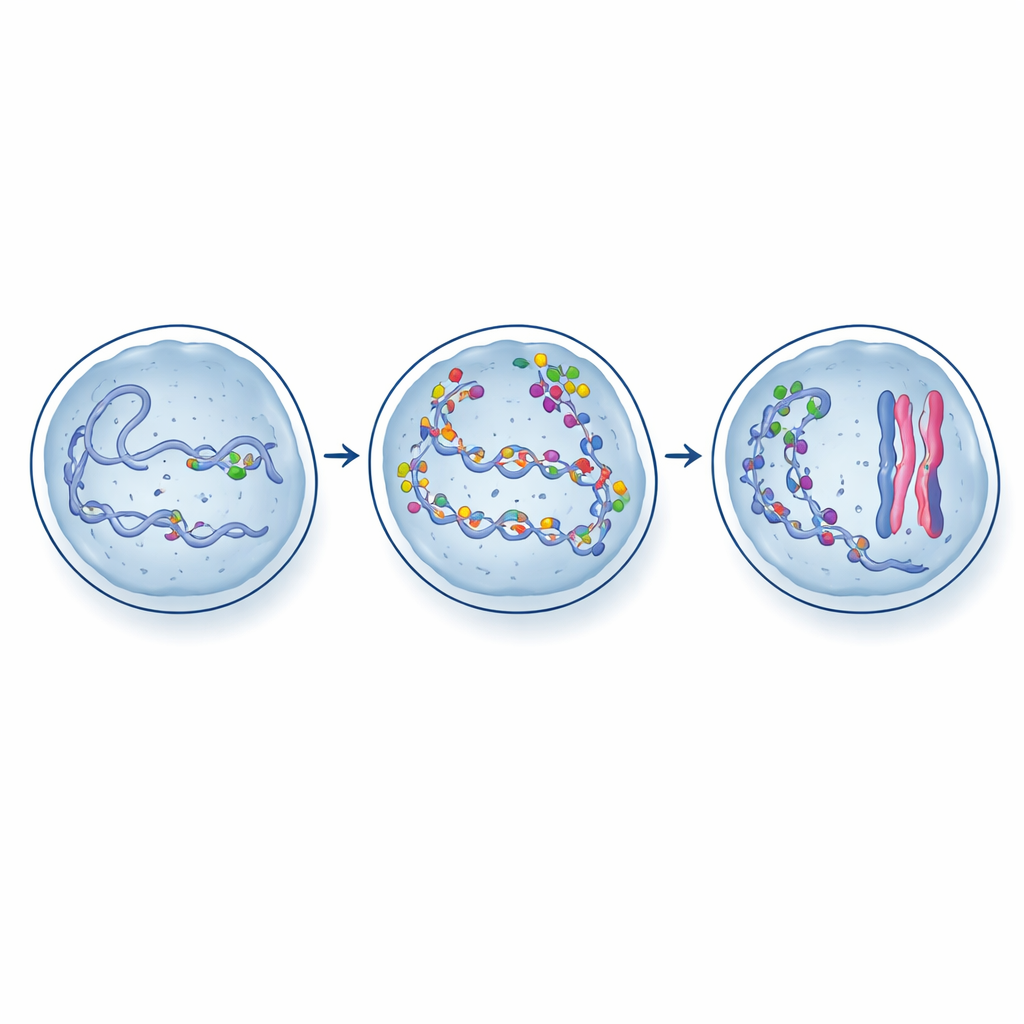
To understand how this single mark exerts such broad influence, the team integrated several genome-wide methods. They re-analyzed a mapping dataset for H3K9me2 and found that the mark accumulates directly at the start sites of the Sox2 gene and of many genes that encode ATP-dependent chromatin remodeling complexes—the molecular machines that slide and reshape nucleosomes along DNA. When H3K9me2 was reduced, chromatin became more accessible at these sites, as shown by ATAC-sequencing, and the corresponding genes became more active. Many of the affected remodeling factors are already known to support pluripotency in embryonic stem cells. The data suggest that H3K9me2 normally sits on these promoters to keep both the pluripotency network and its chromatin “support machinery” in check, allowing germ cells to exit the dividing program and commit to meiosis.
What this means for making eggs in the lab
Taken together, the study positions H3K9me2 as a molecular gatekeeper for the transition from ordinary cell division to meiotic division in female germ cells. By placing a repressive mark at key control points—including the Sox2 gene and several chromatin remodelers—H3K9me2 helps germ cells abandon their stem-cell-like identity and gain the competence to enter and progress through meiosis. When this mark is missing, cells linger in an immature state, fail to complete meiosis, and are more likely to die. These insights deepen our understanding of how subtle changes in DNA packaging steer cell fate and could guide future efforts to generate functional eggs from stem cells for research or fertility treatments.
Citation: Hu, Y., Zhou, H., Shi, L. et al. H3K9me2 is a determinant for the mitosis-to-meiosis transition in female germ cells. Cell Death Dis 17, 289 (2026). https://doi.org/10.1038/s41419-026-08473-y
Keywords: germ cell development, chromatin remodeling, histone modification, meiosis initiation, pluripotency