Clear Sky Science · en
Gompertz growth with a shared carrying capacity optimally simulates primary and metastatic tumor growth dynamics
Why Tumors Talk to Each Other
Cancer is often described as a local problem—a lump that can be cut out or zapped with radiation. Yet most cancer deaths happen because of metastases, the colonies that spread to distant organs. This study explores a deceptively simple question with big consequences: do tumors growing in the same body quietly compete and constrain each other, and can removing one unleash the others? Using mouse experiments and mathematical modeling, the authors propose a shared limit on how much total cancer a body can sustain at once—and show how surgery or other treatments might tip that balance in surprising ways. 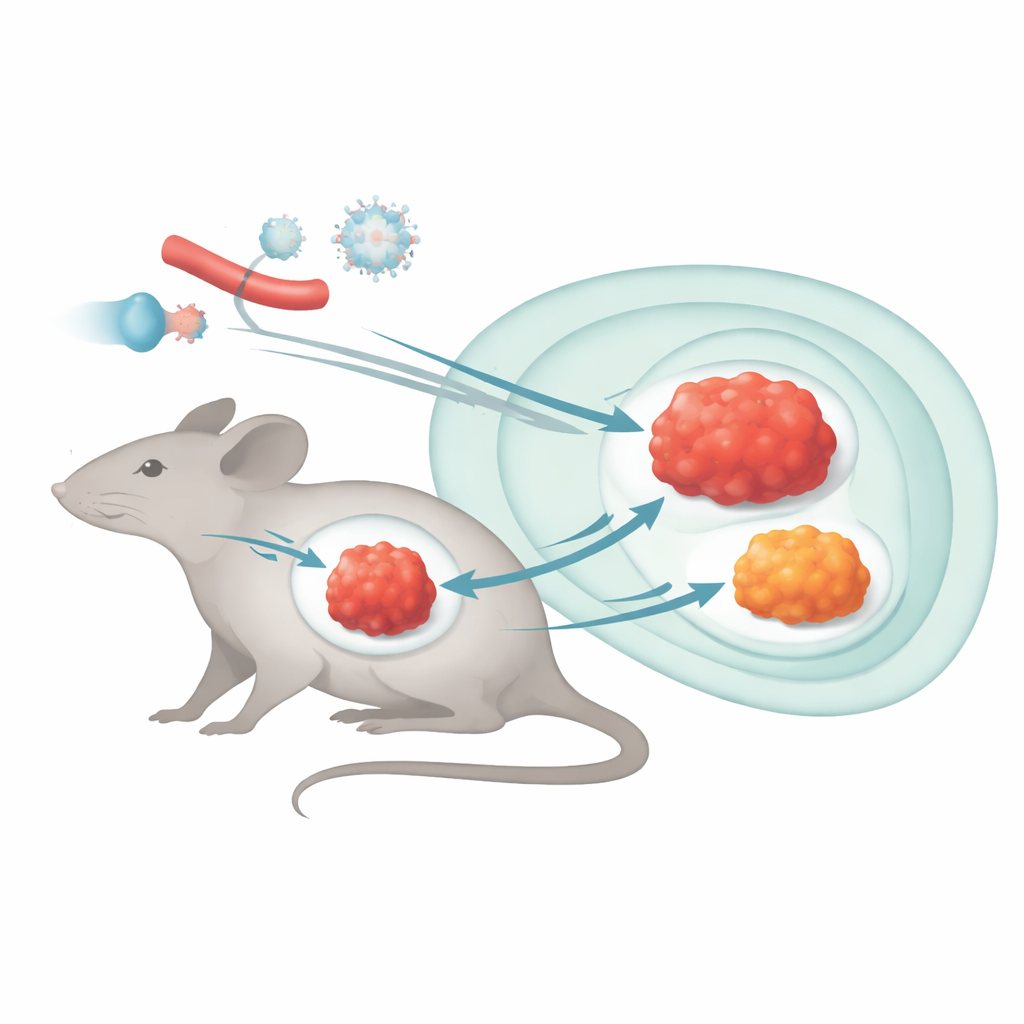
A Simple Rule for Complex Tumor Growth
The researchers base their work on a long-established growth pattern called Gompertzian growth, which captures a common observation: tumors grow quickly when small, then slow down as they get larger. Traditionally this pattern is used for a single tumor at a time, with an upper limit known as the carrying capacity—the maximum size that tumor can reach in its current environment. Here, the team extends the idea to multiple tumors growing together in the same host. Instead of each tumor having its own independent limit, they test a model where all tumors share one overall carrying capacity, reflecting the body’s finite resources such as blood supply, nutrients, and systemic tolerance for tumor burden.
Experiments in Mice Reveal Hidden Competition
To probe this idea, the authors analyzed two sets of mouse experiments. In one, some mice carried a single lung tumor while others carried two tumors on opposite sides of the back. In the second, mice were implanted with breast cancer cells that reliably seed metastases in the lungs; tumor sizes were measured over time, and lung metastases were quantified at the end using digital pathology and image analysis. The team then fit a range of mathematical models to these time courses, comparing classic growth laws and different assumptions about how tumors might or might not interact.
One Shared Limit Fits Better Than Many Separate Ones
Across these datasets, the Gompertz model with a shared carrying capacity consistently gave the most economical and accurate description of tumor growth. In the two-tumor mice, both tumors were best described by identical intrinsic growth rates but constrained by a single, mouse-specific total capacity. This meant the larger tumor always gained volume faster than the smaller one, simply because it already occupied more of the shared “space.” In the metastasis experiments, the same shared-capacity framework captured the combined behavior of the primary tumor and many lung lesions, using a small set of parameters that differed between aggressive and less aggressive cancer cell lines, and between individual mice.
When Removing One Tumor Frees the Rest
With this calibrated model in hand, the researchers ran virtual “what if” scenarios. They simulated surgical removal of the main tumor at specific times and followed the predicted behavior of metastases. In many cases—especially for the more aggressive cancer line—removing the primary tumor led to a burst of metastatic growth: micro-metastases that had been held in check began to expand rapidly once the shared capacity was no longer dominated by the primary mass. In contrast, when a mouse had little or no metastatic burden at the time of simulated surgery, removing the primary tumor did not trigger such an explosion. These differences were traced mainly to two mouse-specific factors: how fast metastases could grow, and how many cells in a tumor were capable of spawning new metastatic colonies. 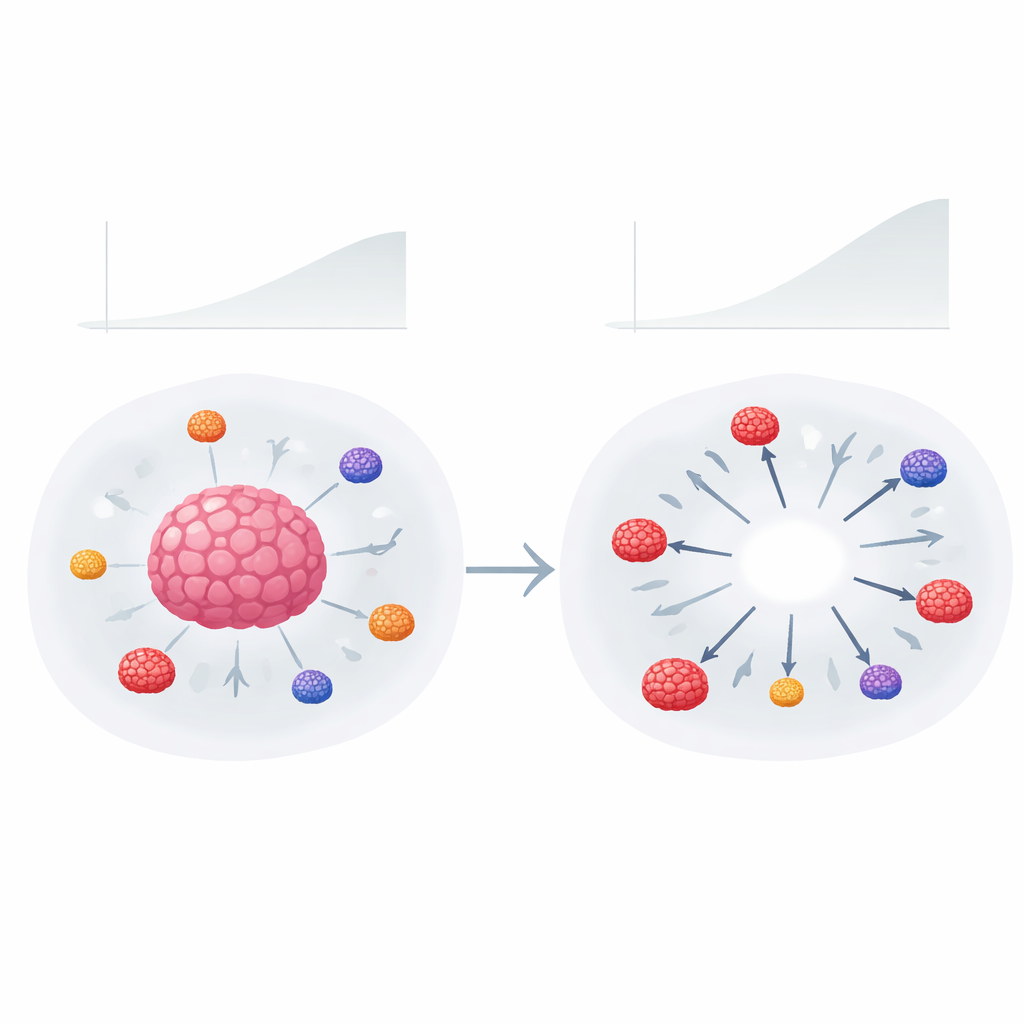
What This Means for Future Cancer Care
To a non-specialist, the key message is that tumors in the same body do not grow in isolation; they appear to share and compete for a common pool of systemic resources. This shared-capacity model offers a compact mathematical way to capture that interplay and helps explain clinical puzzles, such as why metastases sometimes flare after surgery or why local radiation can have distant effects. While the work is based on mice and simplifies many biological details, it suggests that understanding a patient’s overall “tumor budget” could help identify who is at higher risk for hidden metastases and who might safely benefit from certain local treatments. In the long run, such models could become part of digital “twins” of patients, guiding personalized strategies to keep metastatic disease under better control.
Citation: Schlicke, P., Korangath, P., Pan, X. et al. Gompertz growth with a shared carrying capacity optimally simulates primary and metastatic tumor growth dynamics. Br J Cancer 134, 1138–1149 (2026). https://doi.org/10.1038/s41416-025-03306-9
Keywords: tumor growth modeling, metastasis dynamics, cancer surgery effects, shared carrying capacity, mathematical oncology