Clear Sky Science · en
KDM6B safeguards mineralized tissue homeostasis from mechanical stress through epigenetic control of PIEZO1-mediated mechanotransduction in the mouse incisor
How Teeth Feel the Force
Our teeth and bones quietly endure the push and pull of daily life, from walking to chewing hard foods. This paper explores how a tiny group of cells inside a mouse’s front tooth senses and survives that constant pressure. Understanding this hidden balance between force and repair could one day help protect human bones and teeth from wear, injury, and diseases linked to overuse.
The Tooth That Never Stops Growing
Unlike human teeth, a mouse incisor grows throughout life. It is kept going by a chain of cells: long-lived stem cells feed rapidly dividing “transit-amplifying cells,” which then mature into the cells that build dentin and pulp inside the tooth. Because mice gnaw and chew with high pressure, this tooth is an ideal testbed for studying how living mineralized tissue stays healthy under repeated mechanical load. The authors focused on a protein called KDM6B, known for controlling how tightly DNA is packed, and asked whether it helps these tooth cells cope with stress.
When Force Meets a Cellular Safety Switch
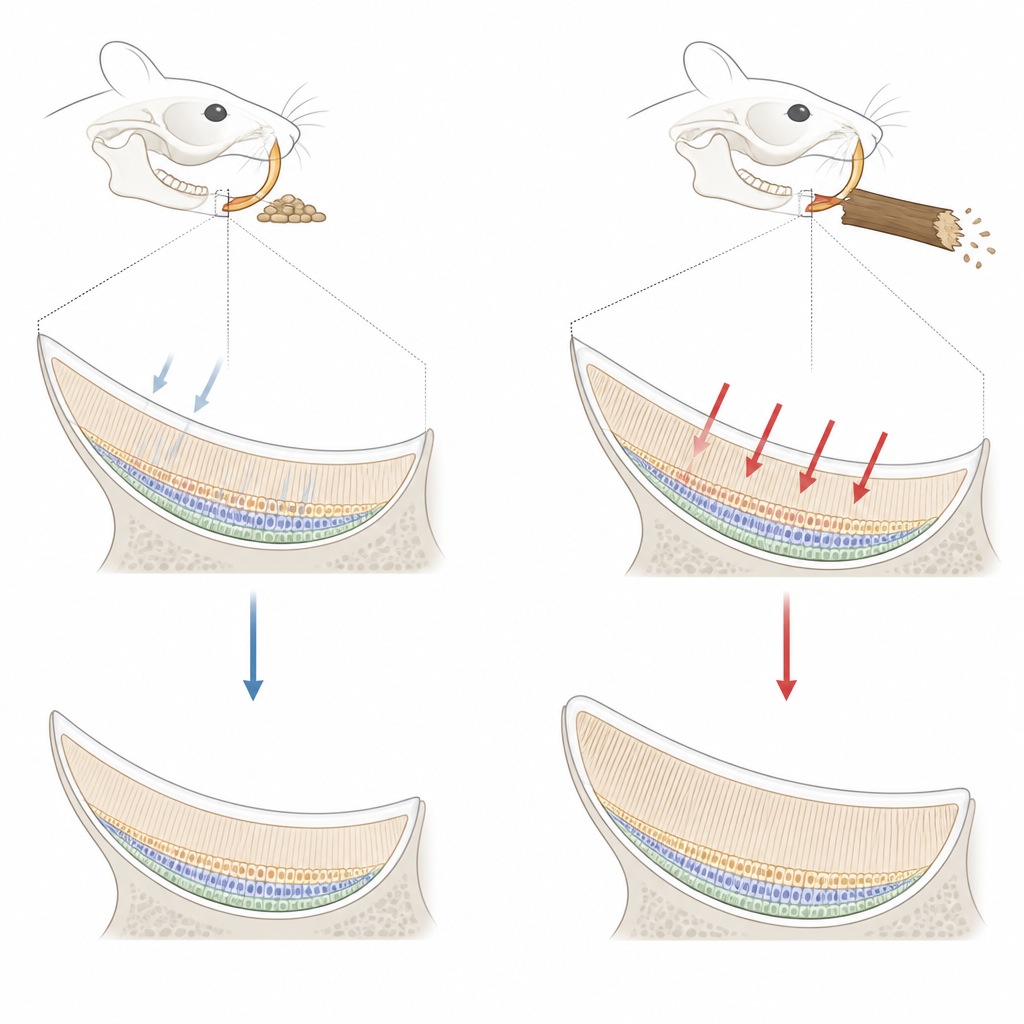
The team used genetically engineered mice to remove KDM6B from a specific stem cell lineage in the incisor and then compared tooth growth under normal and reduced biting forces. When mechanical load was normal, loss of KDM6B slowed tooth growth, thinned hard tissues, and caused an abnormal expansion of the soft pulp cavity. The rapidly dividing transit-amplifying cells were especially affected: they died more often, divided less, and were less able to turn into mature tooth-forming cells. Under reduced load, however, these problems largely disappeared, showing that KDM6B is especially important when teeth are exposed to everyday forces.
Translating Pressure into Signals Inside Cells
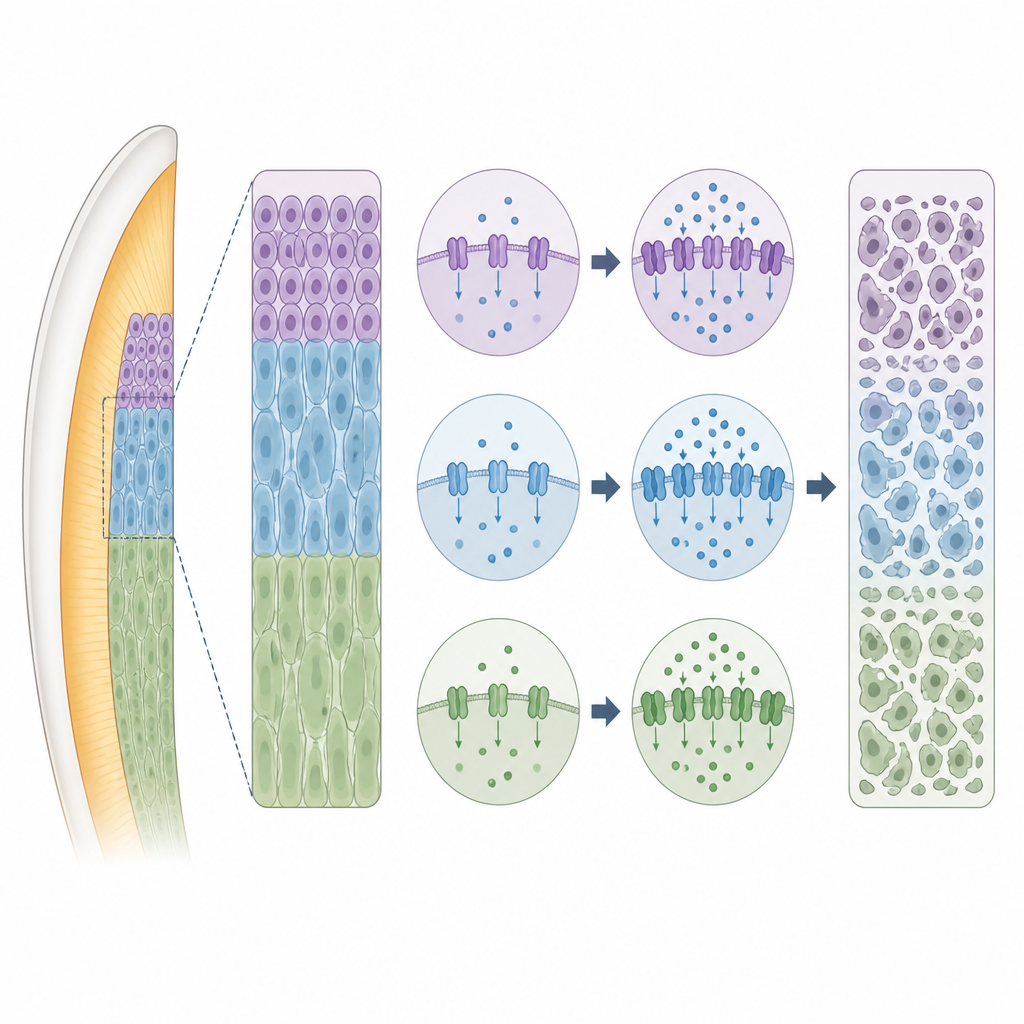
To uncover what went wrong inside these stressed cells, the researchers measured gene activity and calcium signaling, a key messenger system. They found that KDM6B loss switched on the calcium pathway linked to mechanosensing. A membrane channel called PIEZO1, which opens in response to physical force and lets calcium rush into the cell, was strongly increased. Imaging of live cells showed that with KDM6B missing, stimulation of PIEZO1 led to a sharper, higher calcium surge. This calcium overload matched the rise in cell death among transit-amplifying cells, tying excessive mechanical signaling to tissue breakdown.
An Epigenetic Brake on a Force Sensor
The study then traced how KDM6B keeps PIEZO1 in check. KDM6B normally removes a chemical tag, H3K27me3, that silences genes. Without KDM6B, this repressive mark built up at the promoter of another gene, BMI1, reducing BMI1 levels. BMI1 itself acts as a repressor and directly binds the Piezo1 gene to keep its activity low. When BMI1 was reduced, Piezo1 was released from this brake, leading to more PIEZO1 channels and stronger calcium influx. Lowering the level of the enzyme that adds H3K27me3, or genetically reducing Piezo1 itself, rescued calcium levels, cell survival, and overall tooth structure. These experiments revealed a chain of control, from KDM6B to BMI1 to PIEZO1, that fine-tunes how cells feel and respond to force.
Why This Matters for Teeth and Bones
To a lay reader, the core message is that teeth and bones are not passive rocks; they are living systems equipped with a molecular “thermostat” for mechanical load. In the mouse incisor, KDM6B acts as an epigenetic regulator that prevents the tooth’s repair cells from overreacting to everyday pressure. By keeping PIEZO1 activity in a safe range, it protects fast-dividing progenitor cells from calcium overload and death, preserving continuous renewal of hard tissue. The authors suggest that similar mechanisms may operate in other load-bearing tissues and could be targeted in conditions where excessive mechanical stress contributes to degeneration, such as osteoarthritis or bone fragility.
Citation: Meng, L., Zhang, M., Feng, J. et al. KDM6B safeguards mineralized tissue homeostasis from mechanical stress through epigenetic control of PIEZO1-mediated mechanotransduction in the mouse incisor. Bone Res 14, 59 (2026). https://doi.org/10.1038/s41413-026-00544-2
Keywords: mechanical stress, tooth regeneration, epigenetic regulation, PIEZO1, stem cell niche