Clear Sky Science · en
Akkermansia muciniphila attenuates intervertebral disc degeneration via extracellular vesicle-mediated delivery of the effector protein B2UKX5
Why your gut might matter to your back
Low back pain affects hundreds of millions of people and often stems from worn intervertebral discs, the soft cushions between spinal bones. This study explores an unexpected helper living in our intestines: a gut microbe called Akkermansia muciniphila. The researchers show that this microbe, and tiny packages it releases, can slow disc wear in animals and are linked to healthier discs in people, suggesting that gut health and spine health may be more closely connected than we thought. 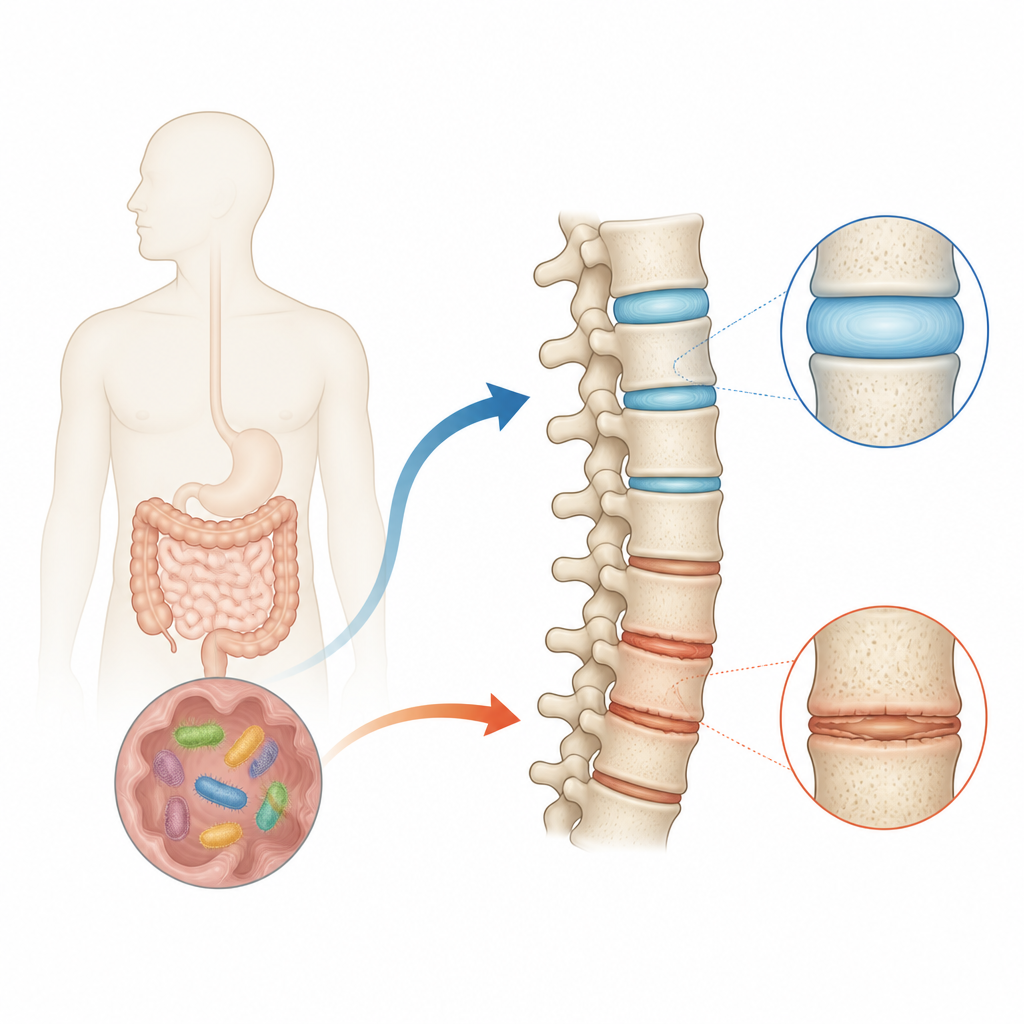
A surprising link between intestines and spine
To ask whether this gut microbe truly relates to disc disease rather than just appearing alongside it, the team first turned to human genetics. Using a method called Mendelian randomization, they examined genetic variants tied to the natural abundance of Akkermansia in the gut and compared them with the risk of intervertebral disc degeneration. People whose genes favored higher levels of this bacterium tended to have a slightly lower risk of disc disease, hinting at a causal protective role rather than a simple correlation.
Checking real-world patients and aging animals
The scientists next measured Akkermansia levels directly in stool samples from patients whose discs were graded by spine MRI. Those with more severe disc damage had lower amounts of the microbe, and its levels also declined with age. Similar patterns appeared in mice: older animals carried less Akkermansia in their feces than younger ones. Together, these clinical and animal observations supported the genetic signal that this gut resident may help keep discs healthier over the course of life.
Testing the microbe in controlled mouse models
Correlation is not enough, so the team tested cause and effect in mice. They first cleared the animals’ gut microbes with antibiotics and then injured the tail discs with a thin needle, a standard model of disc damage. Mice given live Akkermansia by mouth showed less disc collapse on imaging and more normal tissue structure under the microscope than control animals. In contrast, a common gut bacterium, Escherichia coli, did not help. When the researchers blocked the microbe’s ability to release tiny membrane bubbles called extracellular vesicles, the protection disappeared, pointing to these vesicles as key messengers. 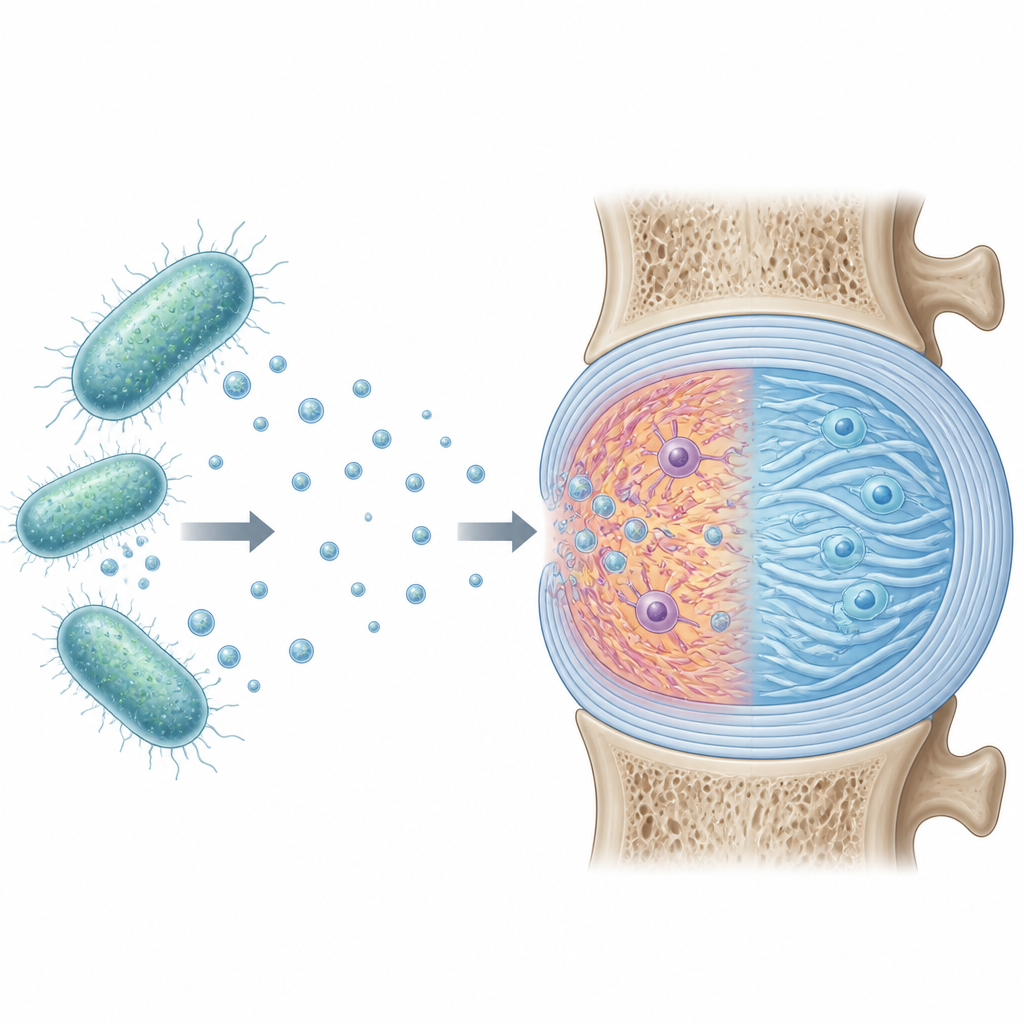
Tiny bubbles carrying a protective payload
Because vesicles from many microbes carry a cargo of proteins and genetic material, the team isolated vesicles from Akkermansia and tracked where they went. After injection, the vesicles accumulated in spinal discs and reproduced most of the benefits of the live bacteria in several mouse models, including injury, aging, and prolonged upright standing that overloads the spine. Detailed protein analysis of the vesicles highlighted one protein, labeled B2UKX5, as especially enriched. In human disc cells stressed with an inflammatory signal, this protein reduced genes linked to breakdown and aging and preserved key structural molecules such as collagen. In mice, adding B2UKX5 alone slowed disc wear without raising systemic inflammation or harming major organs.
How disc tissue responds deep inside
To see how this single bacterial protein reshapes disc biology, the researchers separated the central gel-like core of the disc from its tough outer ring in aging mice and examined gene activity in each region. B2UKX5 boosted genes involved in building and organizing the tissue matrix and dialed down genes tied to tissue scarring, immune activation, and tightly packed chromatin, which can silence helpful genes. Similar adjustments occurred in the outer ring, where the protein supported collagen organization and connective tissue strength. These changes line up with the observed preservation of disc height and structure on imaging and microscopic examination.
What this means for future back care
Overall, the study outlines a “gut–disc axis” in which a beneficial intestinal microbe, its vesicles, and a single exported protein together help maintain the cushion between spinal bones. People and animals with lower levels of Akkermansia, its vesicles, or B2UKX5 tend to have more severe disc degeneration, while supplementing these components protects discs in multiple mouse models. Although it is too early to translate this directly into treatments for back pain, the work suggests that stable microbe-derived products, rather than live bacteria, could one day form part of new strategies to slow or prevent disc wear.
Citation: Guan, Z., Li, X., Chen, Y. et al. Akkermansia muciniphila attenuates intervertebral disc degeneration via extracellular vesicle-mediated delivery of the effector protein B2UKX5. Bone Res 14, 56 (2026). https://doi.org/10.1038/s41413-026-00541-5
Keywords: gut microbiome, low back pain, intervertebral disc, extracellular vesicles, Akkermansia muciniphila