Clear Sky Science · en
Light-curing units in restorative dentistry: a clinically oriented narrative review of performance, selection, and emerging optical functions
Why the right dental light matters
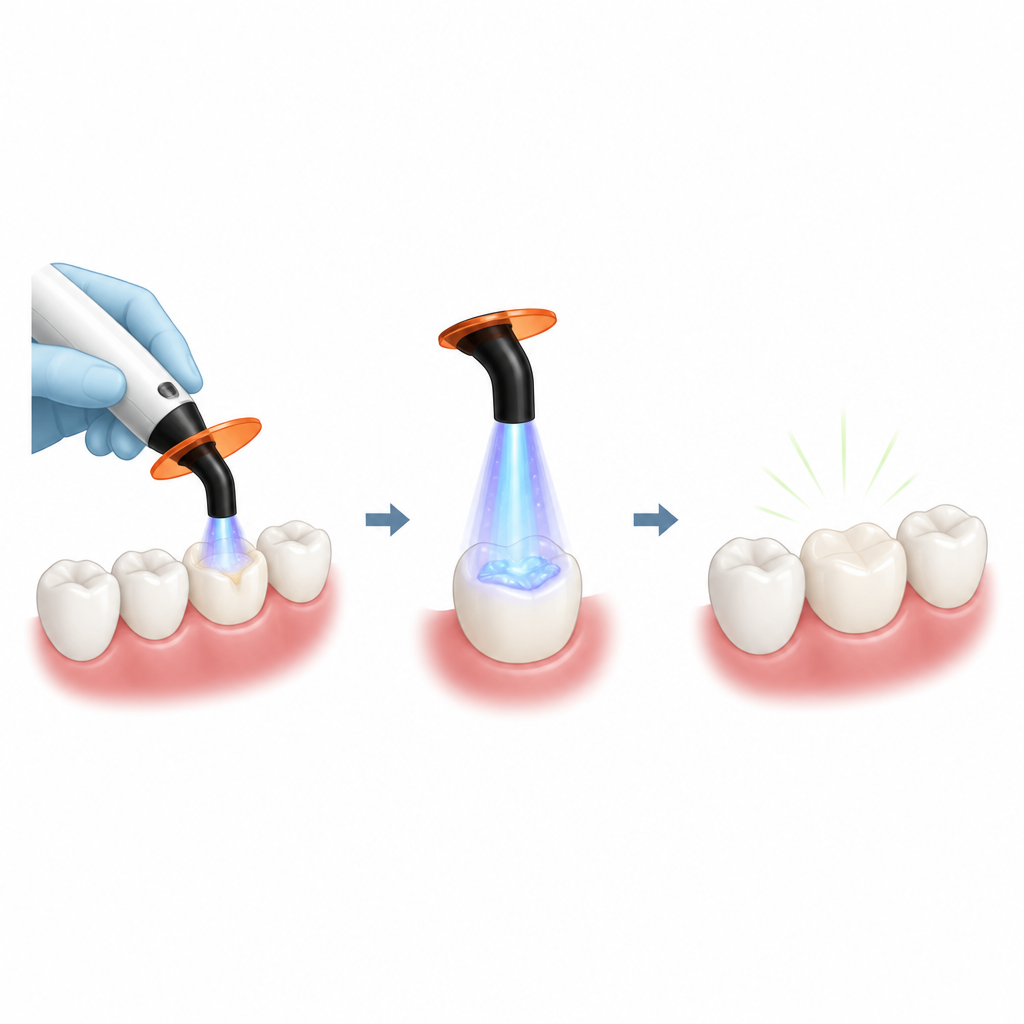
Whenever a dentist repairs a tooth with a white filling or bonds a crown, they shine a blue light on the material to make it hard. This step can look routine, but it is actually a delicate energy delivery process. If the light is not matched to the material, not strong enough in the right place, or used for too little time, the restoration may be weaker, wear out faster, or even harm the tooth. This review explains how modern dental curing lights work, how dentists can choose and use them wisely, and how new light-based features may also help with diagnosis.
From hot bulbs to smart blue LEDs
Early dental curing lights were based on hot halogen bulbs, and some clinics tried powerful plasma lamps and lasers to shorten curing time. These older systems gave off a broad mix of light and heat, needed filters and cooling fans, and could wear out quickly. Over the last two decades, compact blue light-emitting diode (LED) units have taken over. First and second generation LED lights mainly produced blue light tuned to the most common activator in filling materials. Newer “polywave” LED units combine blue and violet light to better cover the range of light-sensitive molecules used in many modern composites and cements, especially for very light or opaque shades. The authors conclude that these third generation LED units are generally the most flexible choice for day-to-day practice.
It is not just how bright, but how and where
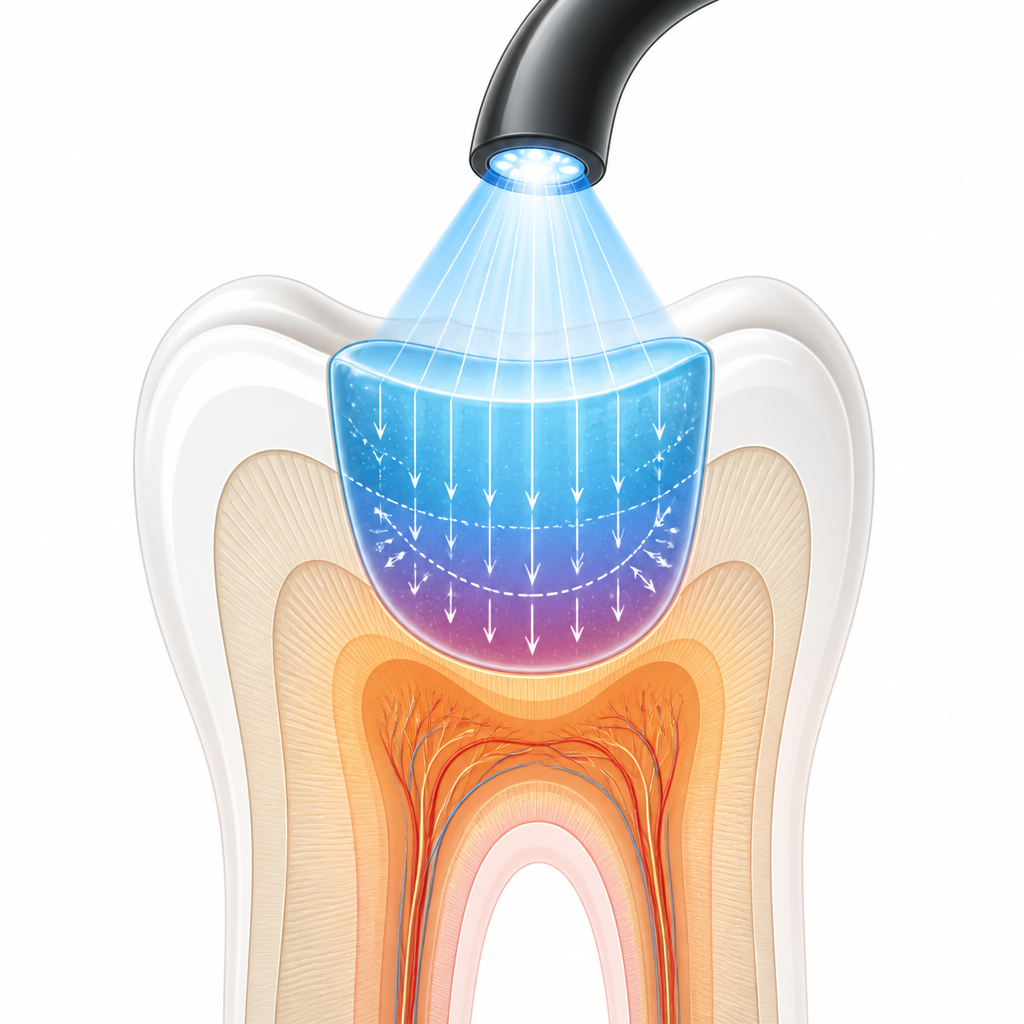
Manufacturers often advertise a single power number for their light, but this review shows that what really counts is how much energy reaches the material over time and how evenly it is spread. Two lights with similar stated output can behave very differently in the mouth. The size of the tip, how parallel the beam is, and how uniform the spot of light is across its face all affect which parts of a filling actually cure well. If the beam is patchy or too small, corners of large back-tooth fillings or deep side boxes may be undercured even when the middle looks fine. The safest approach is to think in terms of total energy delivered, to favor lights with well-tested, even beams and large effective tips, and to add extra curing steps from different angles when access is limited.
How everyday technique changes the result
Even an excellent curing light can perform poorly if it is used carelessly. The distance between the tip and the tooth, the angle of the beam, and how long the trigger is held all change the energy that actually reaches the resin. Small gaps of just a few millimeters and tilted positioning, which are common in tight back corners, can sharply reduce curing. The review stresses the need for good training, regular checks of output, clean and undamaged light guides, and attention to battery level in cordless models. At the same time, dentists must avoid overheating the tooth or soft tissues. Prolonged or repeated curing can raise the temperature inside the tooth, especially in deep cavities with thin remaining dentin, so cooling pauses and gentle air flow may be needed.
New light tricks for seeing what eyes miss
Modern curing lights are gradually turning into multi-purpose optical tools. By adding special tips and filters, the same handpiece can shine near ultraviolet light to make tooth-colored materials glow differently from natural tooth structure. This can help reveal old fillings, hidden excess cement, or adhesive left after removing braces, and may save healthy enamel during clean-up. Other attachments guide visible light through teeth to highlight cracks, enamel defects, or hidden spots during minimally invasive treatments. Narrow, focused tips can “pin” an indirect crown or veneer in place with a short burst of light before full curing, helping control excess material at the margins. While these features are promising and relatively affordable, the authors note that independent research on their real clinical benefit is still scarce.
Seeing curing as controlled energy, not just time
To a patient, the curing step may look like a simple countdown, but this review argues that it should be treated as precise energy dosing. The best outcomes occur when the color and spread of the light match the material, the total energy is sufficient and well distributed, and the operator is trained and attentive to safety. Third generation polywave LED lights, used with sensible exposure times and careful positioning, provide a robust option when the chemistry of the material is unknown or involves newer light-activated molecules. However, simpler blue-only lights can still perform well for many traditional materials if they are maintained and used correctly. In short, good light-curing is less about gadgets and more about understanding how light, material, and technique work together inside the tooth.
Citation: Ceinos, R., Dubois, M., Attal, JP. et al. Light-curing units in restorative dentistry: a clinically oriented narrative review of performance, selection, and emerging optical functions. BDJ Open 12, 54 (2026). https://doi.org/10.1038/s41405-026-00446-9
Keywords: dental curing light, resin composite fillings, LED light dentistry, restorative dentistry, polywave LED