Clear Sky Science · en
Neural imbalance between feedback sensitivity and motor inhibition in compulsivity and negative urgency
Why our inner brakes sometimes fail
Most people know the feeling of doing something again and again to ease worry, or acting rashly when upset, even if they later regret it. This study asks why some people are especially vulnerable to these patterns. By looking directly at brain activity, the researchers explored how our sensitivity to good and bad outcomes interacts with the brain systems that help us hit the brakes on our actions.
Two traits that shape everyday behavior
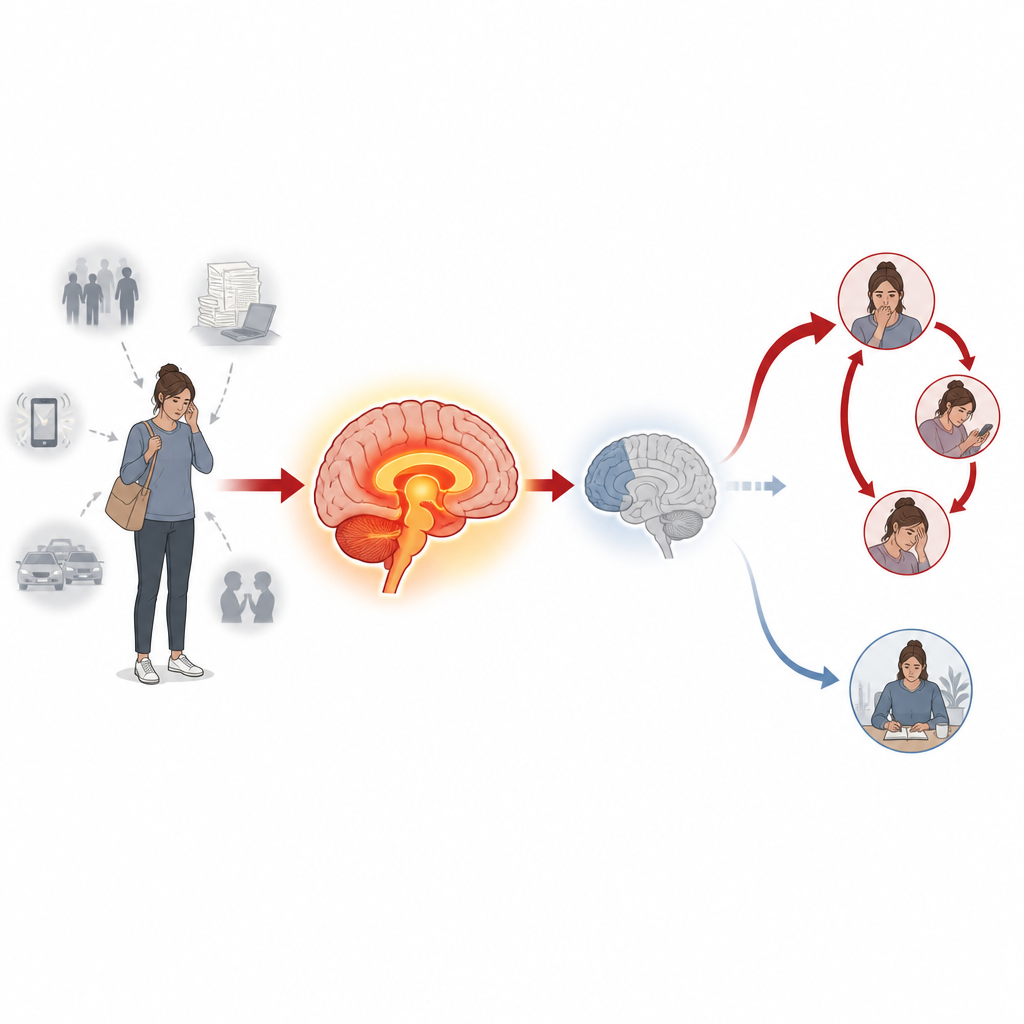
The work focuses on two personality traits that cut across many mental health conditions. The first is compulsivity, a tendency toward repetitive actions driven by urges despite negative consequences, as seen in obsessive habits. The second is negative urgency, the tendency to act quickly and impulsively when feeling bad. Both traits are tied to problems like addiction and obsessive compulsive symptoms, and both involve trouble dealing with unpleasant emotions. The authors wanted to know whether people high in these traits show a kind of internal imbalance between emotional drive and self control.
Putting the brain’s gas and brakes to the test
To probe this imbalance, 205 adults completed four computer tasks while their brain activity was recorded with scalp electrodes. Two tasks tested “motor inhibition,” the ability to withhold a response or stop one that is already underway. In these games, participants usually pressed a button but sometimes had to stop or withhold that response. Two other tasks tested how strongly people reacted to winning or losing money. Here, participants received feedback about gains and losses in a simple speeded task and in a more complex learning task. The researchers focused on a brain signal called the P3, a brief positive wave that appears when people process important feedback or need to stop an action.
Linking emotional reactions to stopping power
The key question was how strongly each person’s brain response to losses was tied to their brain response when they successfully stopped or withheld an action. In people with mild compulsive tendencies, stronger brain reactions to financial losses went hand in hand with stronger brain activity during stopping. A similar pattern appeared in people with low negative urgency. In other words, when losses loomed larger in the brain, the braking system also seemed to ramp up, as if emotional alarms triggered more control to keep behavior in check.
When strong feelings are not matched by strong brakes
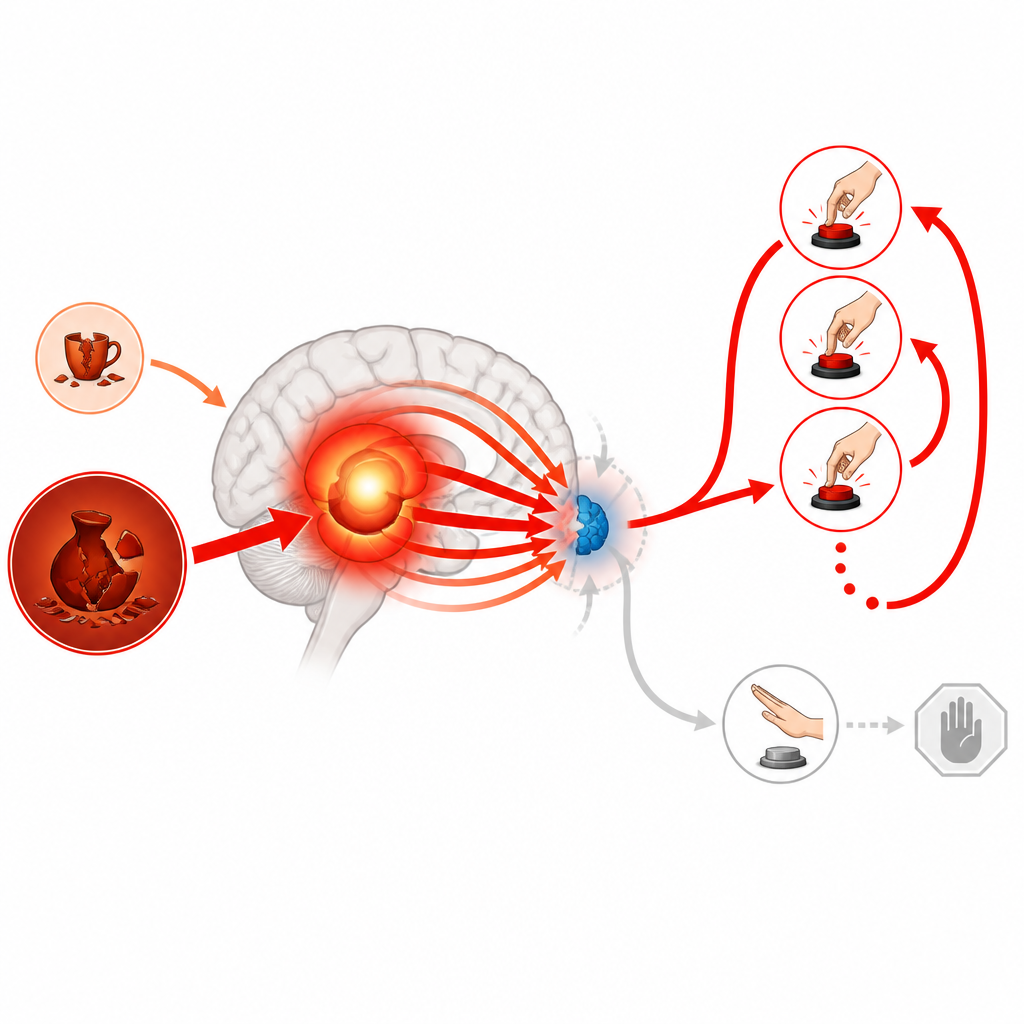
In contrast, this helpful link weakened in people with higher compulsivity and higher negative urgency. For them, strong brain responses to loss were not reliably matched by stronger stopping activity. This pattern appeared across both stopping tasks and in both kinds of feedback task, and it remained even when the researchers statistically separated what the two traits share and what is unique to each. The findings suggest that for some individuals, emotional reactions to setbacks or threats are not adequately balanced by the brain’s braking system.
What this means for everyday life
For a layperson, the takeaway is that trouble with repeated or rash behavior may stem from a mismatch between how strongly the brain reacts to emotional events and how effectively it can pause or stop actions in response. People low in compulsivity and negative urgency seem able to recruit more control when losses or threats feel intense, helping them steer back toward long term goals. Those high in these traits may not boost their braking system enough when distressed, making it easier for worry driven rituals or spur of the moment actions to take over. While this study was done in mostly healthy volunteers, it points to a subtle imbalance that could increase risk for a range of compulsive and impulsive problems.
Citation: Wüllhorst, R., Overmeyer, R., Dück, K. et al. Neural imbalance between feedback sensitivity and motor inhibition in compulsivity and negative urgency. Transl Psychiatry 16, 248 (2026). https://doi.org/10.1038/s41398-026-04098-z
Keywords: compulsivity, negative urgency, motor inhibition, feedback sensitivity, EEG