Clear Sky Science · en
The paternal brain: longitudinal insights into structural and functional plasticity and attachment over 24 weeks postpartum
A New Look at New Fatherhood
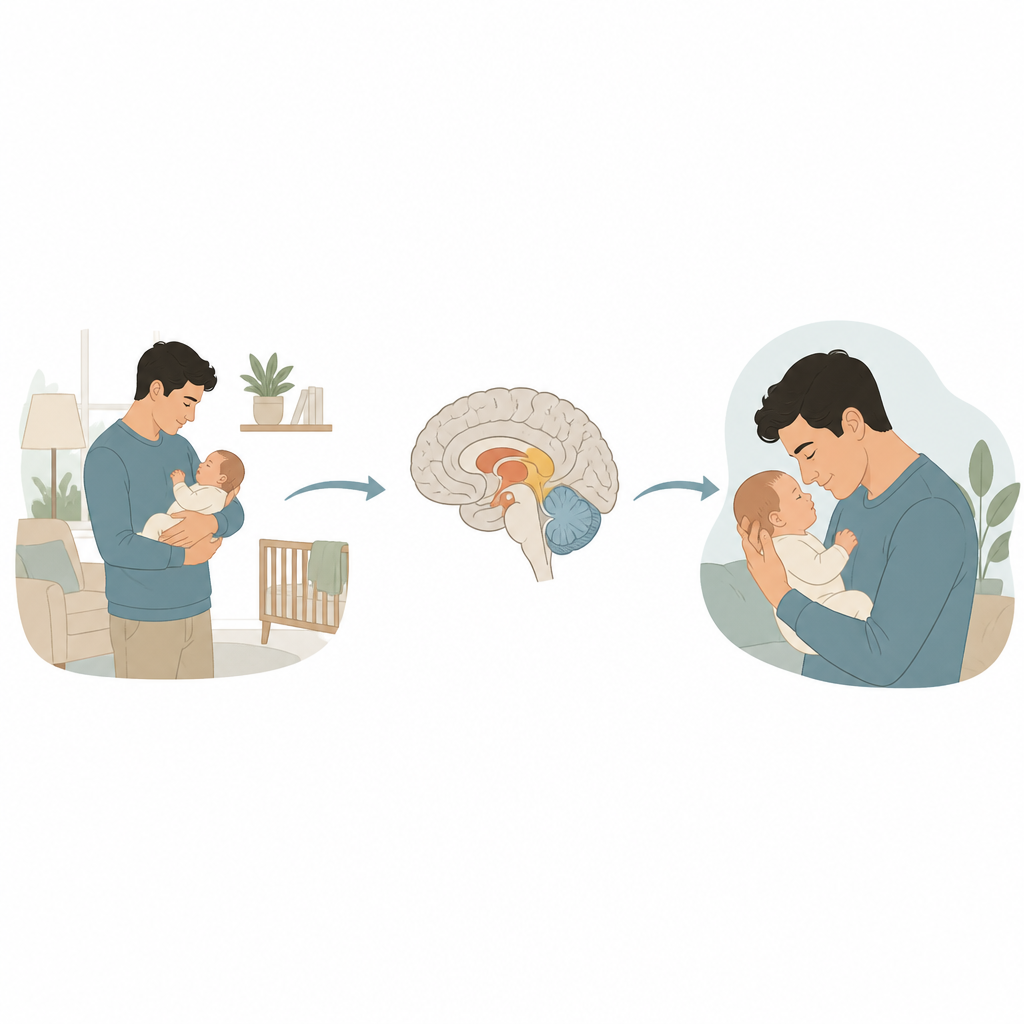
Becoming a parent does not just change your daily routine; it also reshapes your brain. While the spotlight has mostly been on mothers, this study follows new fathers across the first six months after childbirth to see how their brains change as they bond with their babies. The researchers show that fatherhood is linked to a finely timed pattern of brain reshaping and shifting communication between brain regions that together may support caregiving, emotional tuning, and attachment.
How the Study Followed New Dads
The research team recruited 25 biological fathers within the first days after their child was born. Each father underwent brain scans six times over 24 weeks, along with questionnaires about how attached they felt to their infant and how much pleasure and ease they experienced in the relationship. The scans captured both the structure of the brain, focusing on gray matter volume, and how brain regions communicate with each other during rest. By using frequent and regular time points, the study was designed to reveal not just whether fathers’ brains change, but when those changes are most active.
Early Brain Changes in the First Weeks
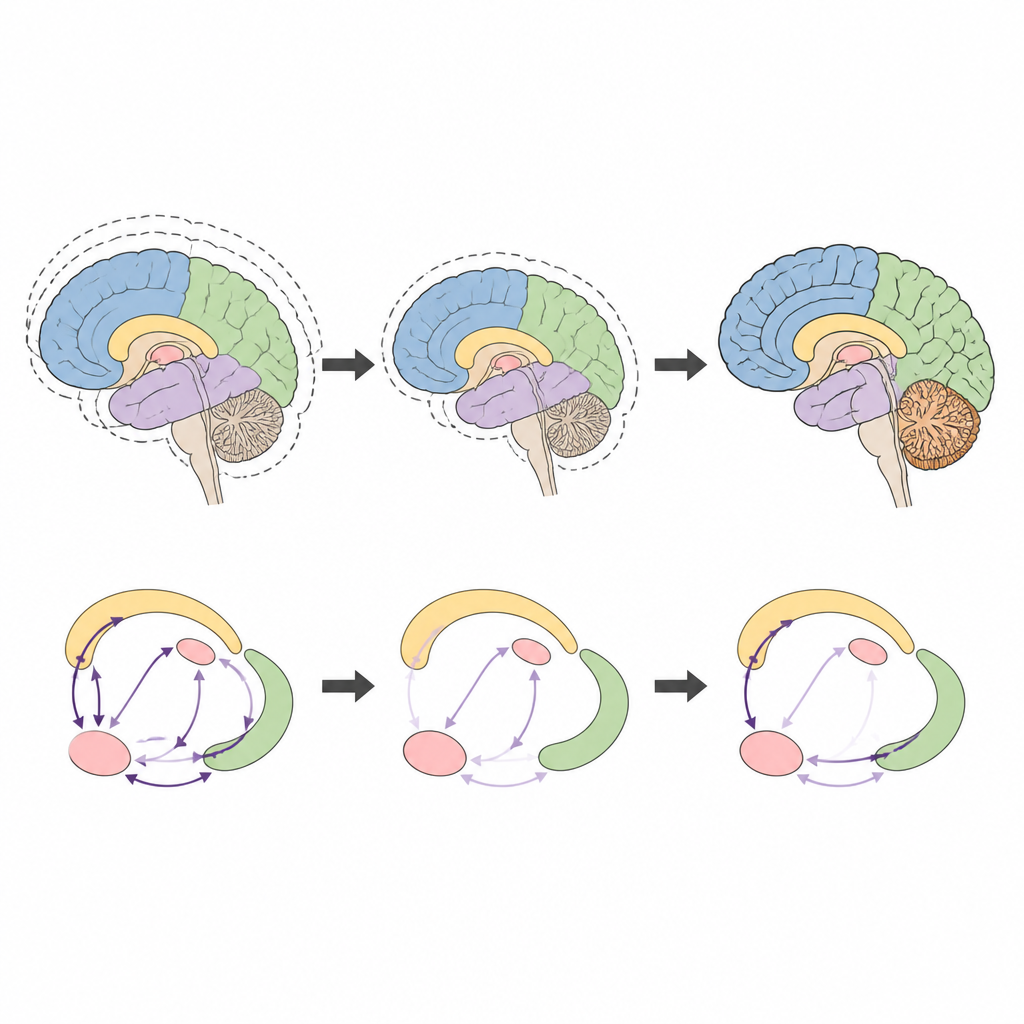
In the first six weeks after childbirth, the fathers’ brains showed widespread reductions in gray matter volume across areas involved in seeing, moving, thinking, and feeling, including occipital, parietal, temporal, and frontal regions, as well as the insula, hippocampus, and temporo parietal junction. These reductions continued, though more mildly, up to around 12 weeks, and then largely stabilized by 24 weeks. From about 12 weeks onward, the pattern partly reversed: some regions, especially in the frontal lobes and cerebellum, began to show growth in gray matter volume, suggesting a shift from broad early reshaping to more focused fine tuning of circuits important for planning, control, and emotion.
Networks That Shift From Sensing to Feeling
Beyond structure, the study examined how large scale brain networks changed their internal communication. Three key networks were tracked: one linked to inward thought and mentalizing, one to detecting important events and emotions, and one to focused thinking and control. During roughly the first nine weeks, connections within and between these networks shifted strongly. The salience network, which helps detect and prioritize important signals, showed more communication with frontal regions and less with basic sensory and visual areas, hinting at a move away from raw sensory processing toward more emotionally and socially meaningful processing. Similar shifts appeared in the default mode and frontoparietal networks, with increased links to areas involved in reflection, emotion, and decision making, and reduced ties to purely sensory regions.
Linking Brain Communication to Attachment
The scientists also asked whether these brain changes related to how attached fathers felt to their babies. They focused on the amygdala, a deep brain structure important for emotional salience and caregiving. While overall gray matter changes were not tied to attachment scores, the way the amygdala communicated with other regions was. During the first 12 weeks, stronger connections between the amygdala and areas such as the cingulate cortex, hippocampus, insula, and cerebellum tracked with higher scores on total attachment and on specific aspects like warmth, low hostility, and pleasure in interaction. For example, better attachment quality was linked to stronger amygdala connections with memory related and social processing regions, suggesting that emotionally rich caregiving experiences may become stamped into memory and support ongoing bonding.
What This Means for Fathers and Families
Taken together, the findings suggest that new fatherhood is accompanied by a distinct wave of brain plasticity. In the first six to nine weeks, the brain appears to undergo broad structural reshaping and strong reorganization of key networks, followed by more targeted strengthening of regions that support emotional regulation, planning, and attachment. The observed links between amygdala connectivity and how attached fathers feel indicate that everyday caregiving experiences may help shape this new "paternal brain." While the exact biological drivers remain unclear, the study supports the idea that fathers, like mothers, undergo meaningful brain changes that help them respond to their infants’ needs and form close, lasting bonds.
Citation: Daneshnia, N., Losse, E.M., Kurz, A. et al. The paternal brain: longitudinal insights into structural and functional plasticity and attachment over 24 weeks postpartum. Transl Psychiatry 16, 247 (2026). https://doi.org/10.1038/s41398-026-04082-7
Keywords: paternal brain, fatherhood, neuroplasticity, parental attachment, resting state connectivity