Clear Sky Science · en
Acute placebo responsiveness predicts longitudinal expectation effects in antidepressant treatment
Hope and Healing in the Mind
When people start antidepressant treatment, their hopes and expectations often rise or fall with each visit. This study asks a simple but powerful question for patients and clinicians alike: can feeling hopeful about treatment actually shift how the brain sees the world and, in turn, shape how well depression improves over time?

A Careful Look at Expectations
The researchers followed adults hospitalized for a current depressive episode. First, each person took part in a lab experiment using a saline nasal spray. On one day, they were told the spray contained oxytocin, a hormone often linked to social bonding and better mood, even though it was actually just saline. On another day, they were told truthfully it was plain saline. Around these sessions, they rated their mood and expectations and completed a computer task that asked them to judge emotional facial expressions as happy, fearful, or neutral.
How a Placebo Shifted Emotional Vision
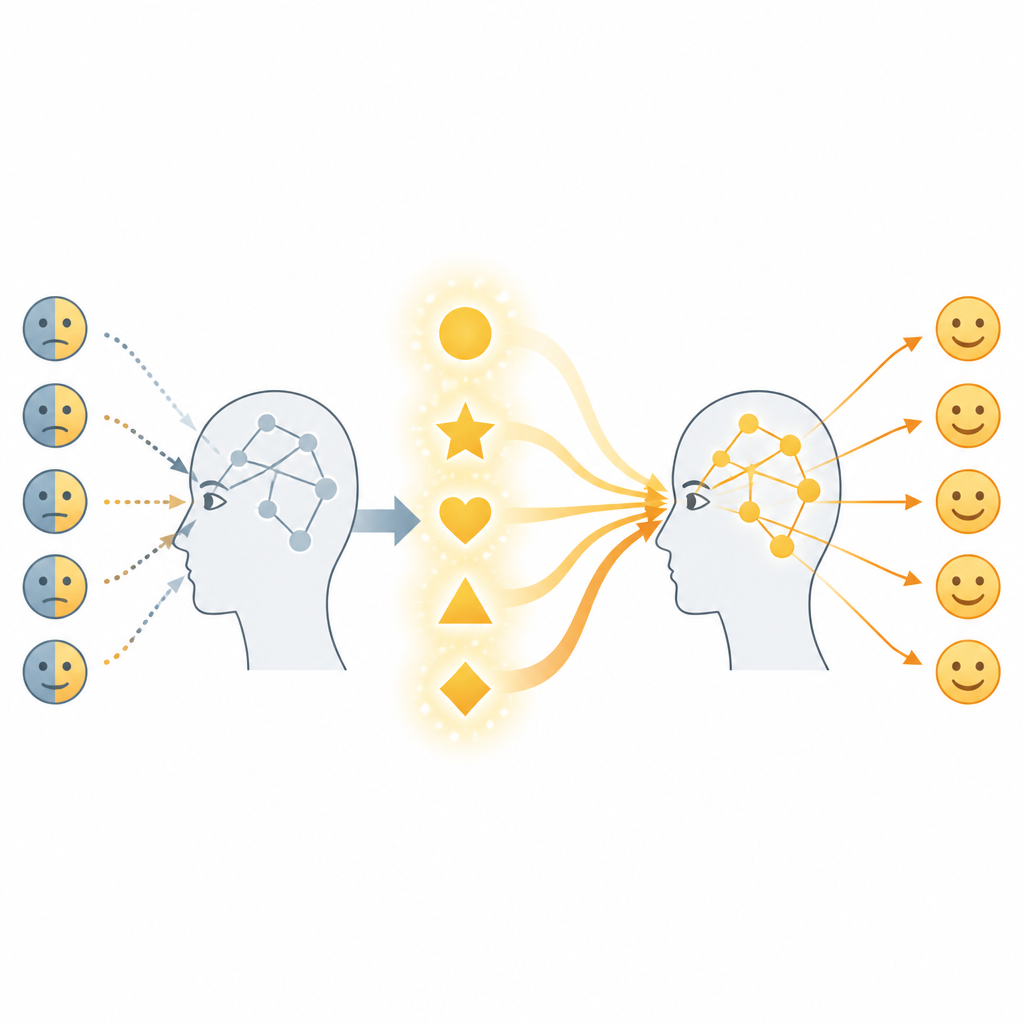
Labeling the nasal spray as a helpful treatment sharply boosted positive expectations compared with the control day. Participants felt better in real time during this placebo session, and they later recalled the experience more positively. On the facial expression task, this hopeful state changed how they interpreted ambiguous faces. Under the placebo condition, people were more likely to see such faces as happy and less constrained by their usual response habits. This created a measurable “positivity bias” in emotional processing, especially for detecting happiness rather than fear.
Tracking Mood and Hope in Real Life
After the experiment, most participants continued with standard antidepressant treatment in the hospital and were followed weekly, plus again three months later. Each week they reported how severe their depressive symptoms felt and how much improvement they expected from their current antidepressant. On average, symptoms steadily decreased over the weeks, while expectations stayed relatively stable. People who held stronger positive expectations in one week tended to show greater symptom improvement by the following week, even after taking into account how long they had been in treatment.
From Lab Response to Bedside Outcome
The team then asked whether the way someone responded to the placebo in the lab could forecast how strongly their expectations would relate to later symptom change. They found that participants who showed a larger placebo-driven positivity bias in the face task also showed a tighter link between hopeful expectations and actual mood improvement during antidepressant therapy. This pattern held even when accounting for medication changes and treatment history, suggesting that some individuals are especially sensitive to the beneficial effects of positive expectations across different settings and time scales.
What This Means for Treatment
In plain terms, the study suggests that what patients expect from antidepressant treatment does not just color their reports but can help nudge their emotional lens toward seeing more positive cues, which in turn relates to feeling less depressed over time. People who are more “expectation sensitive” in a simple placebo test also seem to gain more when they feel hopeful about their real medication. Rather than relying on drugs alone, carefully shaping and supporting realistic positive expectations may be an important and underused ingredient in improving depression care.
Citation: Shim, E.J., Schmidt, L., Rauh, J. et al. Acute placebo responsiveness predicts longitudinal expectation effects in antidepressant treatment. Transl Psychiatry 16, 241 (2026). https://doi.org/10.1038/s41398-026-04070-x
Keywords: placebo effects, treatment expectations, antidepressants, emotional processing, major depression
See more on the researcher's website: https://tinyurl.com/4uvasufn