Clear Sky Science · en
Divergence of C4A and C4B in first-episode psychosis: Insights from CSF and plasma immune profiling
Why brain immunity matters for mental health
Psychosis, a condition where people may hear voices or hold strong unusual beliefs, often appears suddenly in late adolescence or early adulthood. While we usually think of psychosis as a brain disorder, growing evidence suggests that the body’s immune system also plays a role. This study looks at two closely related immune molecules, called C4A and C4B, in the fluid that bathes the brain and in blood, to understand how early psychosis may be linked to subtle changes in the brain’s own defense network.
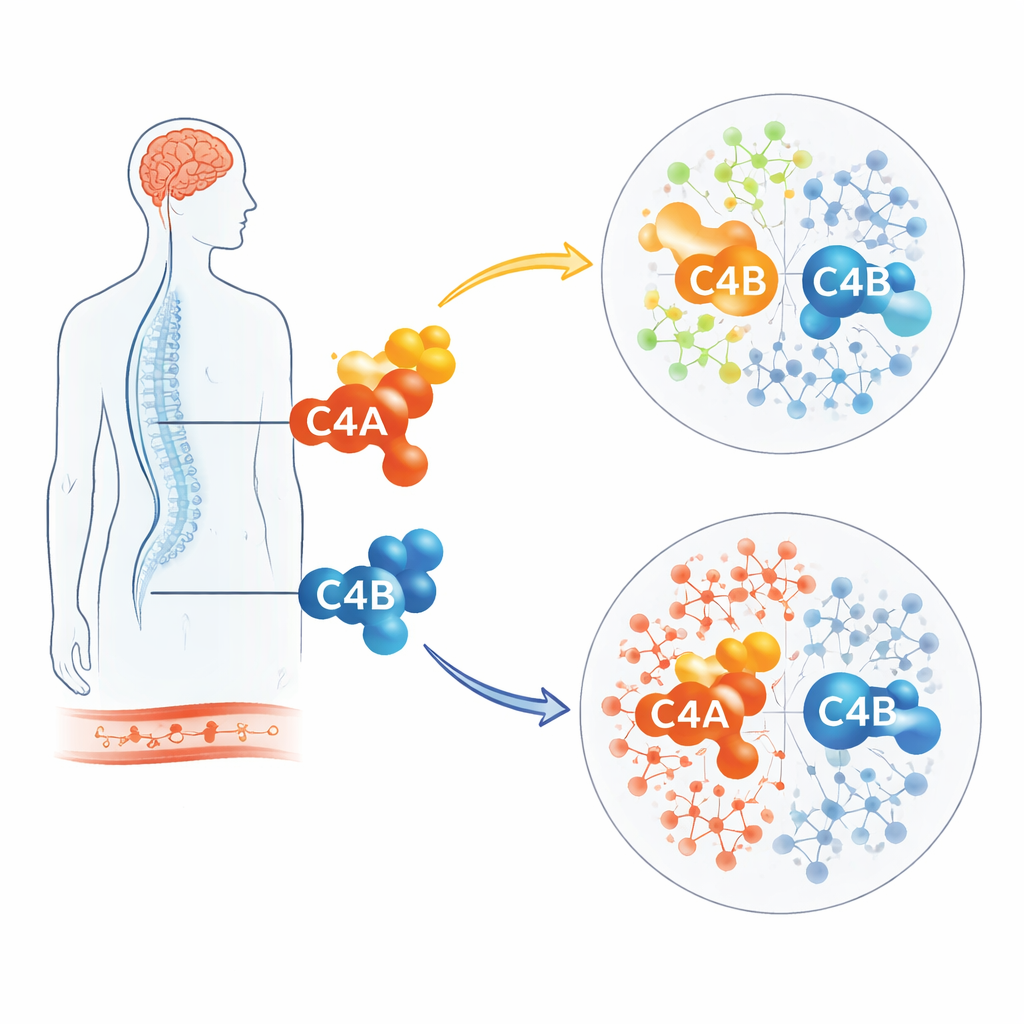
Two similar molecules with different roles
C4A and C4B are part of the “complement system,” a network of proteins that normally help the body recognize and clear away threats such as microbes. In the brain, some of these proteins have been repurposed to help trim back extra connections between nerve cells during development. Earlier genetic studies showed that having extra copies of the C4A gene increases a person’s risk of schizophrenia, whereas C4B does not carry the same risk. Previous work also found that people with first-episode psychosis have higher levels of C4A, but not C4B, in their cerebrospinal fluid. These clues suggested that C4A and C4B, despite being almost molecular twins, may behave quite differently in the human brain.
Looking inside brain fluid and blood
To explore this, the researchers examined samples from 113 people experiencing their first episode of psychosis and 90 healthy volunteers. They measured C4A, C4B, and another key complement protein called C1Q in cerebrospinal fluid, as well as 48 other immune-related proteins in both cerebrospinal fluid and blood plasma. Instead of focusing only on whether levels were higher or lower, they asked how strongly these molecules “move together” — that is, whether they rise and fall in tandem, which can reveal functional relationships within the immune network. Advanced statistical tools were used to map these patterns and compare them between patients and healthy controls, while accounting for age, sex, body mass index, and medication use.
When usual partnerships break and new ones form
In healthy people, both C4A and C4B in brain fluid were tightly linked to C1Q, fitting with the idea that they participate together in the same classical immune pathway. However, in people with first-episode psychosis, the relationship between C4A and C1Q disappeared, while the C4B–C1Q partnership remained intact. At the same time, C4A’s broader pattern of connections shifted dramatically. In healthy volunteers, higher C4A tended to go hand-in-hand with lower levels of many inflammation-related proteins in cerebrospinal fluid. In patients, this pattern flipped: C4A now showed mostly positive relationships, similar to a protein that is increasingly aligned with an activated immune environment. By contrast, C4B’s relationships changed far less and often in the opposite, weaker direction, underscoring that these two molecules participate in distinct immune circuits.
Different stories in brain and blood
When the team looked at blood, some of the same broad trends appeared: C4A again showed a strong shift toward more positive links with inflammatory proteins in patients, whereas C4B changed less and without a clear direction. Yet the specific partners that tracked with C4A and C4B were quite different in cerebrospinal fluid compared with plasma, and most proteins showed little direct correspondence between the two compartments. Only a small subset of markers overlapped, and those differed between patients and healthy participants. This suggests that what happens in the bloodstream only partially reflects what is going on inside the brain, and that brain-focused measurements are crucial for understanding psychosis biology. A combined analysis of complement and inflammatory proteins hinted that certain immune patterns may relate to the severity of “negative” symptoms, such as reduced motivation, but these findings need confirmation in larger studies.
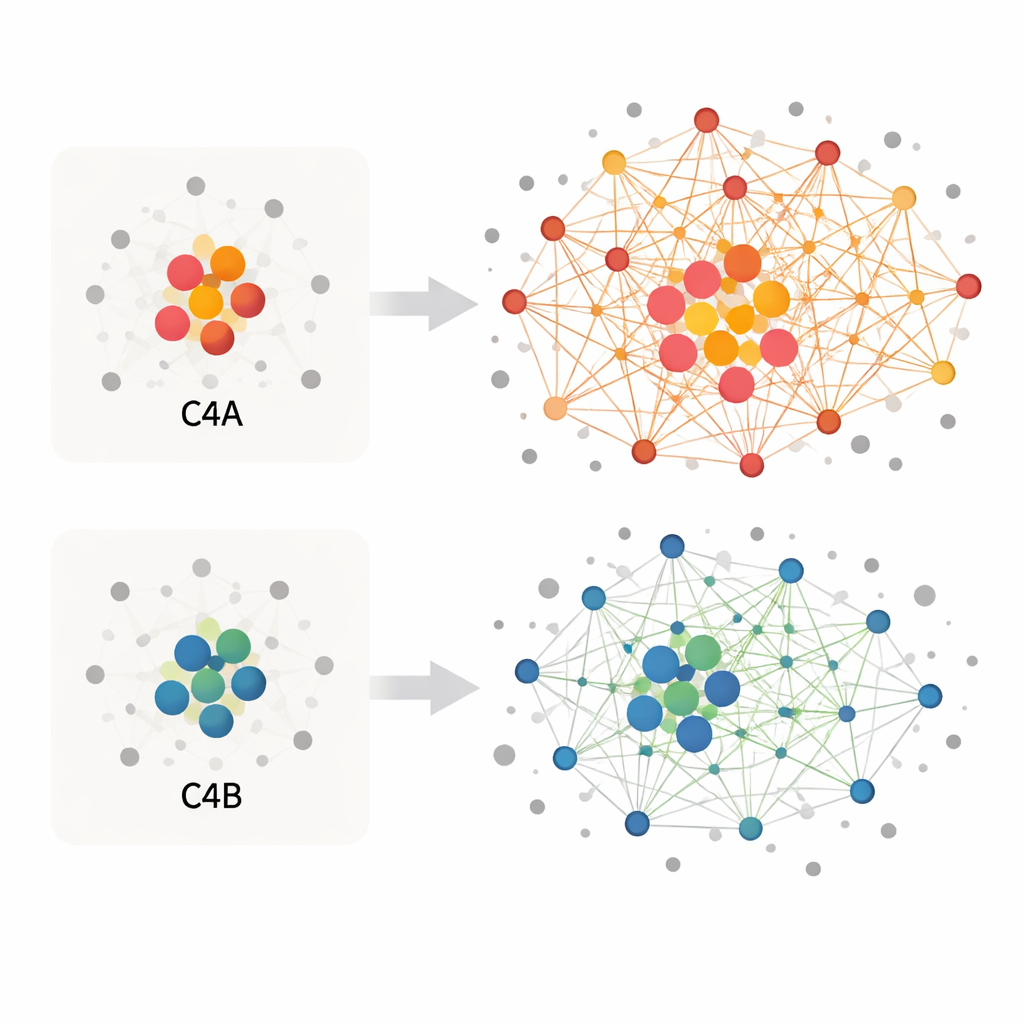
What this could mean for understanding psychosis
Taken together, the results point to C4A as a uniquely rewired player in first-episode psychosis. Its usual partnership with C1Q is lost, and its relationships with many other immune proteins become more positively aligned, whereas C4B largely retains its established pattern. This supports the idea that C4A may contribute to disease-specific changes in the brain, possibly including excessive pruning of neural connections, while C4B remains more tied to conventional immune activity. Because similar shifts are seen early in the course of illness, these immune signatures could one day help researchers track risk, refine diagnoses, or develop treatments that calm harmful brain-directed immunity without disrupting the body’s normal defenses.
Citation: Arjmand, S., Chaudhary, M., Samudyata et al. Divergence of C4A and C4B in first-episode psychosis: Insights from CSF and plasma immune profiling. Transl Psychiatry 16, 236 (2026). https://doi.org/10.1038/s41398-026-04037-y
Keywords: first-episode psychosis, complement C4A, cerebrospinal fluid, neuroinflammation, schizophrenia risk