Clear Sky Science · en
Suicide risk genes impact evolutionarily conserved survival strategies
Why ancient survival instincts matter today
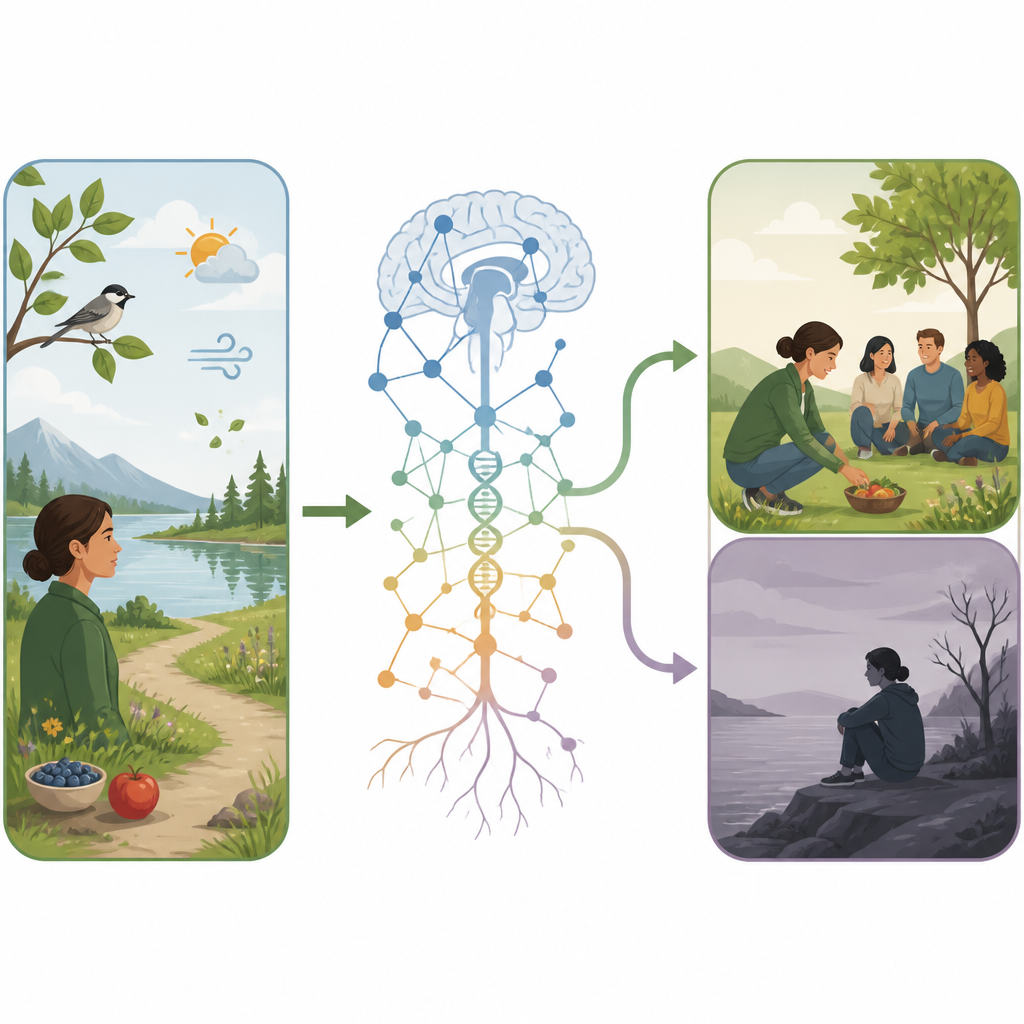
Suicidal thoughts and actions may seem uniquely human, yet the brain systems that shape them grow out of very old survival instincts shared across species. This study uses a tiny roundworm, Caenorhabditis elegans, to ask a big question: do human genes linked to suicide actually control deep, hard‑wired behaviors like threat sensing and motivation to seek food, and can the same types of drugs that reduce suicidal behavior in people reset those behaviors?
From human genetics to tiny worms
Large genetic studies have identified more than a hundred genes that appear more often in people with suicidal thoughts or attempts. Many of these genes are strikingly conserved across evolution and are essential for life, but their concrete effects on behavior have been unclear. The authors focused on 19 worm versions of these human “suicide risk genes” and looked for two basic behavioral patterns that resemble building blocks of human vulnerability: an exaggerated sense of threat, seen as “social feeding” where worms crowd nervously at the edge of a food patch, and a loss of drive to search for food when it runs out, a kind of ancient apathy.
Threat sensitivity and crowding at the table
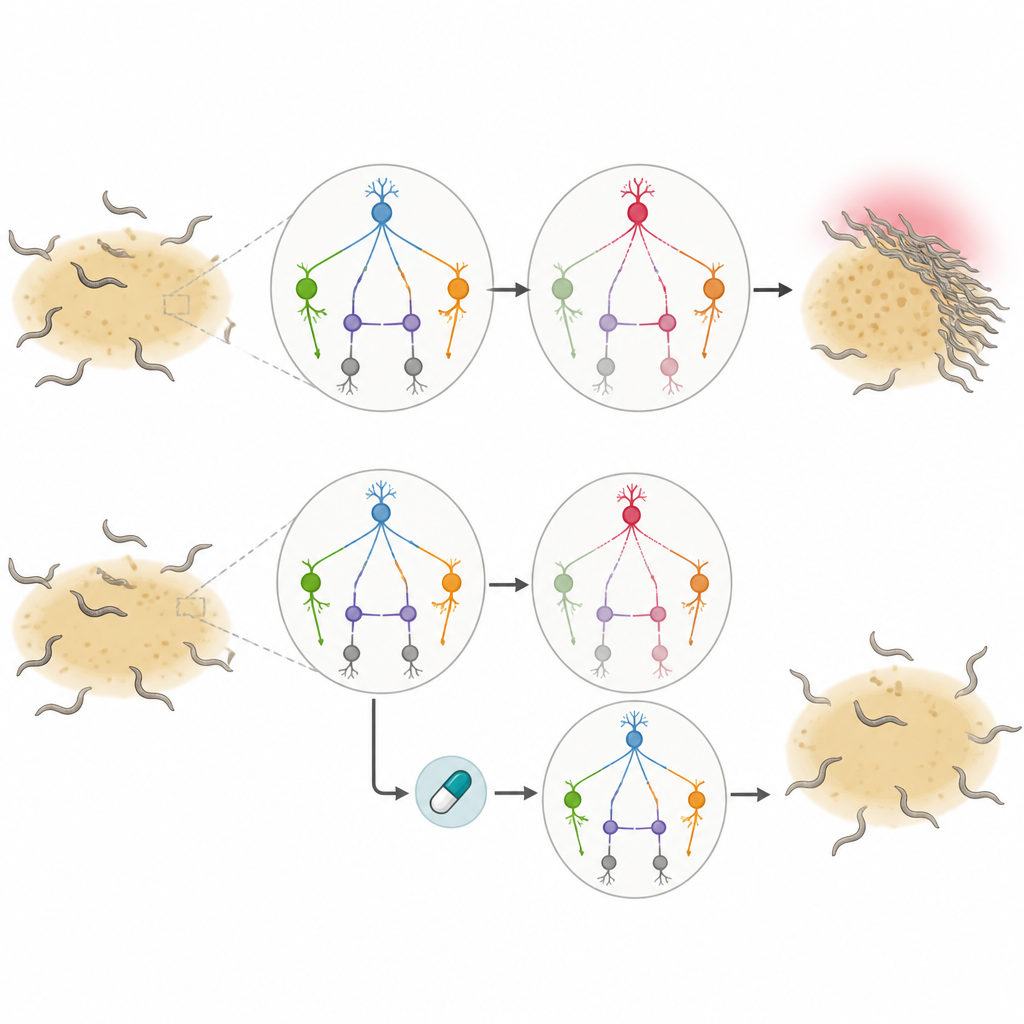
Most mutant worms behaved like normal solitary feeders, wandering through their bacterial food. But six mutants, each carrying a different risk‑gene change, showed strong social feeding: they rushed to the border of the food lawn and formed clumps, a behavior known to reflect over‑sensitivity to oxygen in the air. In nature this “safety in numbers” response can lower perceived danger, but here it represents a misreading of a relatively harmless environment as threatening. That so many rare social‑feeding mutants turned out to be counterparts of human suicide risk genes suggests a tight link between these genes and the brain circuits that judge whether the world feels safe or dangerous.
When the drive to seek food fades
The same study then examined what happened when food was removed. Normally, hungry worms become more active, first searching nearby and then roaming farther afield. Several mutants with social feeding, including those affecting worm versions of the neuropeptide Y receptor and a growth‑factor pathway, failed to maintain this search. After hours without food, many stopped moving even though they could still quickly wriggle away when touched. This pattern indicates not paralysis but a collapse in goal‑directed motivation, echoing human experiences of hopelessness and loss of energy, both powerful contributors to suicidal thinking.
Drugs and shared brain pathways
The researchers next tested a range of antidepressants, antipsychotics, and lithium at doses known to alter worm brain function. In multiple social‑feeding mutants, drugs such as clozapine and tricyclic antidepressants reduced crowding and restored more normal solitary feeding. The same antidepressant also rekindled food‑seeking in worms that had become immobile after starvation. Not every drug helped every strain, and some, like lithium or the antipsychotic haloperidol, had opposite effects in different mutants, pointing to specific gene‑drug interactions rather than a general stirring‑up of movement. When the team examined where these risk genes are switched on, they found they cluster in worm neurons and in human brain regions that process threats, pain, motivation, and reward, suggesting a shared network that spans species.
What this means for understanding suicide risk
Taken together, the findings support a simple but powerful idea: genes that raise the risk of suicide normally serve to protect life by tuning how organisms sense danger and how strongly they are driven to seek resources like food. Subtle changes in these genes may push ancient survival programs out of balance, making the world feel more threatening while dampening the energy to respond constructively. In humans, that combination can contribute to persistent distress and suicidal thinking. By tracing these effects in a humble worm, the study offers a clearer view of the basic circuits and chemical signals that future research may target to better understand and, ultimately, ease suicidal suffering.
Citation: Dustin, A., Dwyer, D.S. Suicide risk genes impact evolutionarily conserved survival strategies. Transl Psychiatry 16, 281 (2026). https://doi.org/10.1038/s41398-026-04021-6
Keywords: suicide risk genes, evolutionary neuroscience, C. elegans behavior, threat sensitivity, motivation and foraging