Clear Sky Science · en
ECM remodeling in the mPFC exacerbates cocaine-induced hyperactivity and impairs threat vigilance
Why this study matters to everyday life
Cocaine is often thought of as a drug that simply speeds people up, but it also quietly warps how the brain reads danger in the environment. This study in mice looks beyond brain cells themselves to the “scaffolding” that surrounds them, asking how changes in this support mesh influence hyperactivity and vigilance. The work suggests that trying to loosen this mesh in the wrong way can backfire, making drug driven behavior more intense and blunting sensitivity to threats.
How cocaine reshapes movement and awareness
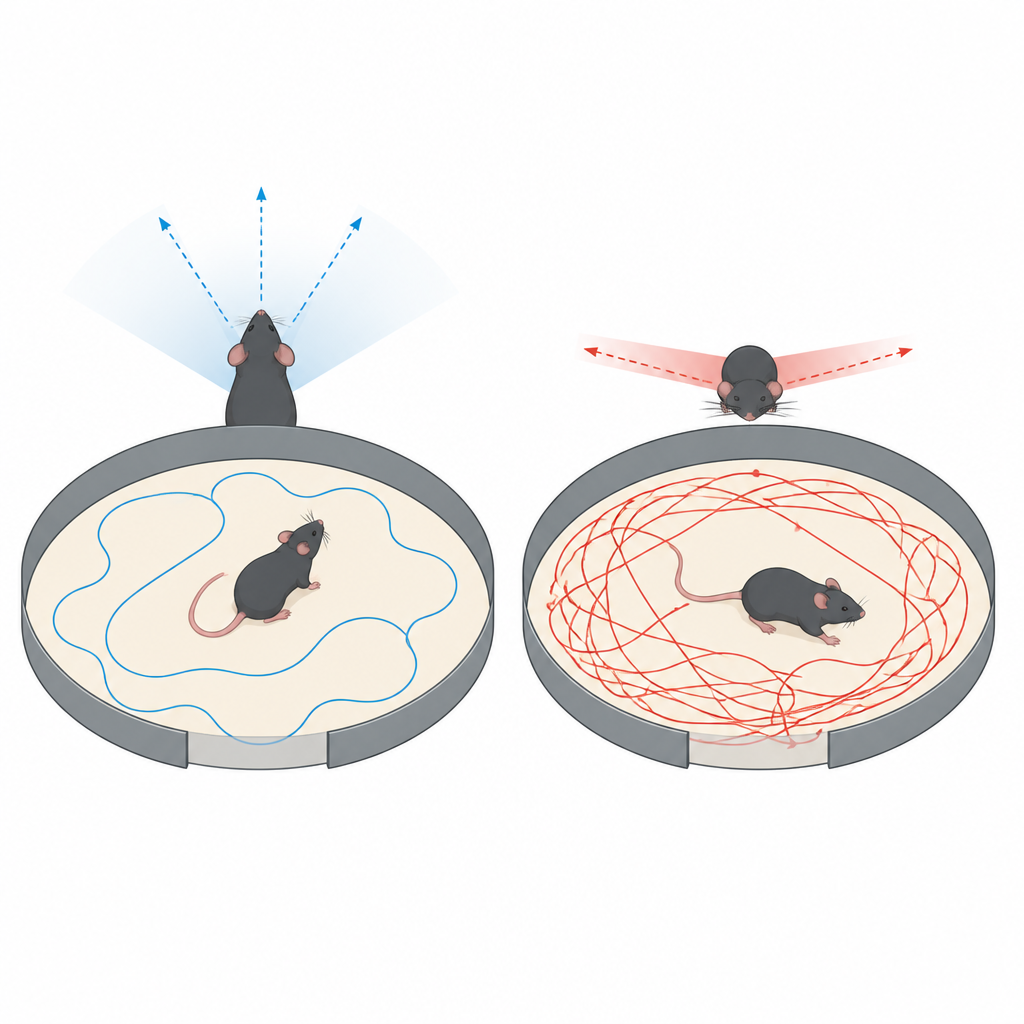
The researchers first used a sophisticated 3D tracking system to watch how mice moved after a week of daily cocaine injections. Instead of judging behavior by simple distance traveled, they captured the position of many body points and used machine learning to group natural actions like running, sniffing, rearing up, and hunching. Cocaine made the animals far more active, with longer paths and faster motion. At the same time, the mice spent less time in postures associated with scanning their surroundings and preparing for danger, such as standing up on their hind legs. Their movements also became more repetitive and less flexible, hinting at reduced motor coordination.
The brain’s hidden mesh and how cocaine changes it
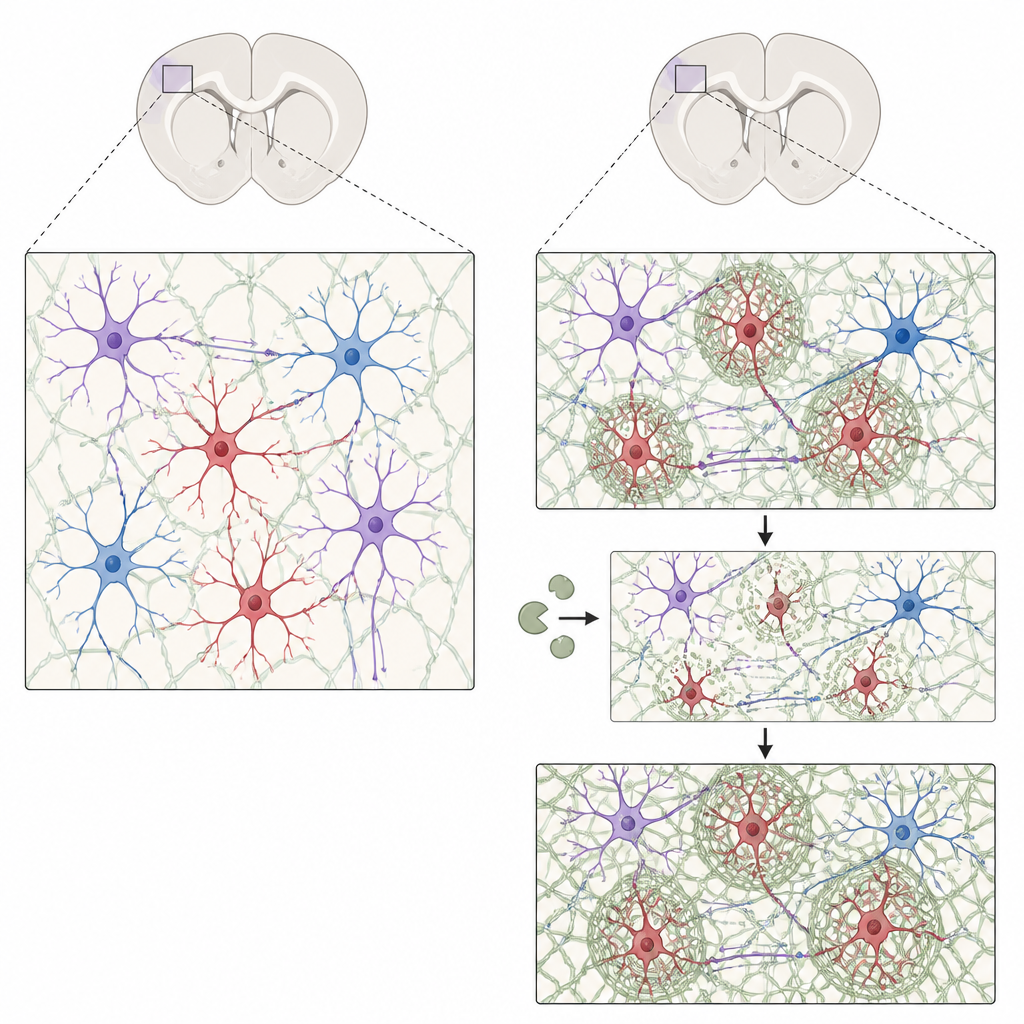
Next, the team turned to the medial prefrontal cortex, a brain region that helps control decision making and drug seeking. Around and between brain cells lies the extracellular matrix, a web of molecules that both supports neurons and influences how easily connections can change. Special lattice like structures called perineuronal nets wrap some fast acting inhibitory cells and are thought to help lock in mature wiring. Using a staining method that highlights major matrix components, the scientists found that chronic cocaine exposure strengthened this web in specific layers of the prefrontal cortex. The diffuse matrix between cells became denser, and more inhibitory neurons were tightly wrapped in bright, thick nets, suggesting a shift toward a more rigid, less flexible microenvironment.
When cutting the web makes things worse
Because earlier work had shown that removing these nets in some brain regions could weaken drug memories, the team tested what would happen if they degraded the matrix before cocaine exposure. They infused an enzyme called chondroitinase ABC into a prefrontal subregion to cut key matrix chains, successfully stripping away both the nets and much of the surrounding mesh for at least two weeks. Contrary to hopes, this treatment did not protect the animals. Instead, cocaine produced even stronger hyperactivity, more rigid body postures, and deeper losses in threat related postures and coordinated movements. In other words, loosening the matrix in this area amplified the very behavioral changes the drug causes.
Molecular clues from the brain’s support system
To understand why cutting the matrix backfired, the researchers measured genes related to the brain’s scaffolding. Cocaine alone boosted levels of Neurocan, a core matrix component, and reduced a type of collagen, pointing to a rebalanced mix of materials. Adding the enzyme reversed those particular changes but also triggered a surge in other molecules that can stiffen or reorganize the matrix, including lysyl oxidase, which cross links collagen. This suggested that the brain responded to matrix loss with an active rebuilding program that could leave the tissue tougher and more restrictive, rather than looser.
Pinpointing a key player in threat vigilance
Finally, the team asked whether any of these newly elevated molecules were driving the behavioral problems. They used small interfering RNA to selectively reduce either lysyl oxidase or another matrix linked protein, osteopontin, in the same prefrontal region of enzyme treated, cocaine exposed mice. Silencing lysyl oxidase did not calm the overall hyperactivity, but it did restore some of the lost threat related behaviors: mice spent more time rearing and lifting their heads, and less time in low, ground focused sniffing. Reducing osteopontin had little effect on these measures. This points to lysyl oxidase driven stiffening of the local matrix as a contributor to dulled threat vigilance under cocaine.
What this means for future treatments
For a non expert, the key message is that the brain’s support mesh is not just passive scaffolding. In this study, cocaine thickened that mesh around certain cells in a control region of the brain and, when scientists tried to cut it, the tissue rebuilt itself in a way that made behavior even more hyperactive and less alert to danger. Targeting specific molecules like lysyl oxidase, rather than broadly stripping the matrix, may offer a more precise way to influence drug related behaviors without worsening them. The work underscores that any future therapies aimed at the brain’s structural environment must account for its complex, context dependent responses.
Citation: Lin, X., Huo, Y., Wang, X. et al. ECM remodeling in the mPFC exacerbates cocaine-induced hyperactivity and impairs threat vigilance. Transl Psychiatry 16, 269 (2026). https://doi.org/10.1038/s41398-026-04014-5
Keywords: cocaine, extracellular matrix, prefrontal cortex, perineuronal nets, mouse behavior