Clear Sky Science · en
R-loop landscapes in the developing human brain are linked to neural differentiation and cell type-specific transcription
How tiny DNA loops may guide brain growth
The human brain begins as a crowded nursery of stem-like cells that must turn into many kinds of neurons at just the right time. This study looks at unusual three-stranded loops in our DNA that form where genes are read and asks whether these loops act like timing marks, helping young brain cells know when to switch on key neuron genes that shape later brain function and behavior.
Special loops in DNA mark future neuron genes
Inside each cell, DNA is usually a double helix. Sometimes, when a gene is being read, the emerging RNA pairs back with one DNA strand and pushes the other aside, forming a three-stranded structure called an R-loop. The authors mapped where these loops appear across the genome in human prenatal brain tissue. They compared a deep, stem-cell-rich layer, the germinal matrix, with the overlying cortical plate, where more mature neurons reside. They found that about 2 percent of the genome sat in these looped structures and that the pattern of loops differed sharply between the two layers, hinting that loops might take on cell-type-specific roles in brain development. 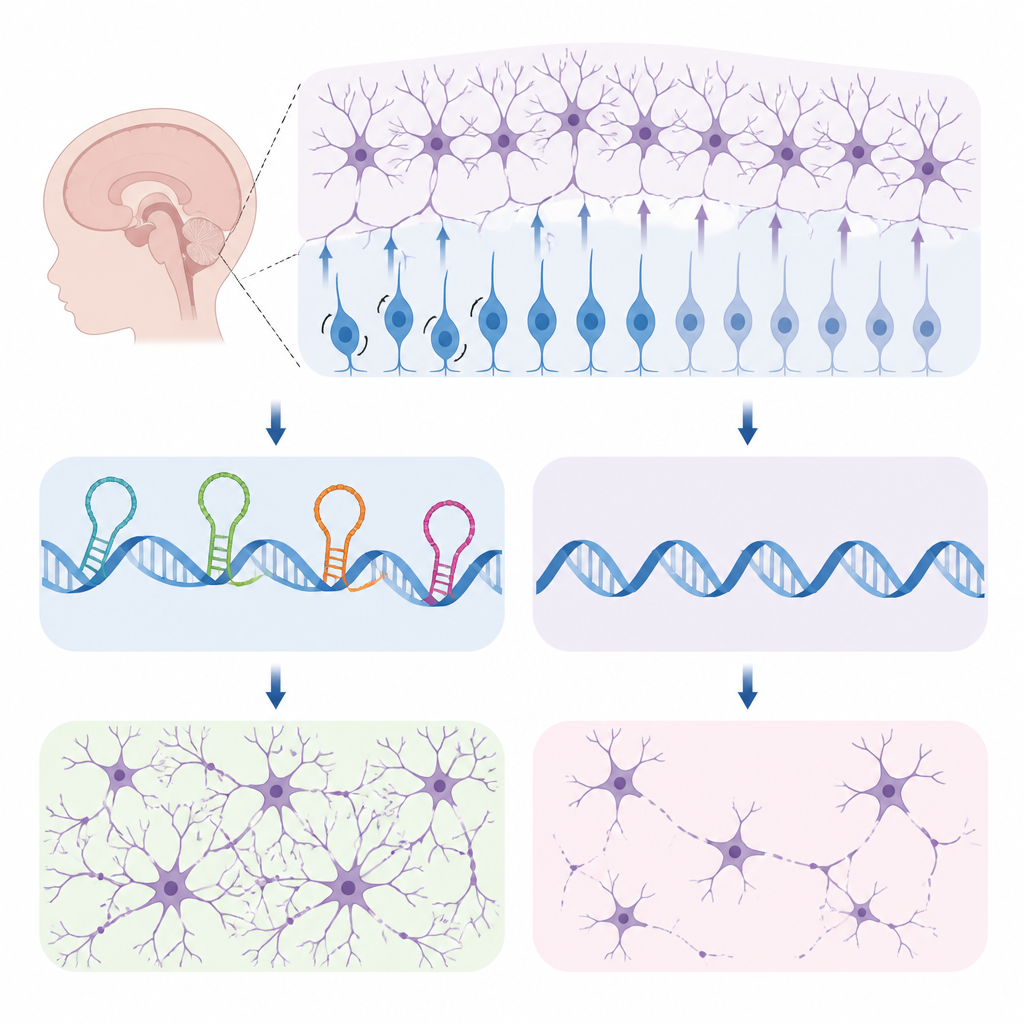
Early brain cells carry loops on genes they will use later
When the team overlaid their loop maps with gene activity data from fetal brains, a striking pattern emerged. In the mature cortical plate, loops tended to sit on genes that were already active and involved in nerve signaling. In the germinal matrix, however, many loops sat on promoters of genes that were still quiet there but become strongly active later in neurons. These genes are enriched for roles in axon growth, synapse formation, and neuron differentiation, and match a previously described set of “primed” neuronal genes in mouse neural progenitors. Promoters with loops also carried DNA motifs for known repressor complexes, suggesting that the loops may help keep these genes poised but not yet fully turned on.
Removing loops nudges cells toward neurons but disrupts control
To test causality, the researchers used human stem-cell-derived neural progenitors in culture and introduced an enzyme, RNase H1, that specifically cuts away the RNA portion of these DNA/RNA loops. Over weeks of differentiation, this reduced the overall looped regions by roughly one third, especially at gene promoters. Single-cell RNA sequencing showed that cells with high RNase H1 levels were more likely to become neurons rather than glia. At the same time, hundreds of genes gained expression when their promoter loops were lost, with strong enrichment for neuron differentiation, neurite outgrowth, and synaptic genes, including many linked to autism risk. This supports the idea that loops at promoters act as part of a fine-tuned brake, preventing certain neuron genes from switching on too early or too strongly.
Loop loss weakens brain cell communication
The study then asked whether changing these loops alters how neurons connect and fire. In cultured human neurons, prolonged loop removal reduced spontaneous electrical spiking and network bursts, signs that circuits were not maturing normally. In mouse embryos, overexpressing the same loop-cutting enzyme in developing cortical neurons led to fewer dendritic branches and a lower density of dendritic spines in the prefrontal cortex, structures that normally receive synaptic input. Notably, overall cell survival and migration were not broadly impaired, pointing to a specific disruption of connection-building rather than wholesale developmental failure. 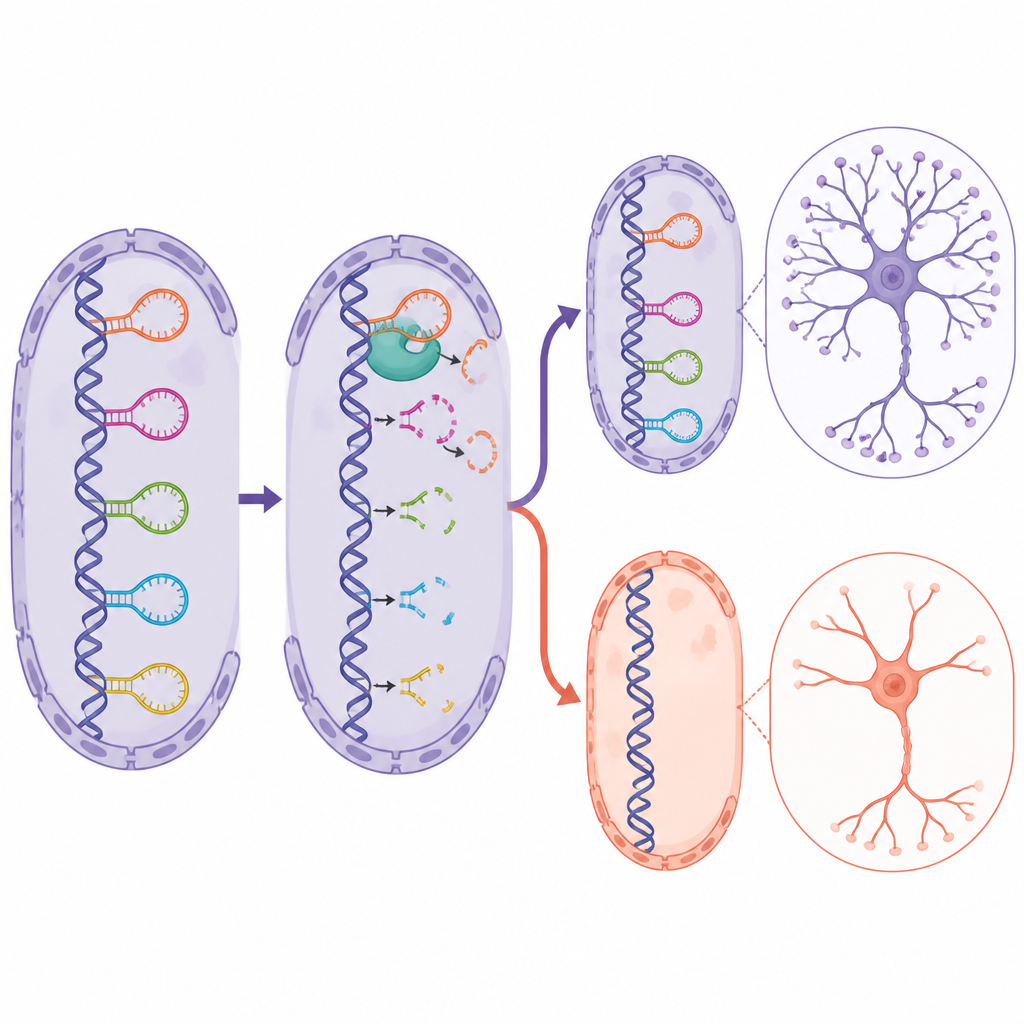
What this means for understanding brain disorders
Taken together, the work suggests that R-loops in early brain cells help mark and restrain neuron-specific genes so they can be turned on with the right strength at the right time. When this loop landscape is artificially contracted, many neuron and synapse genes, including several associated with autism, become overexpressed and neural networks develop fewer, weaker connections. For a layperson, the message is that tiny structural features on DNA may serve as subtle timing dials for brain development, and disturbing these dials can shift how brain cells specialize and wire together, with possible relevance to neurodevelopmental conditions.
Citation: LaMarca, E.A., Saito, A., Plaza-Jennings, A. et al. R-loop landscapes in the developing human brain are linked to neural differentiation and cell type-specific transcription. Transl Psychiatry 16, 250 (2026). https://doi.org/10.1038/s41398-026-04009-2
Keywords: R-loops, neurodevelopment, neural progenitor cells, synapse formation, autism risk genes