Clear Sky Science · en
Dose-dependent pharmacokinetics and acute effects of intravenous bolus N,N-dimethyltryptamine: double-blind, randomized versus open-label dose-escalation administration study in healthy participants
A fast but powerful mind-altering drug
Many people have heard that psychedelic drugs are being explored as potential treatments for depression and other mental illnesses. One of the most intense of these substances is N,N-dimethyltryptamine, or DMT, famous for producing a rapid, overwhelming shift in consciousness that fades within minutes. This study asked a practical question with big implications for therapy: when DMT is injected directly into a vein in healthy volunteers, how quickly does it act, how long do its effects last, how do different doses feel, and does the way we give the drug change how people experience it?
How the study was set up
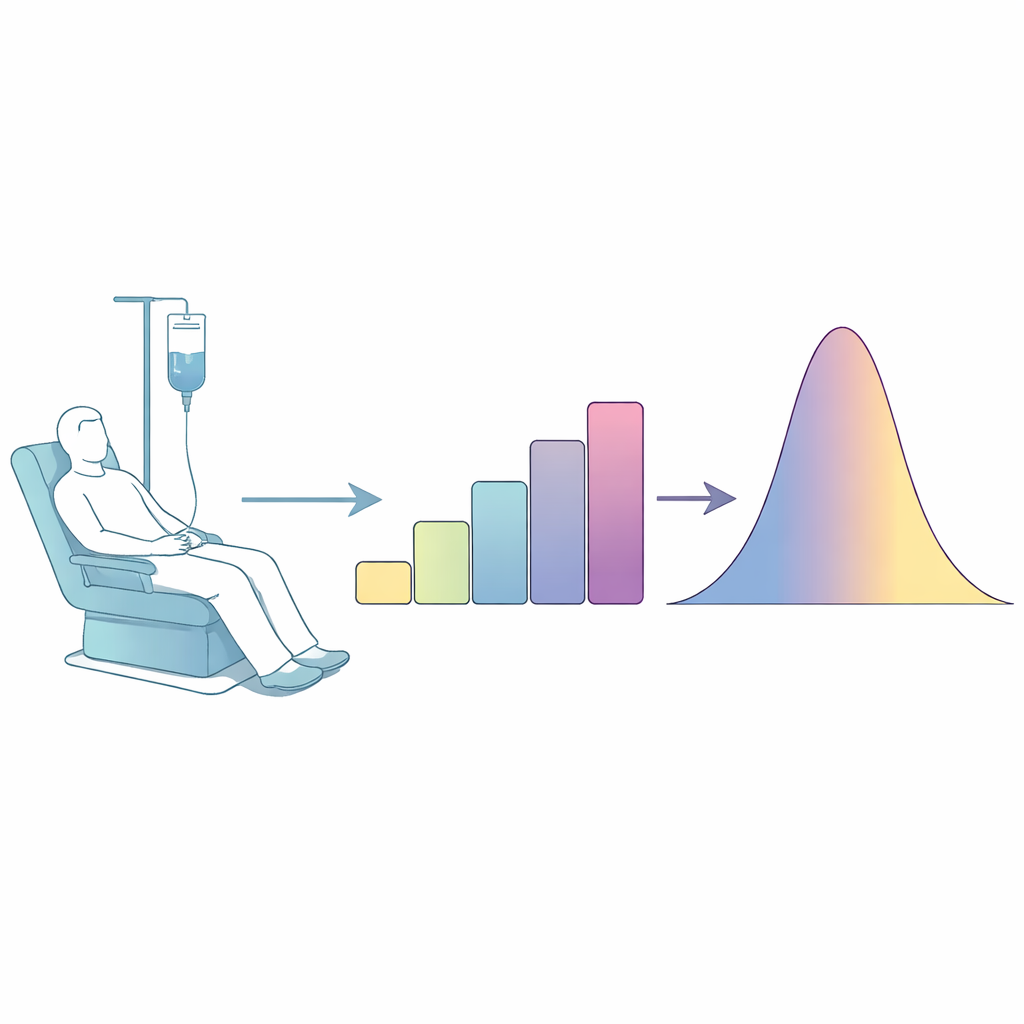
The researchers ran two carefully controlled experiments in a hospital setting with a total of 36 healthy adults. In one arm, 20 participants took part in a double-blind, randomized session: over a single day they received five injections in unknown order—placebo (salt water) and DMT doses of 5, 10, 15, and 20 milligrams. Neither they nor the staff knew which dose came when. In the second arm, 16 participants entered an open-label dose-escalation session: they started with placebo, then knowingly received 5 milligrams of DMT, with the option to continue in 5-milligram steps up to 25 milligrams, stopping whenever they wished. In both arms, each bolus was given over 45 seconds, with about an hour between doses.
What participants felt and how long it lasted
Volunteers repeatedly rated how strongly they felt “any drug effect,” how good or bad it felt, and how fearful they were, and later filled out detailed questionnaires about altered states of consciousness. Across the randomized arm, DMT produced very rapid and intense experiences: effects surged within about 2 minutes of injection, then faded over 12 to 30 minutes depending on dose. By 15 milligrams, ratings of overall intensity reached a ceiling—going to 20 milligrams made the trip last a bit longer but did not make it feel much stronger. Lower doses (5 milligrams) produced only mild psychedelic changes. Higher doses brought more anxiety and feelings of loss of control, even though most people still described the experience as positive overall.
Why mindset and expectations mattered
Comparing the two study arms revealed a striking influence of context and expectation. At the same nominal doses, people in the double-blind, randomized arm generally rated their experiences as stronger and more disturbing than those in the open-label, dose-escalation arm. In the open-label group, knowing the dose, choosing whether to continue, and building up gradually appeared to soften fear and unpleasant feelings by roughly half, even though many participants eventually chose very high doses of 20 or 25 milligrams. Positive aspects of the experience, such as feelings of bliss and insight, increased steadily with dose in this arm, with less of the early “overwhelming” ceiling seen under blinded conditions. These differences highlight how being prepared and having a sense of control can shape the subjective impact of psychedelics.
How the drug moved through the body
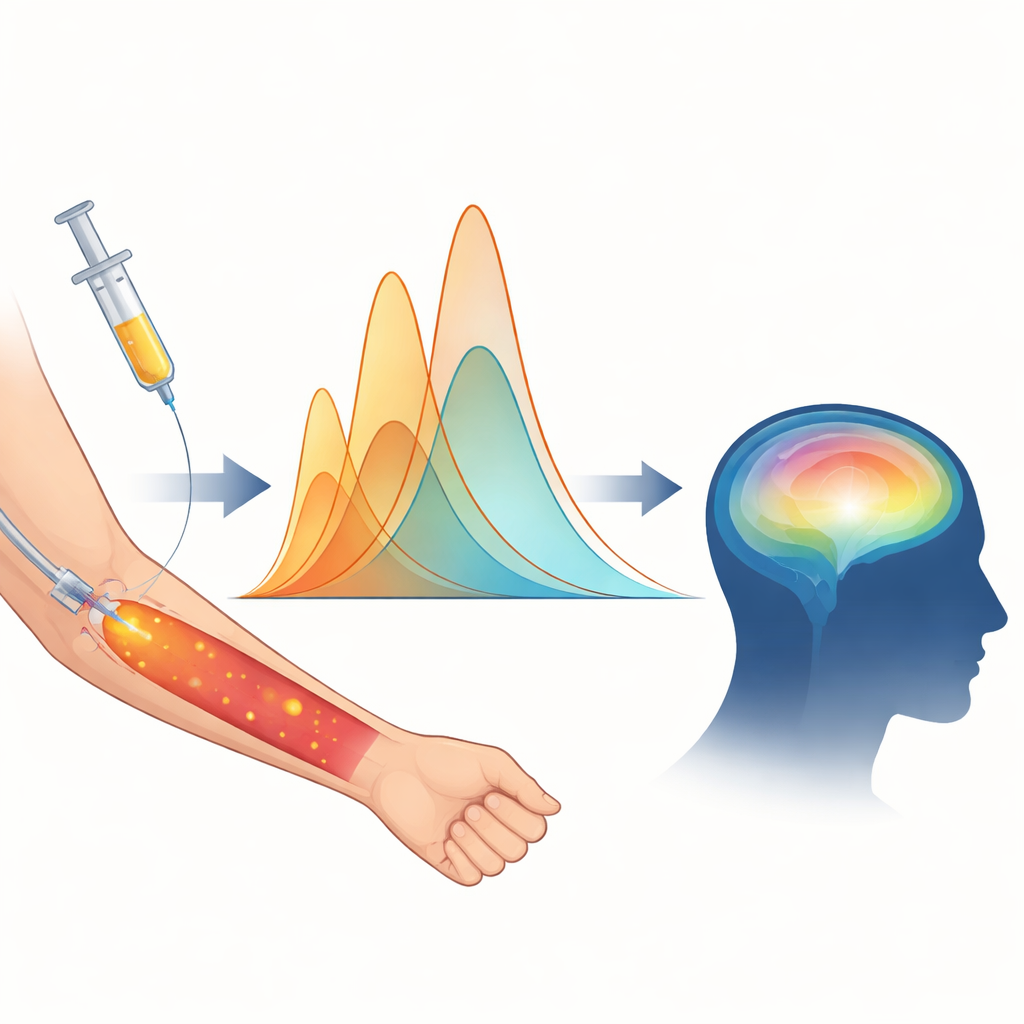
Blood samples taken after each injection showed that DMT enters and leaves the circulation extraordinarily quickly. Peak levels were reached in about 2 to 3 minutes for all doses, and the initial half-life—the time for the concentration to drop by half—was only about 6 to 7 minutes. Higher doses led to proportionally higher blood levels, so the body handled DMT in a predictable, linear way over the tested range. At the lower doses, the time course of people’s reported effects closely mirrored the rise and fall of drug levels in blood, with no sign that the body quickly adapted or developed short-term tolerance to repeated hourly injections.
What this means for future treatments
To a layperson, the key message is that intravenous DMT acts like a powerful but very brief “psychedelic flash,” peaking within a couple of minutes and resolving completely within half an hour. Beyond about 15 milligrams, taking more does not make the experience much more intense, only slightly longer. Crucially, the same chemical dose can feel very different depending on whether it is given blindly and out of the blue or built up stepwise with the person’s informed cooperation. This suggests that if DMT is to be used in therapy—for example, for depression—gradual, open-label dose escalation and careful attention to preparation and setting may greatly improve comfort and safety while still allowing strong, potentially beneficial experiences.
Citation: Erne, L., Mueller, L., Straumann, I. et al. Dose-dependent pharmacokinetics and acute effects of intravenous bolus N,N-dimethyltryptamine: double-blind, randomized versus open-label dose-escalation administration study in healthy participants. Transl Psychiatry 16, 213 (2026). https://doi.org/10.1038/s41398-026-03987-7
Keywords: DMT, psychedelics, dose escalation, pharmacokinetics, depression treatment