Clear Sky Science · en
Disentangling individual heterogeneity reveals robust network and molecular signatures of major depressive disorder with suicidal ideation
Why this brain study matters
Suicidal thoughts are a devastating part of major depression, yet doctors still lack clear biological markers that explain why some people with depression think about suicide while others do not. This study combines brain scans and molecular data to look beneath the surface, teasing apart common patterns shared across patients from those that are unique to each person. By doing so, the researchers aim to reveal brain network changes and underlying chemistry that could one day support more precise assessment and treatment of suicidal risk.
Looking at brain wiring in new ways
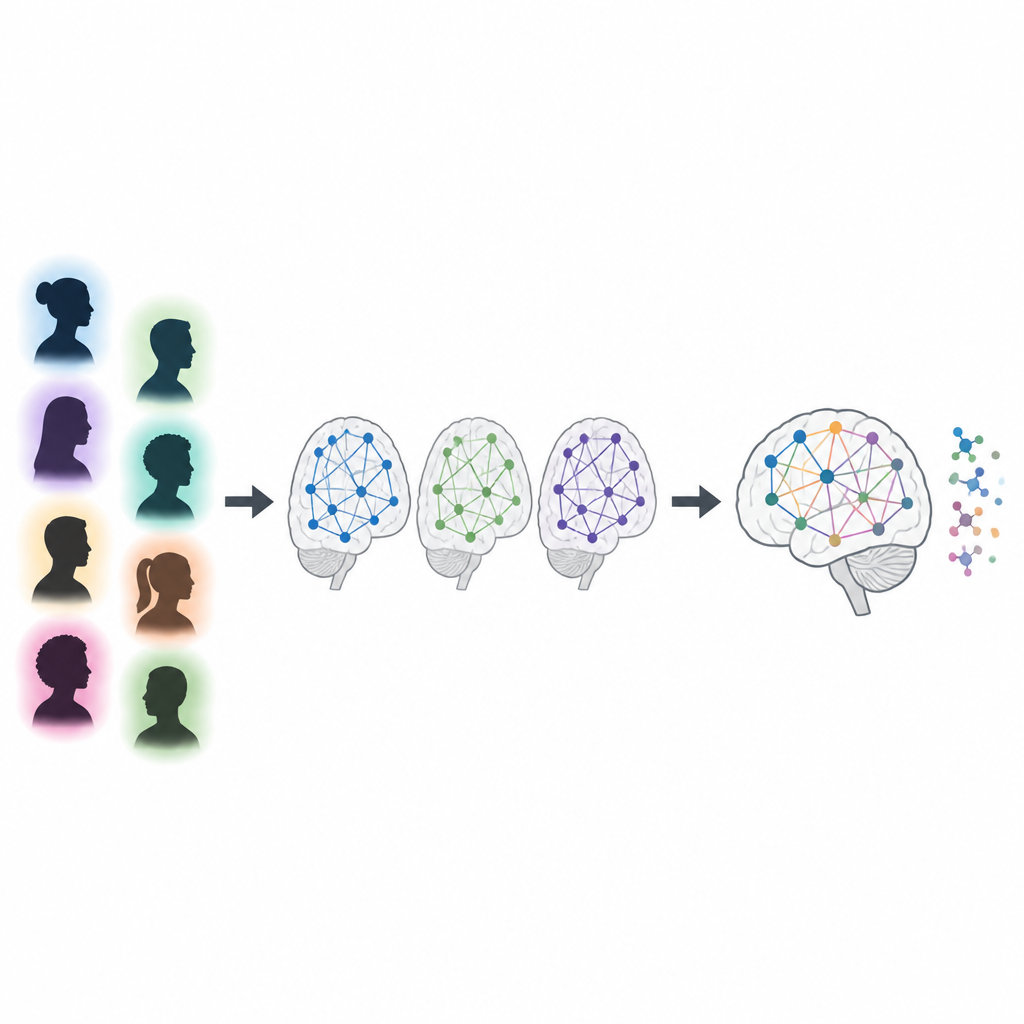
Past research has shown that depression with suicidal thoughts is linked to changes in both brain structure and brain activity, especially in regions that handle emotion, thinking, and self-reflection. Most of those studies, however, rely on simple comparisons between groups, averaging across many people and potentially hiding important individual differences. In this work, the researchers studied more than 650 people from many sites in China, including healthy volunteers, people with depression without suicidal thoughts, and people with depression plus suicidal thoughts. They built three types of brain networks from MRI scans for each person: a structural network based on physical wiring, a functional network based on synchronized activity, and a third network that captures how structure and function are coupled.
Shared and personal brain network patterns
To move beyond simple averages, the team used a mathematical method that separates brain connections into two parts: patterns shared across individuals and patterns specific to each person. The shared networks revealed where people with depression differed, as groups, from healthy volunteers. Across all three types of networks, the clearest changes involved two large-scale systems: the default mode network, which supports inward focus and self-related thought, and the action mode network, which helps maintain goals and organize actions. In people with depression and suicidal thoughts, connections between these two systems were consistently weaker, suggesting a breakdown in coordination between inner emotional life and outward, goal-directed behavior.
How network changes relate to symptoms and biology
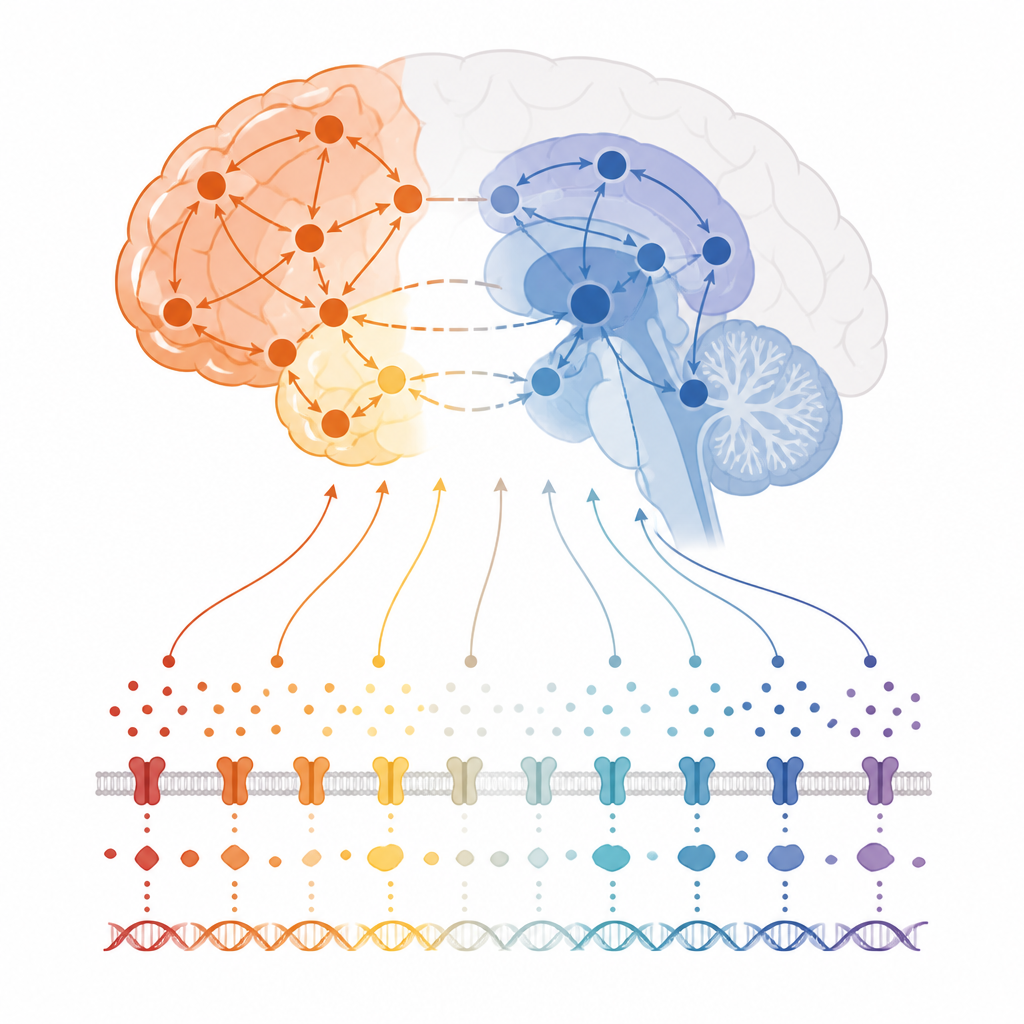
The person-specific networks told a different but complementary story. Once shared patterns were removed, the remaining individual signatures were more strongly linked to how severe a person’s depression and suicidal thoughts were. Certain connections within the action mode network, and between this network and the default mode network, tracked both overall depression scores and specific ratings of suicidal thinking. The researchers then asked whether these network changes lined up with maps of gene activity and brain chemicals. They found that affected connections tended to fall in regions enriched for genes involved in brain development, synapses, and the transport and release of neurotransmitters. Changes were also tied to the distribution of a particular serotonin receptor, 5-HT2A, which has long been implicated in suicide risk.
Toward more accurate identification of risk
Beyond understanding mechanisms, the team tested whether these refined brain networks could help distinguish healthy volunteers, depressed patients without suicidal thoughts, and depressed patients with such thoughts. Using a machine learning model that pays special attention to the most informative connections, they found that person-specific structural networks provided far better classification than the original, unprocessed networks. In an independent set of participants, this model correctly identified group membership in more than nine out of ten cases, highlighting the value of separating shared and individual components when searching for potential imaging markers.
What this means for people with depression
Taken together, the findings suggest that suicidal thoughts in depression are linked to a common pattern of weakened communication between brain systems that manage self-focused thinking and action planning, layered on top of more individual differences in brain wiring. These network changes align with specific genes and serotonin receptors, pointing to biological systems that may be especially relevant to suicidal risk. While this work does not yet translate into clinical tests, it introduces a framework for reducing noise from individual variability and for connecting brain networks with underlying molecules, offering a clearer starting point for future studies of risk screening, neuromodulation, and medication strategies.
Citation: Diao, Y., Huang, Y., Guo, M. et al. Disentangling individual heterogeneity reveals robust network and molecular signatures of major depressive disorder with suicidal ideation. Transl Psychiatry 16, 273 (2026). https://doi.org/10.1038/s41398-026-03965-z
Keywords: major depressive disorder, suicidal ideation, brain networks, serotonin, gene expression