Clear Sky Science · en
Brain-wide induction of ΔFOSB and altered co-activation networks in a rat model for exercise training
Why Exercise Talks to the Brain
Most of us know that regular exercise is good for the body, but it also has powerful effects on the brain—lifting mood, sharpening thinking, and guarding against stress. Yet it has been surprisingly hard to see, in a whole-brain way, how something as simple as daily running reshapes the networks of nerve cells that underlie these benefits. This study used rats that voluntarily ran on wheels to map how weeks of exercise alter long-lasting patterns of brain activity and the “wiring diagram” that connects key mood, stress, and reward centers.
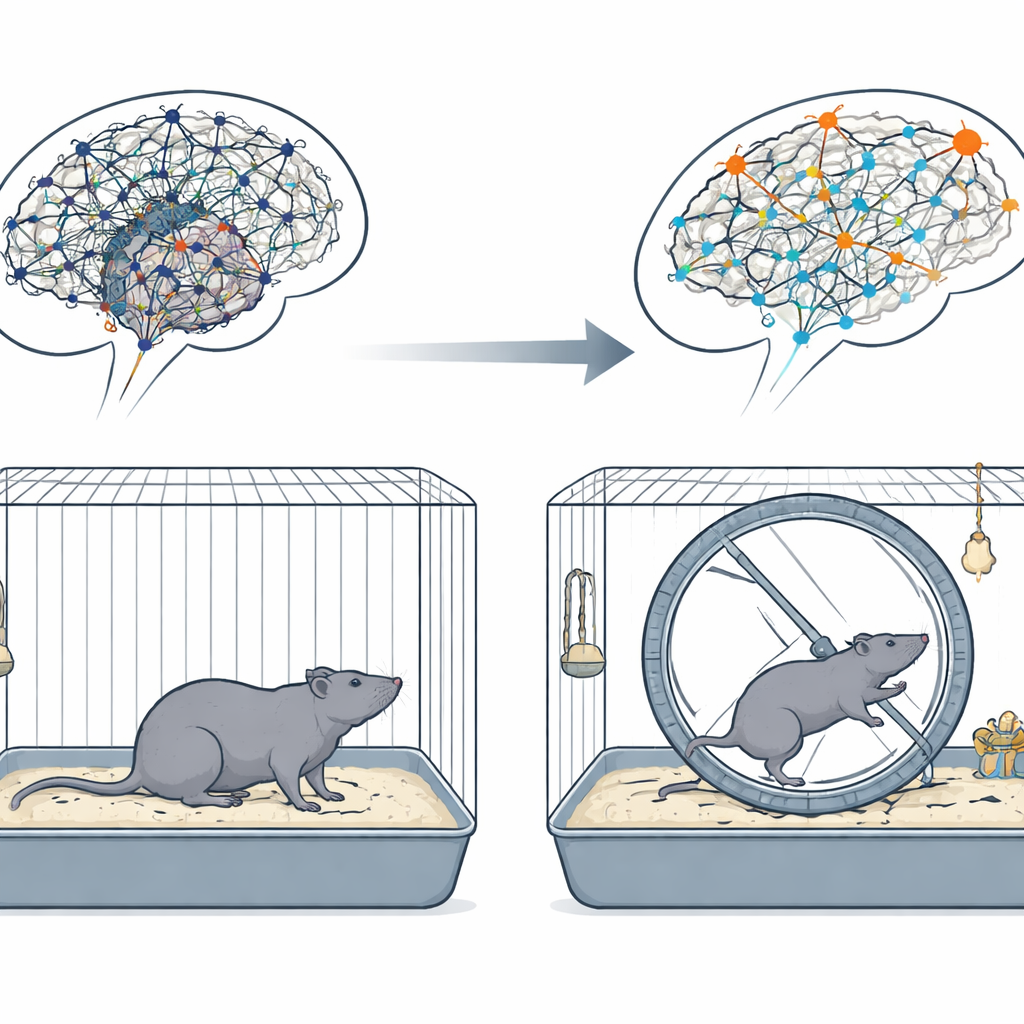
A Running Wheel as a Window into Brain Change
Researchers housed male and female rats either in standard cages or in cages equipped with running wheels for four weeks. The animals could choose how much to run, mimicking self-motivated exercise in people. As expected, running improved several measures of metabolic health: runners gained less weight, carried less abdominal fat, and showed changes in their stress-related adrenal glands. Females consistently ran farther than males, often logging several times the distance each day, echoing earlier work showing strong exercise drive in female rodents.
A Lasting Molecular Footprint of Activity
To capture which brain regions had been repeatedly activated over this month-long period, the team measured a protein called ΔFOSB in 44 areas involved in stress responses, learning and memory, and reward. ΔFOSB is unusual: it builds up slowly in neurons that are stimulated again and again, and then lingers for days to weeks. That makes it a kind of molecular footprint of long-term activity rather than a momentary snapshot. Using a semi-automated atlas-based method, the scientists counted ΔFOSB-marked cells across the brain, allowing an unbiased, brain-wide view.
Exercise Lights Up and Rebalances Key Hubs
Running boosted ΔFOSB in a broad set of regions. In males, increases appeared in frontal cortical areas linked to decision-making and emotion control, parts of the reward system such as the nucleus accumbens and striatum, and memory-related structures in the hippocampus, as well as stress-related zones in the hypothalamus and amygdala. Females showed even more widespread increases, especially across frontal and hippocampal regions and in midbrain centers like the ventral tegmental area, a key component of the brain’s reward circuitry. Although not every individual difference remained statistically robust after strict corrections, the overall picture was clear: habitual running induces chronic activation in a large, interconnected network rather than in a single “exercise center.”
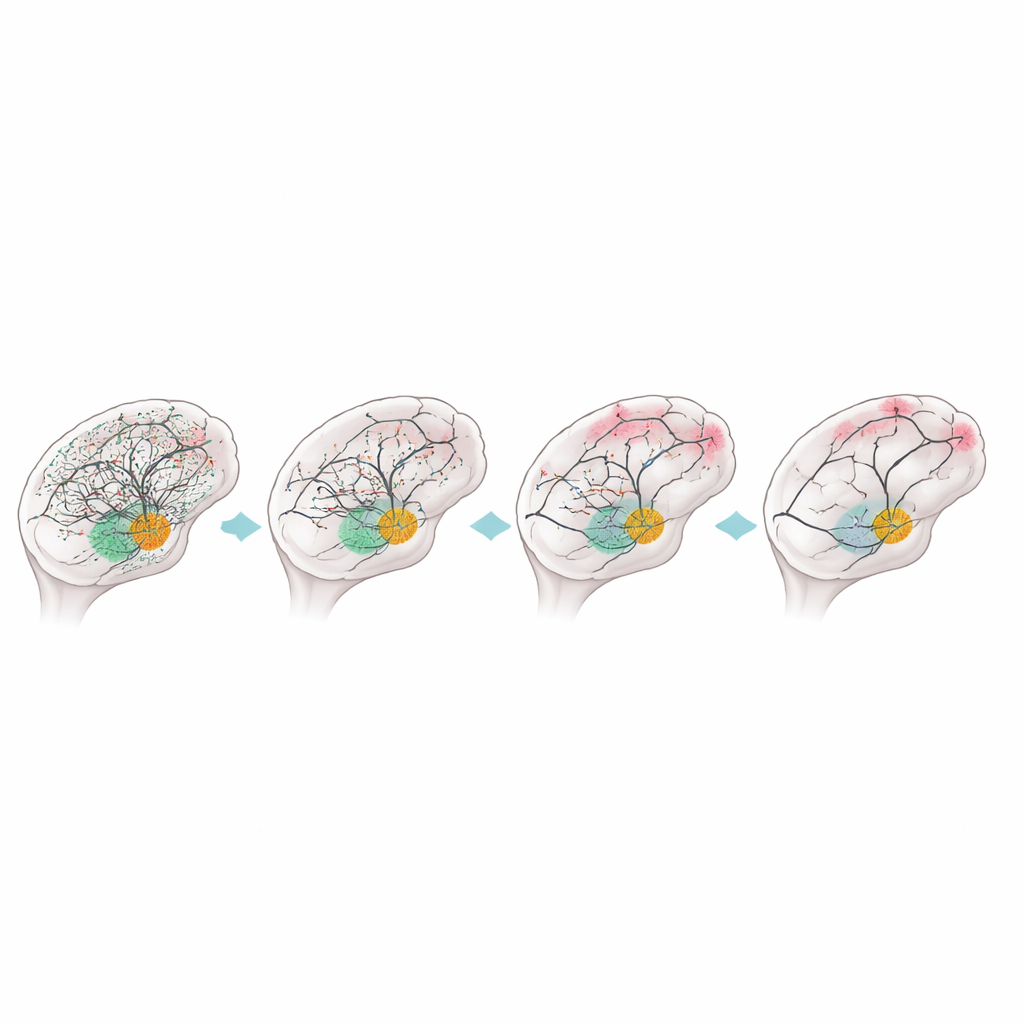
From Dense Tangles to Sleeker, Smarter Networks
The team then asked how these activated sites interact as a system. By examining how ΔFOSB levels rose and fell together across regions, they built “co-activation” networks, where nodes represent brain areas and links represent tightly coupled activity. In sedentary animals, both sexes showed dense, highly clustered networks in which hippocampal and amygdala regions sat at the core—suggesting a strongly memory and emotion-centered architecture. After weeks of running, overall connectivity became sparser, but the remaining links formed more efficient, small-world–like patterns. Importantly, the most influential hubs shifted forward, toward cortical regions involved in planning, control, and flexible thinking, while some reward-related nuclei also gained prominence.
What This Means for Stress, Mood, and Cognition
Because ΔFOSB is known from other studies to dampen the excitability of certain neurons and to reshape gene expression in ways that stabilize circuit changes, the authors propose that exercise gradually “re-tunes” brain networks. Rather than simply turning everything up, running appears to prune and refine connections, easing the burden on stress and fear centers while strengthening top-down guidance from the cortex. In everyday terms, regular exercise may help the brain shift from a reactive, emotionally driven mode toward a more balanced state where thoughtful control and resilience can prevail. This brain-wide ΔFOSB atlas and network map in exercising rats offers a framework for future work that links specific molecular changes to the well-known mental health and cognitive benefits of staying physically active.
Citation: Hardonk, M.H., Vuuregge, A.H., Hellings, T.P. et al. Brain-wide induction of ΔFOSB and altered co-activation networks in a rat model for exercise training. Transl Psychiatry 16, 209 (2026). https://doi.org/10.1038/s41398-026-03953-3
Keywords: exercise and brain, neuroplasticity, stress resilience, brain networks, ΔFOSB