Clear Sky Science · en
Development and validation of a precision treatment rules for first-line antipsychotic recommendations in first episode psychosis jointly incorporating effectiveness, side effects and patient preferences
Why choosing the right medicine matters
For people experiencing psychosis for the first time, starting antipsychotic medication is a major turning point. The choice of which pill to take is not simple: different drugs can work about as well to ease symptoms, but they carry very different risks of weight gain, drowsiness, hormonal changes and other side effects that can shape everyday life. This study asks whether data from real-world patients can be used to guide that first choice in a way that balances benefits, side effects and what each person says matters most to them.

Turning medical records into a guide
The researchers used anonymised electronic health records from early intervention services for psychosis in South London, covering 1709 people with a first episode of psychosis. All had started one of three commonly prescribed newer antipsychotic drugs: aripiprazole, olanzapine or risperidone. The team tracked how often people were hospitalised or had to switch medication in the first two years, and whether they developed key side effects such as movement problems, hormonal changes, strong sleepiness, sexual problems or weight gain. They also drew on information about age, sex, diagnosis, symptoms and substance use, some of it extracted automatically from doctors’ notes using text-mining software.
Building rules around what patients care about
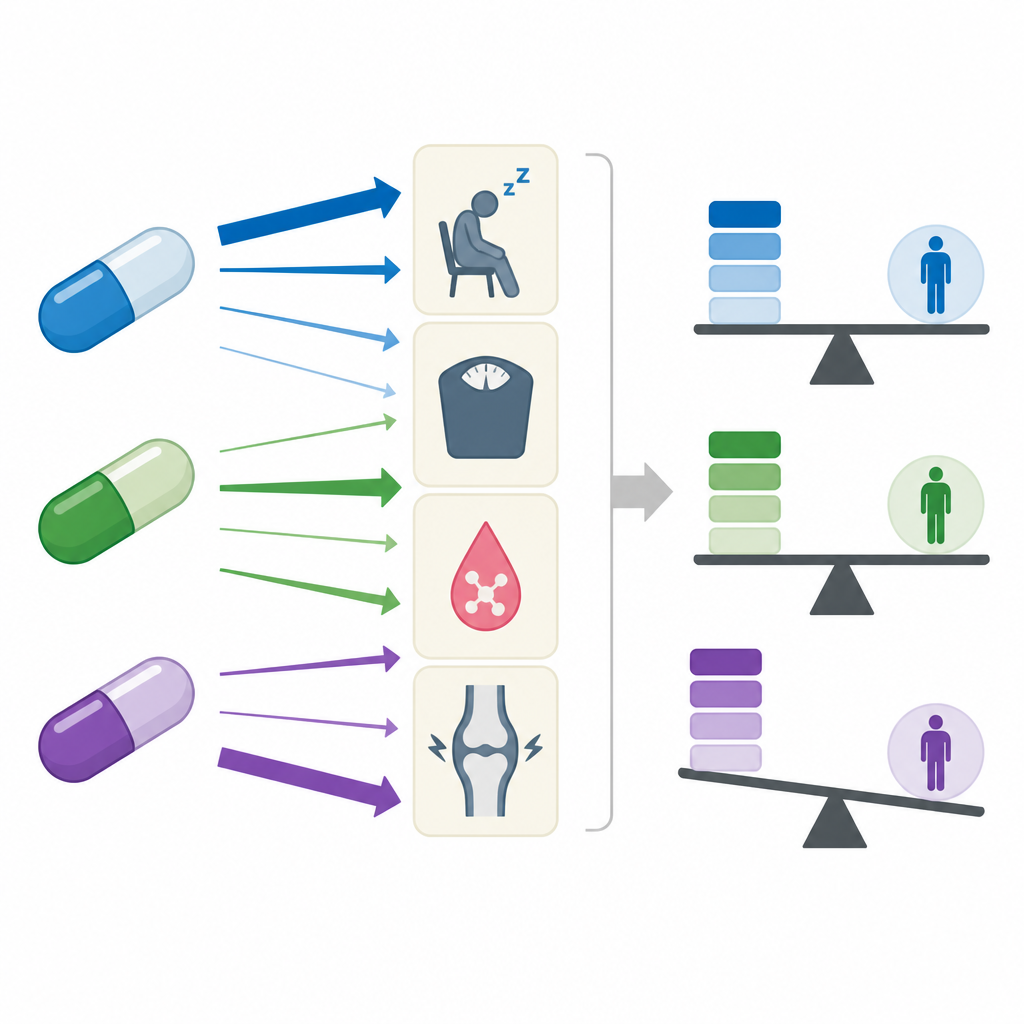
Rather than seeking a single “best” drug, the team built what they call precision treatment rules. These rules are computer-based recipes that take a person’s clinical profile and their stated side effect worries and turn them into a tailored recommendation. To do this, the researchers grouped outcomes into two buckets: how well treatment worked (staying on the drug and avoiding hospital) and unwanted effects. They then let patients, in theory, rank up to three side effects they most wanted to avoid, such as weight gain or sedation. Each ranking was converted into a set of weights that told the algorithm how heavily to count each outcome when searching for the option with the lowest overall risk.
What the data say about three common drugs
When the researchers compared the three medications overall, they found little difference in how often people were hospitalised or needed to change drugs. The big contrasts lay in side effects. Aripiprazole was linked to markedly lower rates of hormonal problems, sedation, sexual side effects and weight gain than olanzapine or risperidone. Olanzapine, in turn, appeared to cause fewer movement-related side effects than the other two. Despite these trade-offs, the algorithm’s rules, across 86 different ways of ranking side effect worries, pointed to aripiprazole as the recommended first choice for the vast majority of patients, typically more than 90 percent. Only when avoiding movement problems was made the top concern did olanzapine become more common as a suggestion, and even then most people were still steered toward aripiprazole.
Estimated impact on real outcomes
The team then asked what would have happened if, in the past, patients had received the drugs recommended by these rules instead of what was actually prescribed. Using statistical methods designed to mimic the fairness of a randomised trial, they estimated that following the rules would not change rates of hospitalisation or medication switches. However, it would lower several side effects: fewer people would be expected to develop hormonal problems, sedation, sexual side effects or substantial weight gain. The trade-off would be a modest increase in movement-related problems. A simple rule that gave aripiprazole to everyone produced very similar estimates, suggesting that there may be limited room, with current data and drug options, to fine-tune choices for different subgroups.
What this means for future care
For someone starting antipsychotic treatment, the study suggests that aripiprazole will often offer a good balance: similar chances of staying well compared with other options, but lower risks of several troublesome side effects, at the cost of a somewhat higher risk of movement issues. Just as important, the work shows that it is possible to fold a person’s own preferences into data-driven tools that can support shared decisions between patients and clinicians. While these rules still need to be tested in real-world trials and expanded to more drugs and more detailed health information, they point toward a future in which the choice of first antipsychotic can be guided by evidence and personal values together, rather than trial and error alone.
Citation: Krakowski, K., Oliver, D., Arribas, M. et al. Development and validation of a precision treatment rules for first-line antipsychotic recommendations in first episode psychosis jointly incorporating effectiveness, side effects and patient preferences. Transl Psychiatry 16, 252 (2026). https://doi.org/10.1038/s41398-026-03914-w
Keywords: first episode psychosis, antipsychotic choice, side effects, patient preferences, precision psychiatry