Clear Sky Science · en
Applying machine-learning and deep-learning to predict depression from brain MRI and identify depression-related brain biology
Why brain scans and algorithms matter for mood
Depression affects hundreds of millions of people worldwide, yet doctors still lack objective tests that can flag who is at risk or help tailor treatment. This study asked a simple but pressing question: can detailed brain scans, combined with modern computer techniques, provide a reliable signal of depression? By analysing thousands of brain MRI images from the UK Biobank and comparing traditional machine-learning with deep-learning methods, the researchers explored how much information about depression is actually written into the brain’s grey matter structure.
Looking for patterns in thousands of brain scans
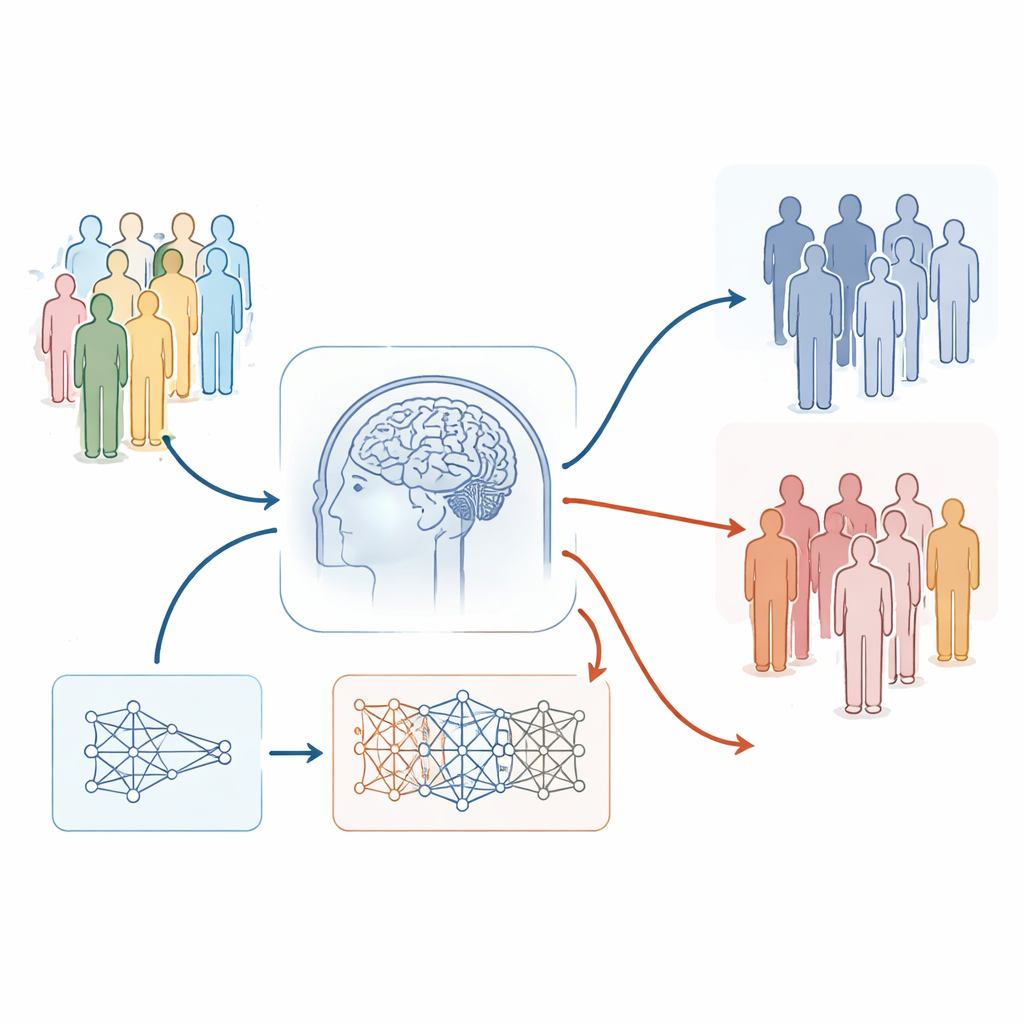
The team used structural MRI scans from the UK Biobank, focusing on people with and without a history of major depressive disorder. They worked with more than 1,400 people with depression and over 29,000 carefully screened controls, and then carved out a balanced subset for training and testing their models. Instead of averaging the brain into large regions, they kept a fine-grained, three-dimensional grid of tiny units called voxels across the grey matter. This approach preserves subtle, local differences in brain structure that might be lost when data are heavily simplified. All images were processed and aligned into a common template so that each voxel could be meaningfully compared across individuals.
Comparing a classic model with deep-learning
The researchers trained two types of predictors. One was a statistical machine-learning approach called a BLUP model, which linearly combines information from hundreds of thousands of voxels into a single brain-based risk score. The other was a modern deep-learning model (a 3D ResNet) that attempts to learn complex patterns directly from the MRI volumes. When tested in an independent group of almost 2,500 people, the BLUP score showed a modest but reliable ability to distinguish those with depression from controls. People with depression tended to have slightly higher scores, and each standard-step increase in the BLUP score was linked to about a 28% increase in odds of having major depression. By contrast, the deep-learning model performed only slightly better than chance and did not hold up after stricter statistical checks.
What the brain score reveals about key regions
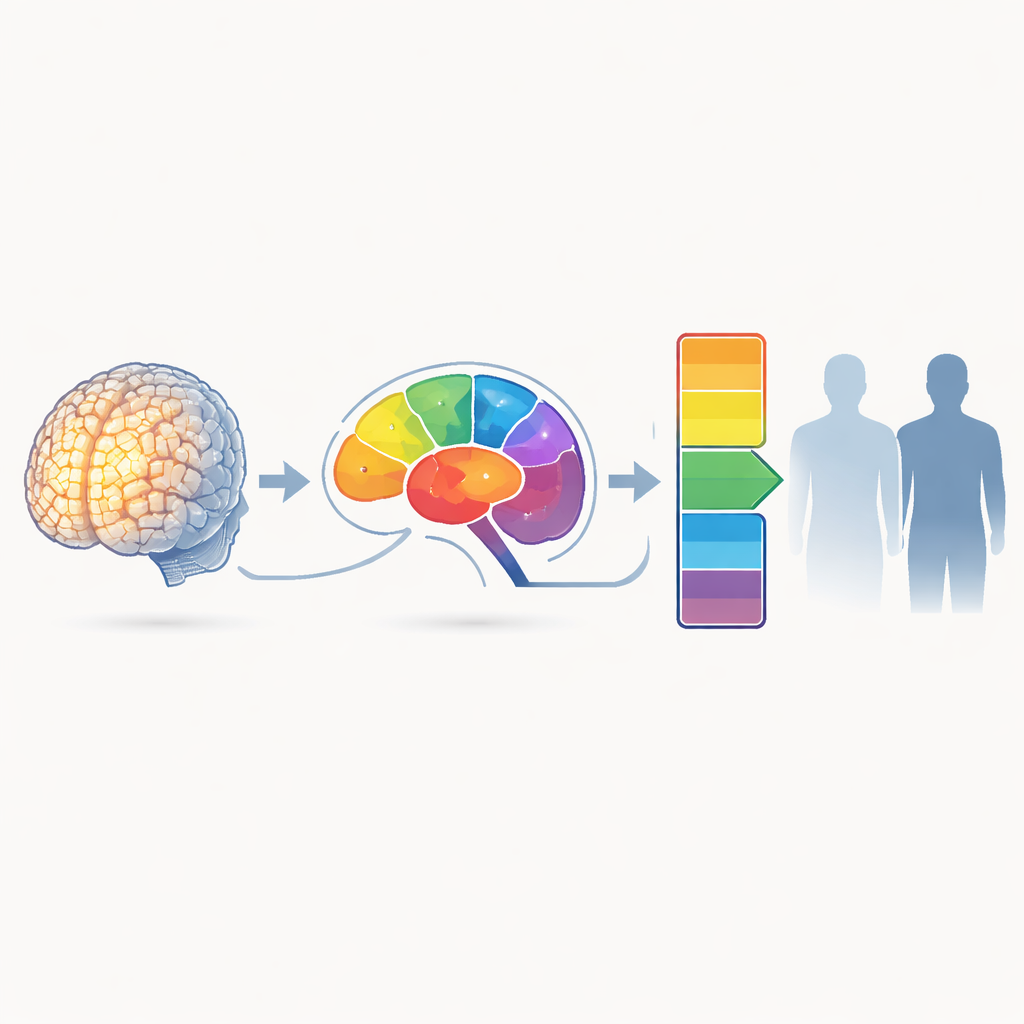
To make the brain score more interpretable, the authors broke it down by anatomical regions. They asked which areas, when considered on their own, contributed most strongly to the prediction. Several regions previously suspected to be involved in depression—such as the hippocampus and amygdala—showed signals in the expected direction, along with parts of the thalamus, cerebellum, and certain frontal and temporal areas. However, none of these region-specific effects were strong enough to remain significant after correcting for the large number of areas tested. A small clinical sample scanned with different equipment showed mostly consistent directions of effect but lacked the size needed to confirm any association firmly.
Weighing brain structure against genetic risk
Because genes also influence depression, the team compared their brain-based score with a polygenic score that summarises risk across many genetic variants. The brain score and genetic score were modestly correlated, suggesting they tap into some shared biological vulnerability. Importantly, adding the brain score to the genetic score produced only a tiny improvement in prediction accuracy. The authors also estimated that overall, grey matter structure accounts for only about 6% of the variation in who has depression in their sample; even in an ideal world, this would cap the performance of any purely structure-based brain predictor at a relatively modest level.
What this means for future tests and treatments
For the lay reader, the headline is that current structural brain MRI, even when analysed with sophisticated tools, cannot yet serve as a reliable stand-alone test for depression. The BLUP model’s performance was statistically clear but far from the accuracy needed for clinical decision-making, and deep-learning did not outperform simpler methods. Still, the work offers valuable clues about which brain areas and features are most informative and how brain structure relates to both genes and life experiences that shape mental health. The authors argue that future progress will likely come from combining multiple types of brain data, genetics, and environmental information, and from focusing on specific symptom patterns rather than depression as a single broad category.
Citation: Jiang, JC., Brianceau, C., Delzant, E. et al. Applying machine-learning and deep-learning to predict depression from brain MRI and identify depression-related brain biology. Transl Psychiatry 16, 171 (2026). https://doi.org/10.1038/s41398-026-03889-8
Keywords: depression, brain MRI, machine learning, neuroimaging, genetic risk