Clear Sky Science · en
The relationship between regular substance use and cost comparisons in stable and volatile learning contexts
Why some people keep using despite the downside
Many people who struggle with alcohol or drugs say they “know the costs” yet still find themselves using. This study asks a deeper question: are they truly blind to the downsides, or are they inconsistent in how they use cost information when making choices? By putting people through a carefully designed computer game that mimics real-world trade-offs, the researchers explored how regular substance use relates to learning from negative outcomes in both predictable and unpredictable situations.
A decision game about losing money
To probe cost-based decision-making, 137 adults from the community, with a wide range of substance use histories, played a 200-round computer game. On each round, they chose between a white card and a black card, each showing a possible money loss between one and five dollars. One card was more likely to lead to a loss than the other, but participants did not know which. If they chose the “better” card, they lost nothing on that round; if not, they lost the amount shown. Over time, they had to learn from experience which card was safer, while also weighing how much money was at stake. Their actual earnings depended on the losses from two randomly selected rounds, giving real financial consequences to their decisions. 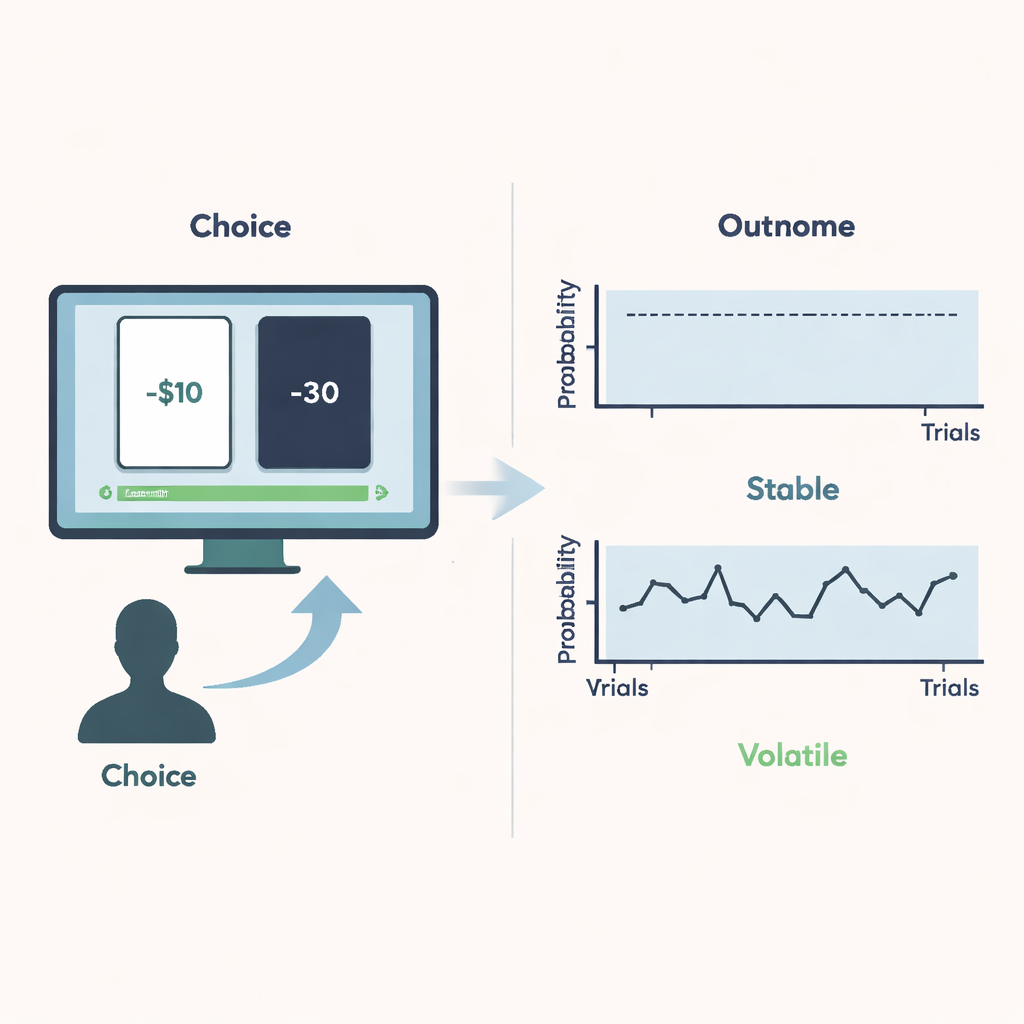
Stable situations versus changing ones
The game quietly flipped between two types of environments. In the stable setting, the same card kept most of the risk throughout 100 rounds: one card was usually bad (high chance of loss) and the other usually good (low chance of loss). In the volatile setting, the risky card switched every 25 rounds, so what had been the safer choice could suddenly become worse. Participants were not told about these shifts; instead, they had to adjust based only on what happened after each choice. This setup mirrors real life, where sometimes the “rules” of our environment are steady, and other times they change in ways that are hard to predict.
What regular substance use changed
Across the whole group, people behaved sensibly: they were more likely to repeat a choice after avoiding a loss, especially in the predictable, stable part of the game. In other words, when something worked, they tended to stick with it. But the pattern shifted among individuals with more years of regular substance use (defined as using a substance at least three times a week). These participants were less likely to repeat a choice even when it had just helped them avoid losing money, and they were less likely to settle into steady strategies in the stable environment, where consistent behavior should pay off most. Their choices looked more scattered, as if they were not fully using information about past outcomes to guide what they did next.
Peeking under the hood of learning
To understand why choices looked more random for heavier, longer-term users, the team used computational models—mathematical tools that estimate how people update beliefs and make decisions trial by trial. The best-fitting model suggested that, compared to others, people with more years of regular substance use were not necessarily less sensitive to the size of potential losses. Instead, they were less consistent in choosing the option with the better overall “deal” (lower expected loss). In technical terms, they had a lower “inverse temperature” parameter, which here reflects how reliably someone follows the option that should, on average, cost them less. 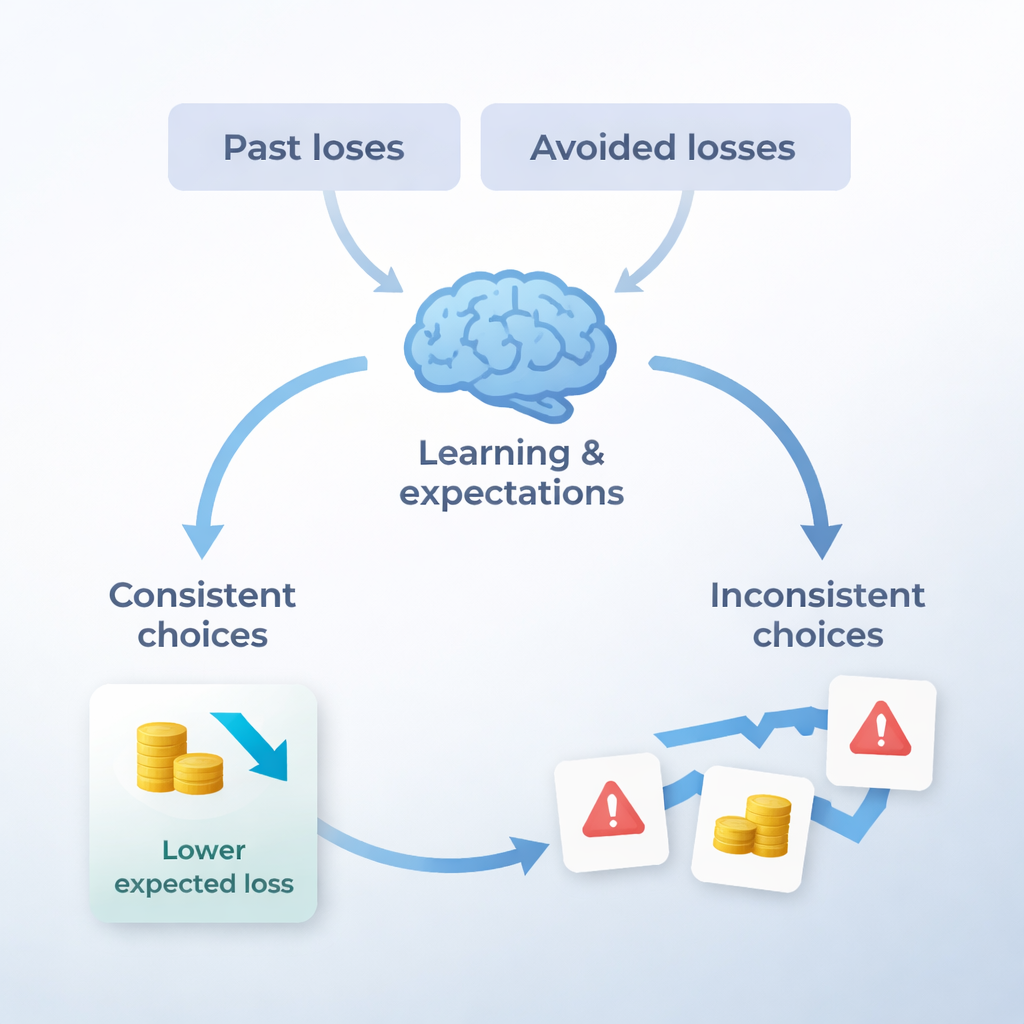
Why inconsistency matters more than numbness to cost
For a layperson, the core message is this: people with more severe substance use may not be numb to consequences—they may recognize that using leads to real harm. The issue is that they do not reliably use what they know to guide their next move, especially in situations where sticking with a good strategy would pay off. Their behavior may look irrational or stubborn, but this study suggests a different story: an underlying inconsistency in how they apply cost information, rather than simple insensitivity to cost itself. Understanding this distinction could help shape treatments that focus not just on teaching about risks, but on strengthening the ability to consistently act on that knowledge across different kinds of real-world situations.
Citation: Ruiz, S.G., Paskewitz, S. & Baskin-Sommers, A. The relationship between regular substance use and cost comparisons in stable and volatile learning contexts. Transl Psychiatry 16, 103 (2026). https://doi.org/10.1038/s41398-026-03830-z
Keywords: substance use, decision making, cost learning, addiction severity, behavioral economics