Clear Sky Science · en
Exploring biomarkers for treatment response in psoriatic arthritis: a focus on multi-omics technologies
Why this matters to people with joint and skin problems
Psoriatic arthritis is a condition that affects both the skin and the joints, often causing pain, stiffness, and fatigue. Many modern medicines are available, but up to four in ten people still do not feel much better after trying a new drug. This article explores how detailed molecular tests, known as multi-omics, could help doctors match each person with the treatment most likely to work for them, reducing trial and error and improving quality of life. 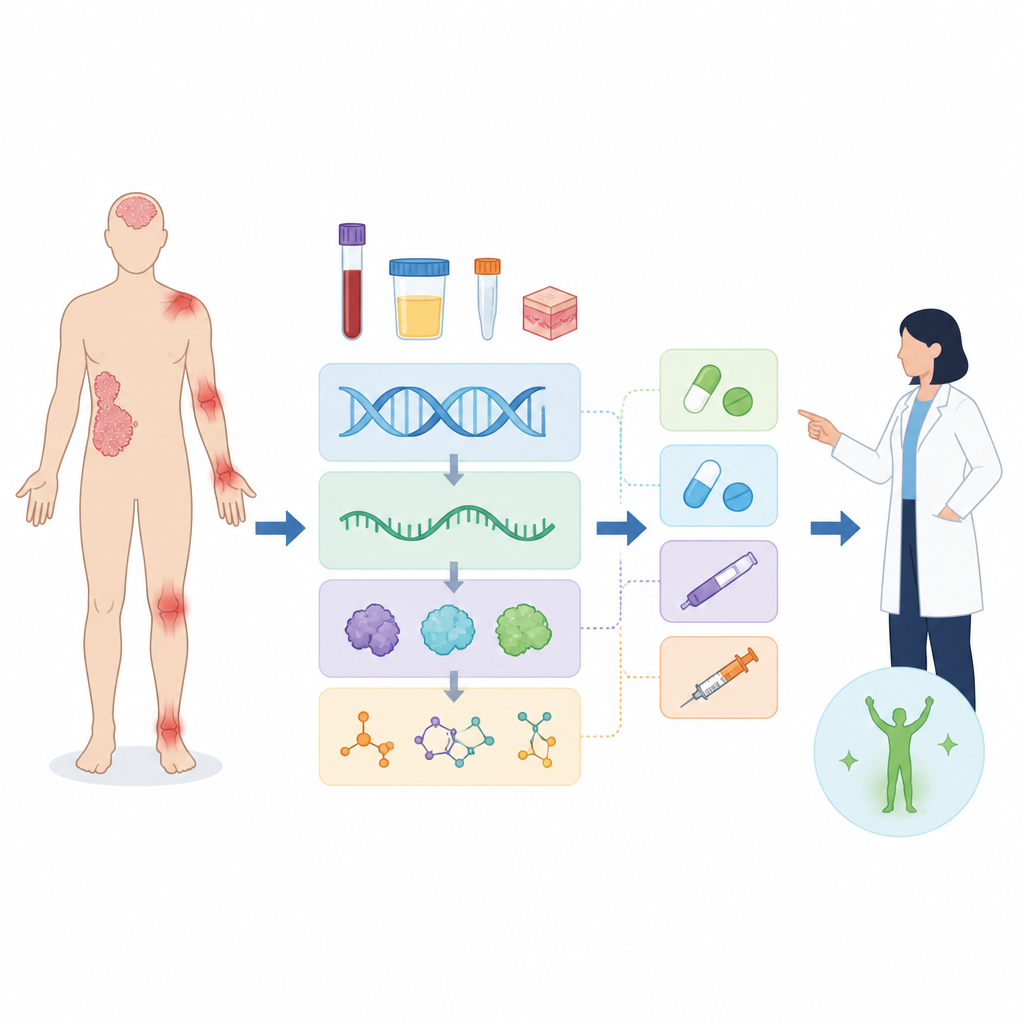
Today’s treatments and why they do not work for everyone
Current care for psoriatic arthritis usually starts with standard drugs such as methotrexate, and then moves on to biologic or targeted pills if needed. These medicines block key messengers that drive swelling and tissue damage, including tumor necrosis factor and a family of signals called interleukins. Different drugs work better for different disease patterns, such as mainly skin, mainly spine, or eye and gut involvement. Even with careful choice, fewer than 40 percent of patients reach a low disease state, and those who fail one biologic often do worse on later ones. Other health issues like obesity, depression, and poor adherence can further limit success.
What makes an ideal treatment-guiding test
The authors describe a wish list for a theranostic biomarker, a test that guides therapy before it begins. In an ideal world, such a test would tell doctors which drug a person is likely to respond to, so they could skip options that are unlikely to help and avoid long periods of ongoing damage. The test might combine several signals into a single score, and it would need to be accurate, simple, affordable, and available in routine clinics. Instead of choosing drugs mainly by cost or trial and error, care could be built around a more precise prediction of benefit.
Looking inside genes, RNA, proteins, and metabolites
Multi-omics technologies open a window into the many layers of biology that shape drug response. Genetic studies look for stable DNA variants that may predict benefit or side effects to drugs like methotrexate or tumor necrosis factor blockers. Transcriptomic studies read RNA levels in blood and immune cells and have linked response to patterns in cell death, inflammatory pathways, and immune cell behavior. Other work has tracked chemical marks on DNA, small regulatory RNAs, and panels of blood proteins, some of which shift early in treatment and may signal whether a therapy is working. A few studies have started to explore small molecules in urine and blood, hinting that metabolic patterns could also separate responders from non responders. 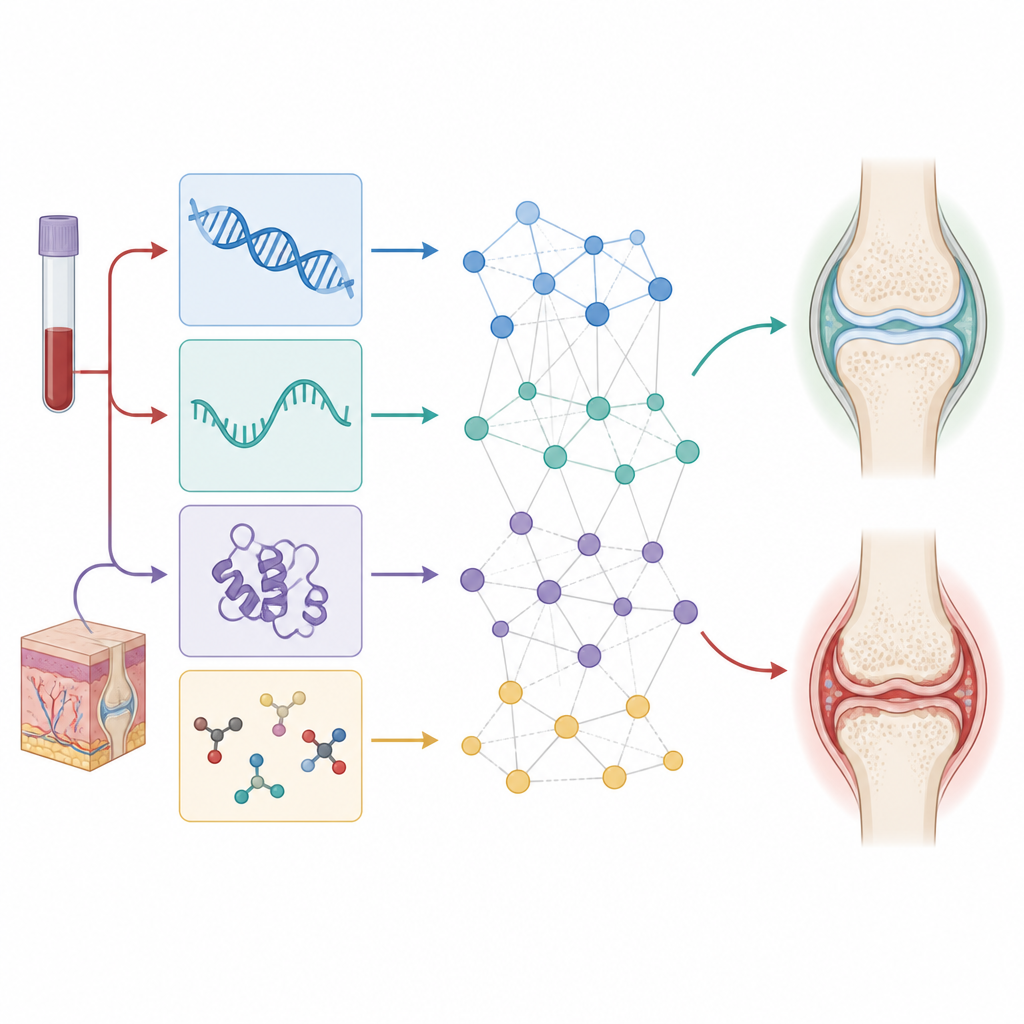
Why findings vary and what is still missing
Although many candidate markers have been reported, there is little overlap between studies. This reflects the wide variety of patients, drugs, tissues sampled, and outcome scores, as well as small study sizes. Psoriatic arthritis itself is highly mixed, with different joints and tissues active at different times, making it unlikely that a single marker will fit all. Often, changes seen at the gene level have not yet been confirmed at the protein or metabolite level, and results from psoriasis or bowel disease do not always carry over to joint disease. These gaps mean current biomarkers are not yet ready to guide everyday care.
Moving toward more tailored care
The review concludes that the best path forward is large, international projects that collect many types of molecular data from diverse patients, then use advanced computer methods to find reliable patterns. Rather than seeking one perfect signal, researchers expect that panels of genes, RNAs, proteins, and metabolites will together predict which treatment is most suitable for each person and when to switch if it fails. If validated and made affordable, such tests could help deliver the right drug to the right patient at the right time, slowing damage and improving daily life for people living with psoriatic arthritis.
Citation: Khasru, M.R., Abdul Jalil, N.A., Nair, N. et al. Exploring biomarkers for treatment response in psoriatic arthritis: a focus on multi-omics technologies. Pharmacogenomics J 26, 21 (2026). https://doi.org/10.1038/s41397-026-00410-8
Keywords: psoriatic arthritis, biomarkers, multi-omics, treatment response, precision medicine