Clear Sky Science · en
Combating small extracellular vesicle–mediated immunological barriers in the tumor microenvironment via strategically activatable PEGylated peptides
Why hidden cell messages matter in cancer
Cancer does not fight the immune system alone. Tumor cells constantly release tiny bubbles, called small extracellular vesicles, that carry signals telling immune cells to stand down and helping tumors build a protective neighborhood around themselves. This study explores a new way to selectively burst those bubbles inside tumors, aiming to unblock existing immunotherapies and help the body’s own T cells reach and attack cancer more effectively.
Tiny bubbles that silence immune attack
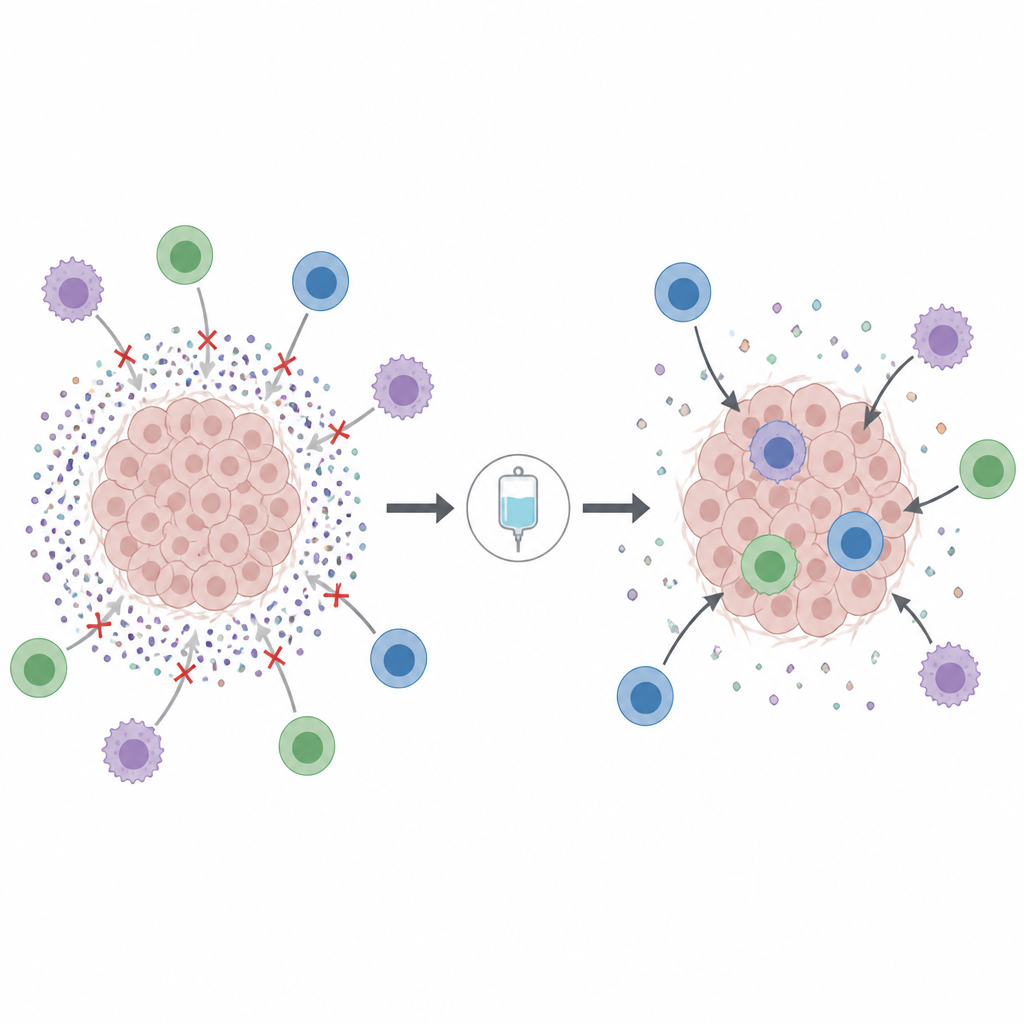
Tumors live within a complex local environment filled with immune cells, support cells, and a dense scaffold of tissue. In this space, tumor cells shed many nanosized vesicles that travel to nearby and distant cells. These vesicles often carry proteins that switch off cancer-fighting T cells and awaken support cells called fibroblasts, which then lay down tough fibers around the tumor. The result is a double barrier: immune cells become exhausted and the physical structure of the tumor blocks their entry, limiting the success of modern treatments such as checkpoint inhibitors and adoptive T cell therapies.
A smart peptide that wakes up in acidic tumors
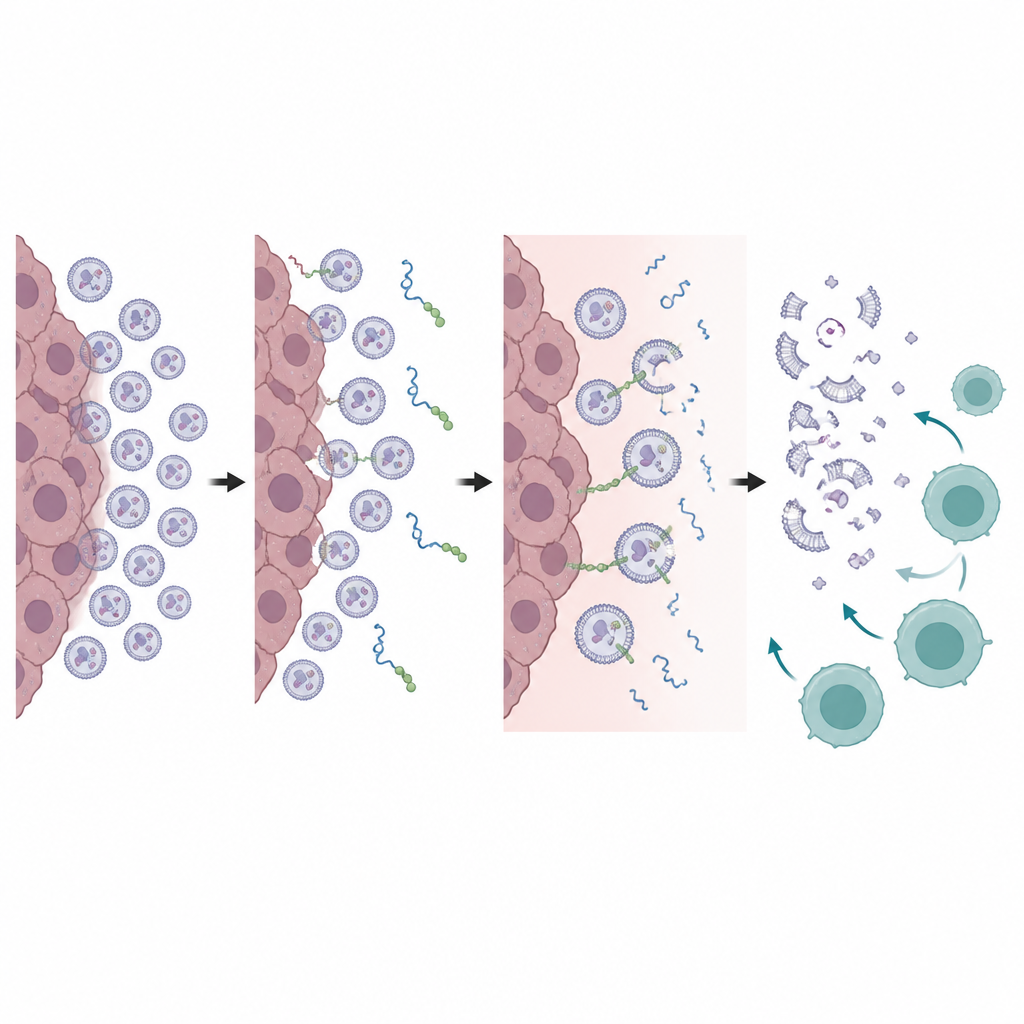
The researchers previously designed a short helix-shaped peptide that can recognize and rupture highly curved membranes like those of these tiny vesicles without harming normal cell surfaces. In this work, they turned that peptide into a systemically usable drug by attaching it to a flexible polymer, PEG, through a chemical link that falls apart only in mildly acidic conditions. Because tumor tissue is slightly more acidic than healthy tissue, this design keeps the peptide shielded and stable in the bloodstream, then releases it mainly inside the tumor microenvironment. The team calls this approach ExoPERM, for pH-enabled rupture of exosome membranes.
Breaking vesicles to rescue tired T cells
In laboratory tests, the acid-sensitive PEGylated peptide stayed largely inactive at normal blood pH but released the active peptide and strongly disrupted tumor-derived vesicles at the lower pH found in tumors. This prevented a key interaction between a protein on the vesicles that normally binds and brakes T cells, helping restore the ability of CD8 T cells to grow and make killing molecules. The peptide did not measurably damage normal cell membranes, supporting its preference for the highly curved vesicle surfaces rather than whole cells.
Remodeling the tumor neighborhood in animals
When given intravenously to tumor-bearing mice, the acid-responsive peptide accumulated more in tumors than in healthy organs and lowered the level of vesicle-bound brake proteins in the blood. On its own it did not shrink tumors, but when combined with an anti–PD-1 checkpoint antibody it greatly slowed tumor growth compared with either treatment alone. Tumors in these mice contained more killer T cells, fewer regulatory T cells that dampen immunity, and T cells showed fewer signs of exhaustion. In a separate colorectal cancer model, pretreating tumors with the peptide before adoptive T cell transfer reduced activation of cancer-associated fibroblasts, thinned the fibrotic stroma, and allowed transferred T cells to penetrate deeper into the tumor mass, improving tumor control.
Turning cold tumors into hotter targets
Taken together, the results suggest that ExoPERM acts as a tumor-localized vesicle disruptor that relieves both chemical and physical barriers to immune attack. By selectively breaking immunosuppressive vesicles in the acidic tumor environment, the strategy helps reawaken T cells and open dense tissue, turning poorly inflamed “cold” tumors into more T cell–rich “hot” tumors. While further studies are needed to refine targeting and test more cancer types, this approach offers a modular way to boost existing antibody and cell-based immunotherapies by neutralizing the tumor’s secreted messages.
Citation: Kim, C.H., Ko, H., Lee, J.A. et al. Combating small extracellular vesicle–mediated immunological barriers in the tumor microenvironment via strategically activatable PEGylated peptides. Sig Transduct Target Ther 11, 200 (2026). https://doi.org/10.1038/s41392-026-02736-y
Keywords: tumor microenvironment, extracellular vesicles, cancer immunotherapy, T cells, PEGylated peptide