Clear Sky Science · en
Suppression of PP2A-B56α drives EMT in EGFR mutant non-small cell lung cancer
Why this lung cancer story matters
Lung cancer remains the top cause of cancer deaths, largely because it often spreads before it is found. This study reveals how a single cellular “brake” helps keep certain lung tumors in a less aggressive state, and what happens when that brake fails. Understanding this hidden control system may open new ways to slow or prevent the spread of disease.
A hidden on–off switch inside lung tumors
Many non-small cell lung cancers are driven by overactive signals from a protein called EGFR, which pushes cells to grow. To prevent chaos, cells also carry molecular brakes that calm these signals. One of these brakes is a protein complex called PP2A-B56α. The researchers asked whether turning down this complex changes how EGFR-driven lung cancer cells behave, especially their tendency to stay put or to travel.
From orderly neighbors to wandering cells
In healthy lung tissue, cells form smooth, cobblestone-like sheets held together by strong junctions. The team studied patient-derived and established EGFR-mutant lung cancer cell lines and found that higher PP2A-B56α levels tracked with features of this orderly, “epithelial” state, such as abundant E-cadherin, a glue-like surface protein. When they reduced PP2A-B56α using genetic tools, the cells changed shape, losing their neat borders and becoming elongated with front–back polarity. At the same time, molecular markers of the epithelial state dropped, while markers of a more mobile “mesenchymal” state rose. These changes define a process known as epithelial-to-mesenchymal transition, or EMT, which is closely linked to cancer spread. 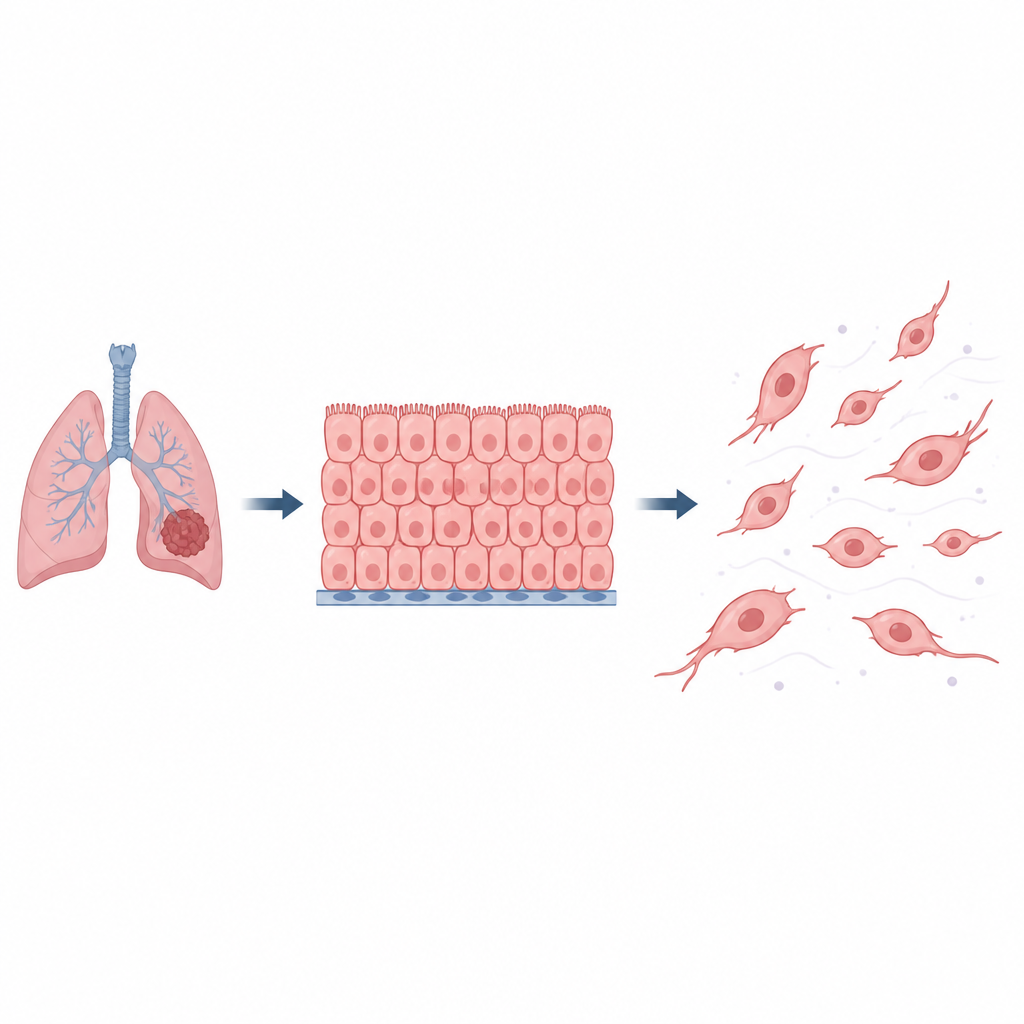
Shifting gears to invasion and drug tolerance
Shape and markers are only part of the story. The scientists also tested what the cells could do. Cells with reduced PP2A-B56α moved more readily through porous membranes and invaded into gel-like material that mimics surrounding tissue, forming ragged, spreading structures rather than compact spheres. Restoring PP2A-B56α dialed this behavior back, making the cells less mobile again. At the same time, broad protein and phosphate-pattern measurements showed that lowering PP2A-B56α rewired hundreds of cellular components, dampening adhesion networks while boosting programs related to cell division, gene control, and well-known cancer drivers such as MYC and the AXL receptor. These shifts also made cells less tied to EGFR activity and less sensitive to an EGFR-blocking drug, hinting that EMT here goes hand-in-hand with reduced drug response. 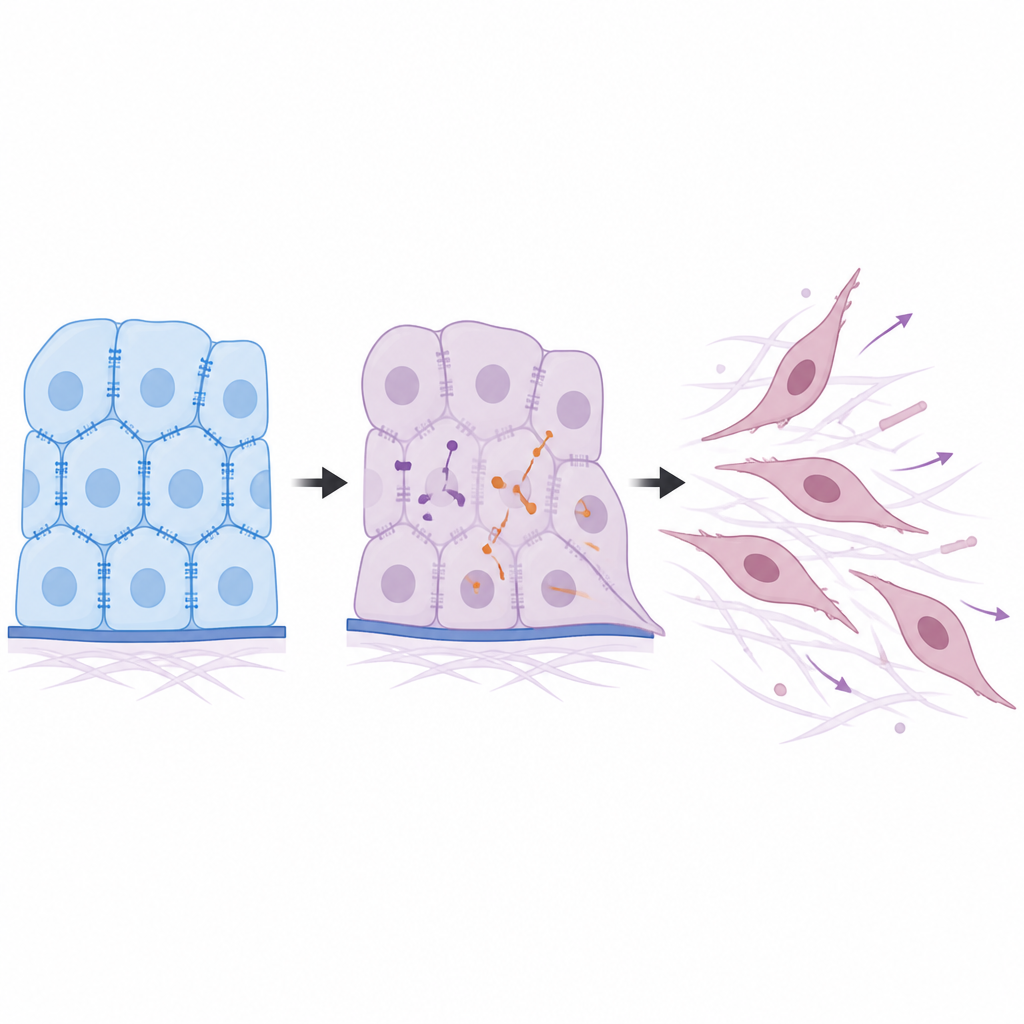
Evidence from living animals
To see whether these lab findings translated into living systems, the team injected lung cancer cells with or without PP2A-B56α into mice via the bloodstream. Cells lacking this brake produced many more tumor colonies in the lungs and frequently caused large growths in the liver, often replacing much of the normal tissue. Under the microscope, these metastatic cells largely lacked the epithelial marker E-cadherin and strongly expressed the mesenchymal marker vimentin, consistent with an EMT-like state. In contrast, control cells formed smaller, more contained clusters that more closely resembled the original epithelial-like tumors.
What this means for patients and future treatments
Together, the results paint PP2A-B56α as a key guardian of cell identity in EGFR-mutant non-small cell lung cancer. When this guardian is suppressed, cells are freer to switch into a more mobile, invasive, and treatment-tolerant mode. While much work remains before this knowledge can guide therapy, the study suggests that restoring or boosting PP2A activity could help lock tumor cells into a less dangerous state and possibly improve the effectiveness of existing targeted drugs.
Citation: Heil, B.N., Baral, G., Pfeffer, C.M. et al. Suppression of PP2A-B56α drives EMT in EGFR mutant non-small cell lung cancer. Oncogene 45, 1861–1873 (2026). https://doi.org/10.1038/s41388-026-03772-2
Keywords: lung cancer, epithelial mesenchymal transition, EGFR, PP2A, metastasis