Clear Sky Science · en
Mechanistic signatures of comorbid PTSD with cognitive impairment implicate cortisol-induced neural toxicity
Why stress and memory in 9/11 responders matter to all of us
Many of the men and women who rushed to help after the 9/11 attacks are now facing memory and thinking problems far earlier than usual. This study asks why long lasting post traumatic stress in these responders seems to speed up cognitive decline, and whether stress hormones like cortisol may be quietly harming the brain over time. Understanding this link could shed light on how severe stress affects brain aging in anyone, not just disaster workers.
Early memory problems in a unique group
The researchers focused on 71 World Trade Center responders in their mid fifties, a group carefully tracked for both post traumatic stress disorder (PTSD) and cognition. Some had PTSD but normal thinking, some had PTSD plus measurable cognitive impairment, and others were trauma exposed yet remained healthy. All had high quality brain scans while resting, allowing scientists to compare how different brain regions communicated with one another in each group.
Reading hidden patterns in brain activity
Using machine learning, the team trained computer models to spot distinct patterns in these communication networks. The models could tell apart responders with PTSD and cognitive impairment from healthy peers with fairly high accuracy, and could also distinguish them from responders who had PTSD alone. The patterns for PTSD without cognitive problems mainly involved emotional control circuits, while those for PTSD with cognitive issues centered on networks used for learning and feedback, hinting that different brain systems are affected as thinking begins to falter. 
Linking brain patterns to stress chemistry
To move beyond simple brain maps, the scientists compared these functional patterns with maps of gene activity across the human brain, drawn from a large postmortem atlas. They focused on genes tied to two leading ideas: one in which stress hormones like cortisol damage nerve cells, and another in which a protein called p53 pushes cells toward programmed death. They found that the brain pattern seen in PTSD with cognitive impairment strongly lined up with genes involved in cortisol signaling, energy use, and a type of brain receptor that can flip from protective to toxic when overstimulated. All PTSD groups, with and without cognitive problems, showed links to genes involved in cell death pathways.
Tracing stress from hormone spikes to neuron loss
With these gene brain connections in hand, the team used structural equation modeling, a statistical method that tests how well different cause and effect chains fit the data. For all PTSD groups, they saw support for a pathway in which oxidative stress and p53 related genes push brain cells toward apoptosis, a controlled form of cell suicide. But only the responders with cognitive impairment showed a tightly fitting pathway where bursts of cortisol altered glutamate signaling in key brain regions, shifting certain receptors toward a more toxic mode and increasing vulnerability to damage. This pattern suggests that repeated extremes of stress chemistry may gradually erode brain circuits important for memory and complex thinking. 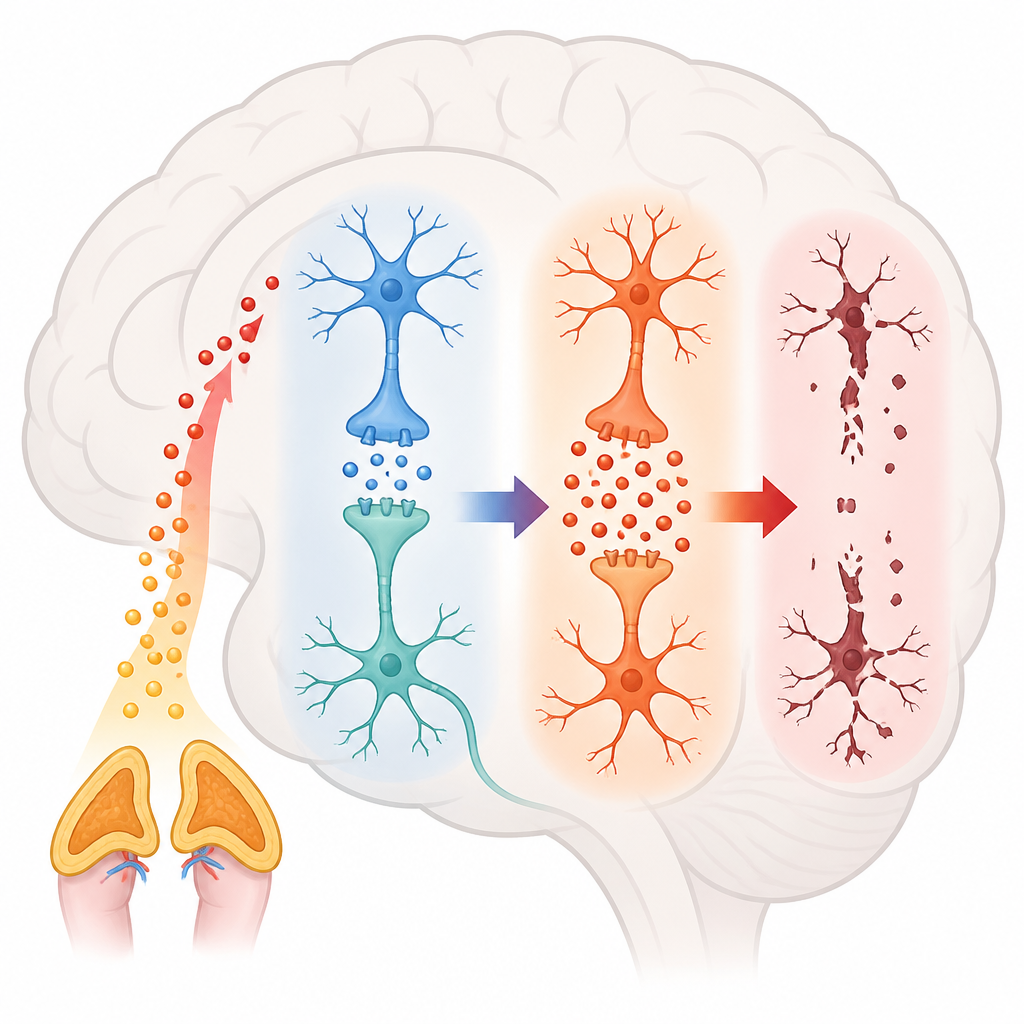
What this means for stress, aging, and brain health
For a general reader, the message is that chronic, dysregulated stress is not just an emotional burden, it may also poison delicate brain networks over years. In these 9/11 responders, PTSD alone was tied to signs of cell stress and death, but when cortisol related toxicity was also present, early cognitive impairment became more likely. While the work has limits, including a modest and mostly male sample, it offers a rare, integrated view that connects life experience, brain activity, and molecular pathways. The findings point toward potential biomarkers for early warning and raise the possibility that better control of stress hormone effects could help protect thinking abilities as we age.
Citation: Kuang, Z., Chesebro, A.G., Strey, SG. et al. Mechanistic signatures of comorbid PTSD with cognitive impairment implicate cortisol-induced neural toxicity. Neuropsychopharmacol. 51, 1325–1334 (2026). https://doi.org/10.1038/s41386-026-02358-6
Keywords: PTSD, cortisol, cognitive impairment, brain networks, stress hormones