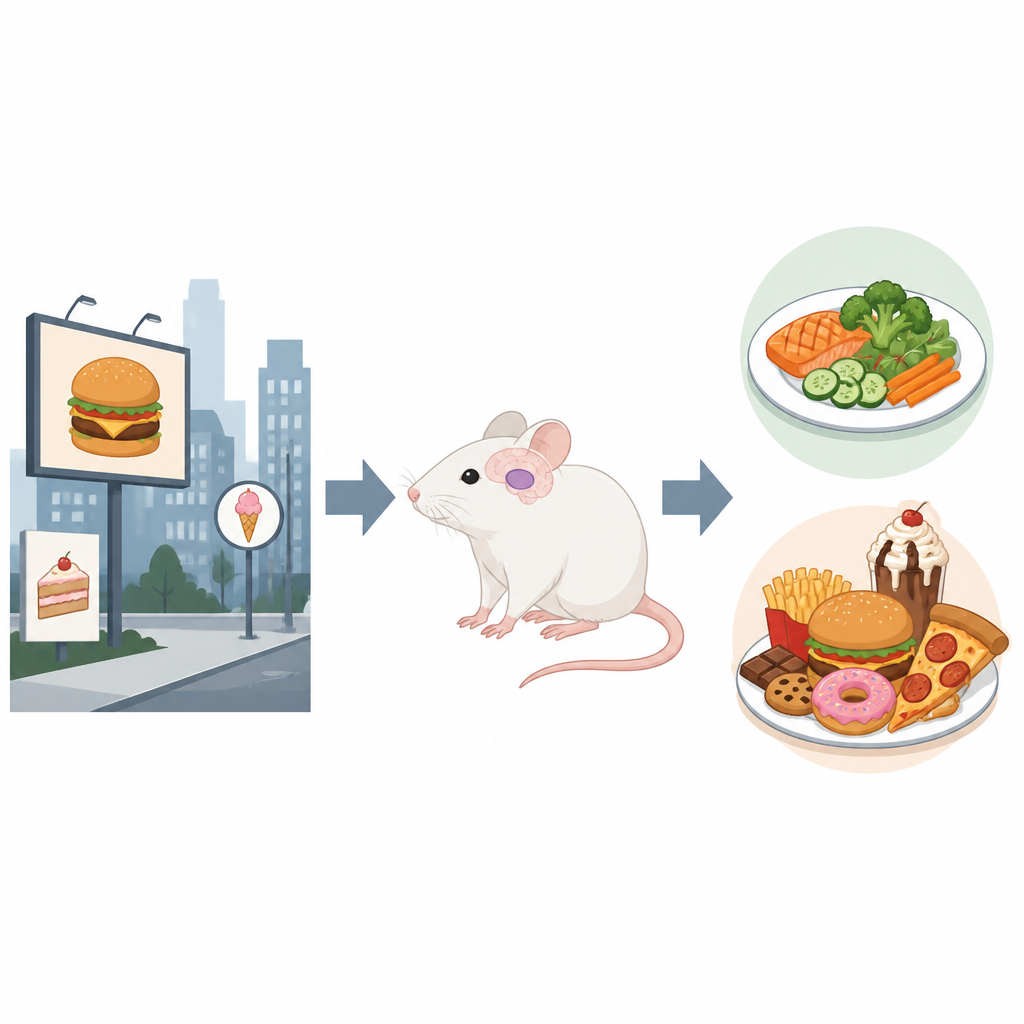
Every day we are surrounded by sights and sounds that promise tasty treats, from glowing fast food signs to snack ads on our phones. Our brains quickly learn to link these cues with rewarding foods, which helps wild animals survive but can push modern humans toward overeating and weight gain. This study asks how two specific brain systems, one that uses the chemical dopamine and another built around melanin-concentrating hormone cells, work together when animals learn that a cue predicts food and when they actually eat.
Two brain messengers that shape eating
Scientists already knew that dopamine release in a region called the nucleus accumbens helps signal rewards and motivates animals to seek them. They also knew that melanin-concentrating hormone, or MCH, neurons in the hypothalamus can drive eating for pleasure and send signals into the same reward circuits. What was missing was a clear picture of how these two systems interact moment by moment in a living brain while an animal learns that a sound predicts food and while it consumes that food.
Watching brain activity during meals Figure 1. How food cues and brain reward circuits turn everyday signals into powerful drives to eat.
The researchers used fiber photometry, a light-based method that tracks fluorescent sensors, to record activity from MCH neurons and dopamine signals in mice. They monitored the animals as they ate regular chow freely and as they received food pellets during a simple training task in which a tone was followed by a food reward. During eating, both systems lit up, but dopamine in the nucleus accumbens tended to rise just before food was consumed, while MCH neuron activity followed. When a non-food object was dropped into the cage, the responses were much weaker, showing that these signals were tied to real rewards rather than general noise or movement.
How the brain learns that a sound means food
During Pavlovian conditioning, mice heard a tone that reliably predicted a pellet of food. Early in training, dopamine signals barely changed at the cue but rose strongly around the time of eating. With repeated pairings, dopamine responses shifted toward the cue and the response to the pellet itself faded, matching classic ideas of reward prediction error. In contrast, MCH neurons showed a small but clear response to the cue very early in training that stayed about the same over days, along with a larger response when the mouse approached and consumed the pellet. This suggests that MCH neurons signal both the upcoming reward and the act of eating, but in a more stable way than dopamine.
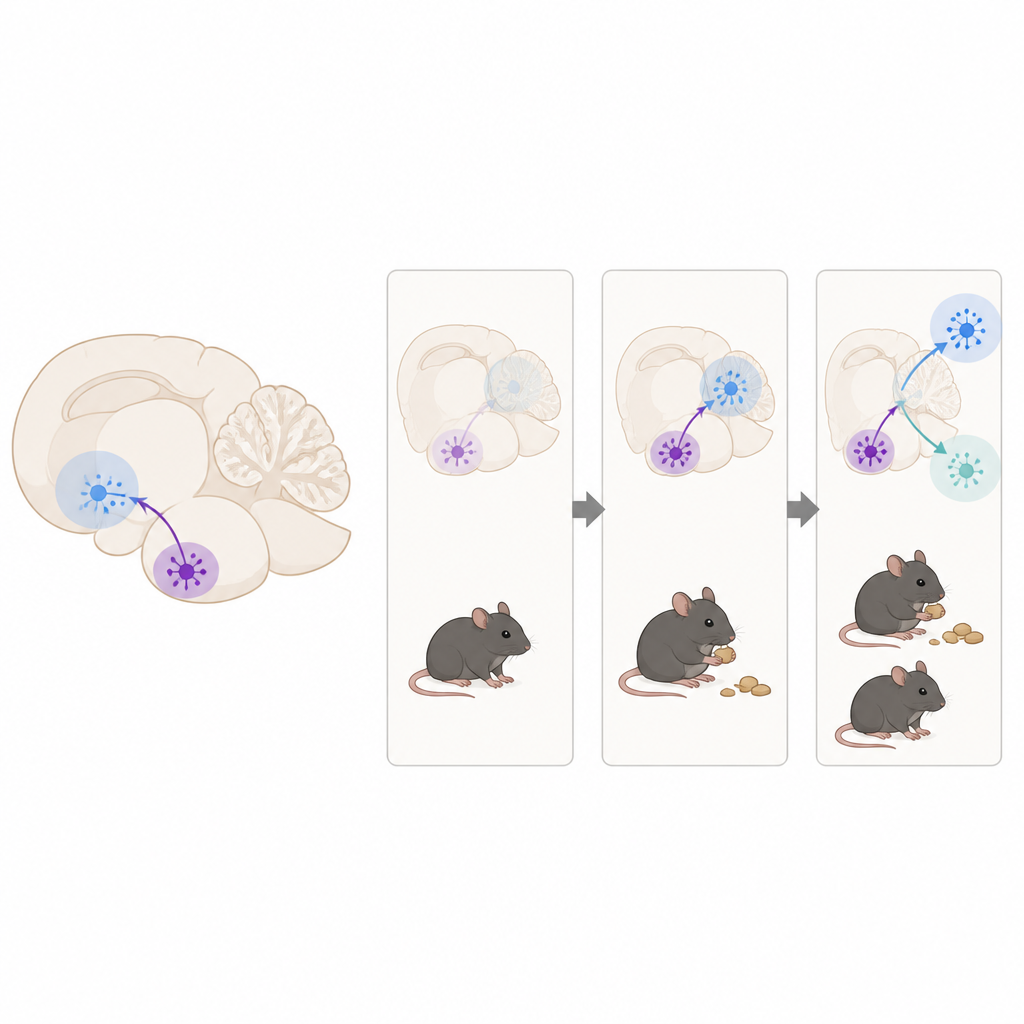
Pushing and pulling on the MCH system Figure 2. How one set of neurons can boost or damp dopamine signals in a key reward hub during food learning.
To move beyond observation, the team next tinkered with the MCH system. Blocking the main MCH receptor or removing glutamate release from MCH neurons did not stop dopamine signals from learning to respond to the cue, although animals appeared somewhat less engaged. However, temporarily silencing MCH neurons or blocking MCH receptors boosted dopamine release, especially during food consumption, while briefly activating MCH nerve endings in the accumbens increased dopamine in a more rapid, phasic way. Together these tests show that MCH pathways can tune dopamine release up or down in this key reward area.
What this means for food choices
For a lay reader, the take-home message is that two interacting brain systems help connect food-related cues with the pleasure of eating and can subtly steer how strongly we respond to tempting foods. The MCH system seems to act like a steady background influence that quickly learns about new food signals and then shapes dopamine release, rather than replacing dopamine’s role in learning. In natural settings this partnership likely supports efficient food seeking and consumption, but in a world full of energy-dense snacks and constant advertising, the same wiring may contribute to overeating and related health problems.
Citation: Potter, L.E., Toth, B.A., Manna, J. et al. Modulation of accumbens dopamine by MCH neurons during learning and consummatory behavior.
Neuropsychopharmacol.51, 1217–1225 (2026). https://doi.org/10.1038/s41386-026-02351-z