Clear Sky Science · en
Combining neurobiological markers and a sociodemographic risk score to predict adolescent depression – An IDEA RiSCo prospective cohort study
Why spotting teen depression risk matters
Many families and teachers worry about which teenagers might go on to develop depression, a condition that can derail school, friendships, and future plans. Yet, most young people who feel low for a while will not develop a full depressive disorder, while some at highest risk show no obvious warning signs. This study asked whether combining simple background information about a teen’s life with subtle signals from the body and brain could sharpen our ability to spot who is most likely to become depressed, opening the door for earlier, more targeted support.
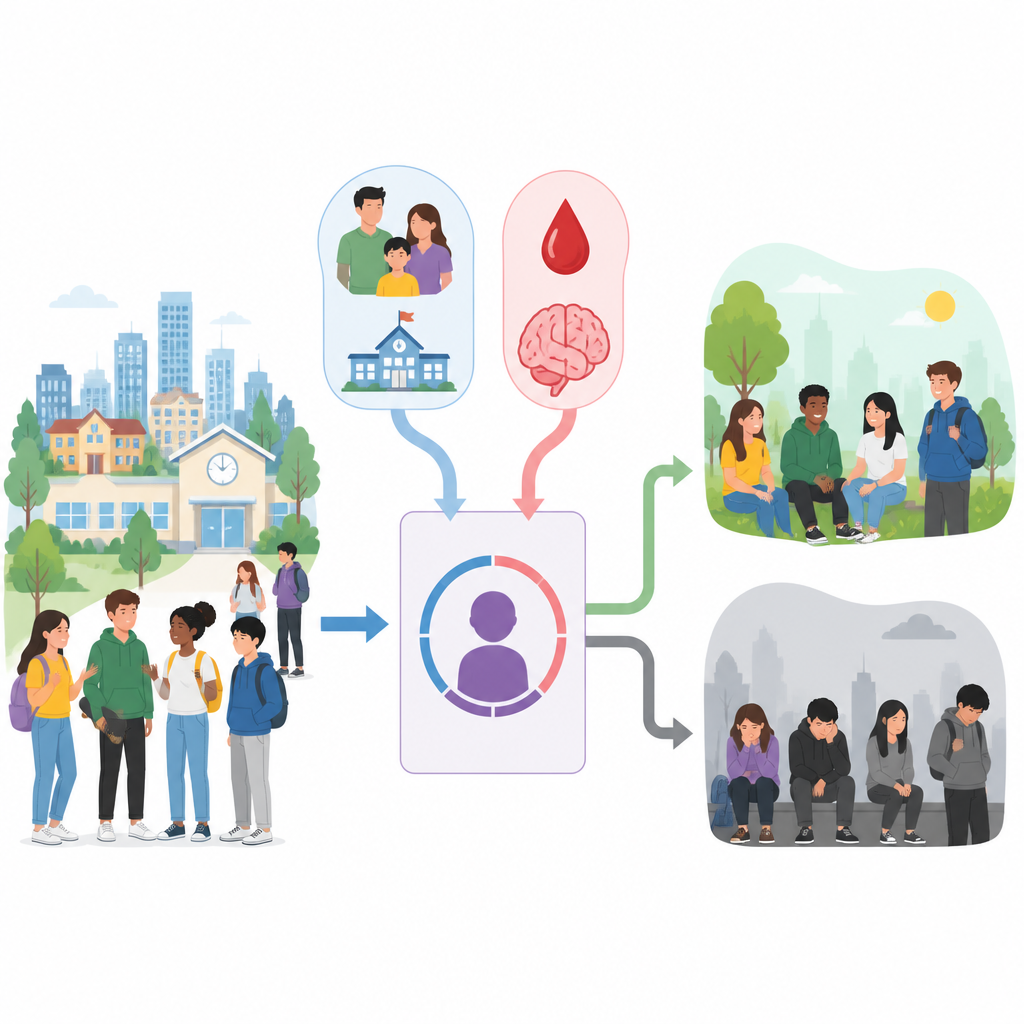
Looking at life circumstances
The research builds on an existing tool called the IDEA risk score, which uses basic sociodemographic details such as family conditions and life stressors to estimate a teenager’s chance of developing depression. This score had already worked reasonably well in different countries, correctly identifying many adolescents who later became depressed. In the present study, the team screened more than 7000 students aged 14 to 16 in public schools in Porto Alegre, Brazil, and selected 100 young people from the lowest and highest ends of this sociodemographic risk scale, all of whom had very low levels of current depressive symptoms at the start.
Adding signals from blood and brain
To see whether biology could add extra insight, the researchers collected blood samples and brain scans from the participating teens at the beginning of the study. In the blood, they measured several immune molecules known as cytokines, which reflect how active the body’s inflammation system is, and examined chemicals from the kynurenine pathway, which can tilt the brain’s chemistry toward being more protective or more damaging. In the scanner, they looked at how strongly the amygdala, a brain region involved in processing emotions, reacted when the teenagers viewed fearful, sad, or angry faces. These different measurements captured how the body and brain were responding to potential stress long before any new depressive episode appeared.
Following teens over three years
The adolescents were then followed for three years, with child psychiatrists assessing whether they had developed depression at any point using a structured diagnostic interview. Nineteen of the 88 teens who completed the final follow-up developed depression. Statistical models showed that when the biological markers were added to the sociodemographic score, the ability to correctly distinguish who would and would not become depressed improved markedly. While the original sociodemographic tool reached only moderate accuracy, the combined approach reached a substantially higher level, correctly classifying more than four out of five participants.
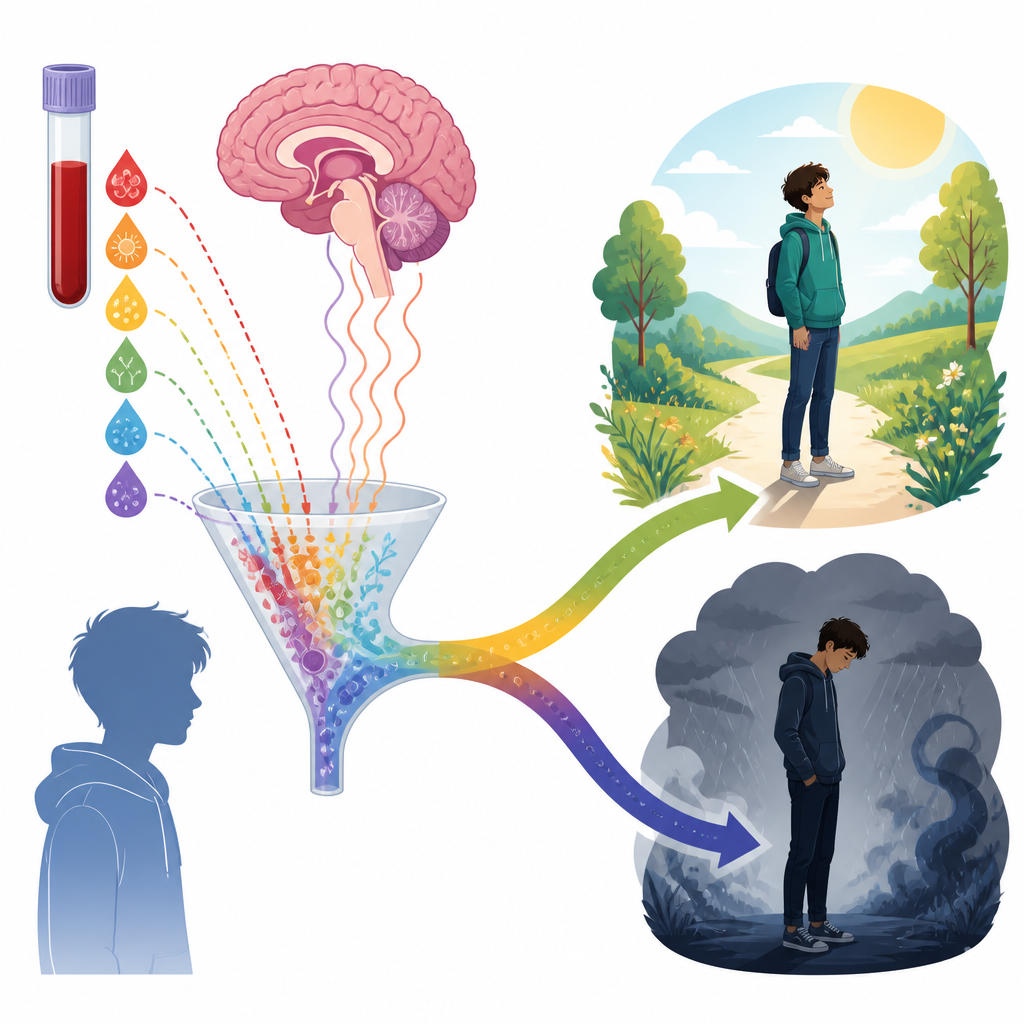
Building a simple biology-based score
To make the findings easier to use in practice, the team created a new biological risk score, called IDEA-BIO-RS. For each teen, they counted how many of the eight biological measures fell on the higher-risk side, taking into account that some markers, like a healthier balance of kynurenine pathway chemicals, are thought to be protective. This produced a score from zero to eight. Young people scoring below the midpoint were considered biologically low risk, and those at or above were considered biologically high risk. Among teens in the biological high-risk group, more than a third developed depression over three years, while almost none in the biological low-risk group did.
Putting life circumstances and biology together
When the researchers combined the original sociodemographic score with the new biological score, the picture became even clearer. They divided teens into four groups: low on both scores, high on sociodemographic risk only, high on biological risk only, and high on both. None of the teenagers who were low on both developed depression. In contrast, almost half of those who scored high on both types of risk did. Those who were high on only one of the two scores had intermediate chances of becoming depressed. This pattern suggests that stressful environments and vulnerable biology may interact, and that considering both gives a more complete view of risk than either alone.
What this means for teens and families
For a general reader, the key message is that subtle changes in the immune system, brain responses to emotional cues, and life circumstances can be combined into a practical set of numbers that better flag which adolescents are most likely to develop depression in the near future. While this approach is not yet ready for routine use in schools or clinics, it shows that a stepwise system, starting with simple questions about a teen’s background and adding more detailed biological tests for those at higher risk, could one day help direct counseling and preventive care to the young people who need it most, before depression fully takes hold.
Citation: Zajkowska, Z., Nikkheslat, N., Manfro, P.H. et al. Combining neurobiological markers and a sociodemographic risk score to predict adolescent depression – An IDEA RiSCo prospective cohort study. Mol Psychiatry 31, 3516–3523 (2026). https://doi.org/10.1038/s41380-026-03481-y
Keywords: adolescent depression, risk prediction, biomarkers, sociodemographic factors, early detection