Clear Sky Science · en
UBE3A isoform-selective and non-selective contributions to Angelman syndrome phenotypes
Why this matters for families and clinicians
Angelman syndrome is a rare genetic condition that causes developmental delay, movement problems, and often hard-to-control seizures. All of this traces back to the loss of a single brain protein called UBE3A. This study asks a practical question with big implications for future gene therapies: do we need to restore one exact version of UBE3A, or is it enough to bring total protein levels back up? The answer could change how new treatments are designed and how well they work on different symptoms.
Two faces of a missing brain protein
Human brain cells make three slightly different forms of the UBE3A protein, which sit in different parts of the cell. One major form lives mainly in the cell’s control center, the nucleus, while another lives mostly in the surrounding fluid, or cytoplasm. In people and in mice, losing the nuclear-enriched form is known to cause Angelman-like features. Until now, the cytoplasmic form seemed less important, because removing only that version had not been linked to clear problems in animal models.
Building a mouse that boosts the cytoplasmic form
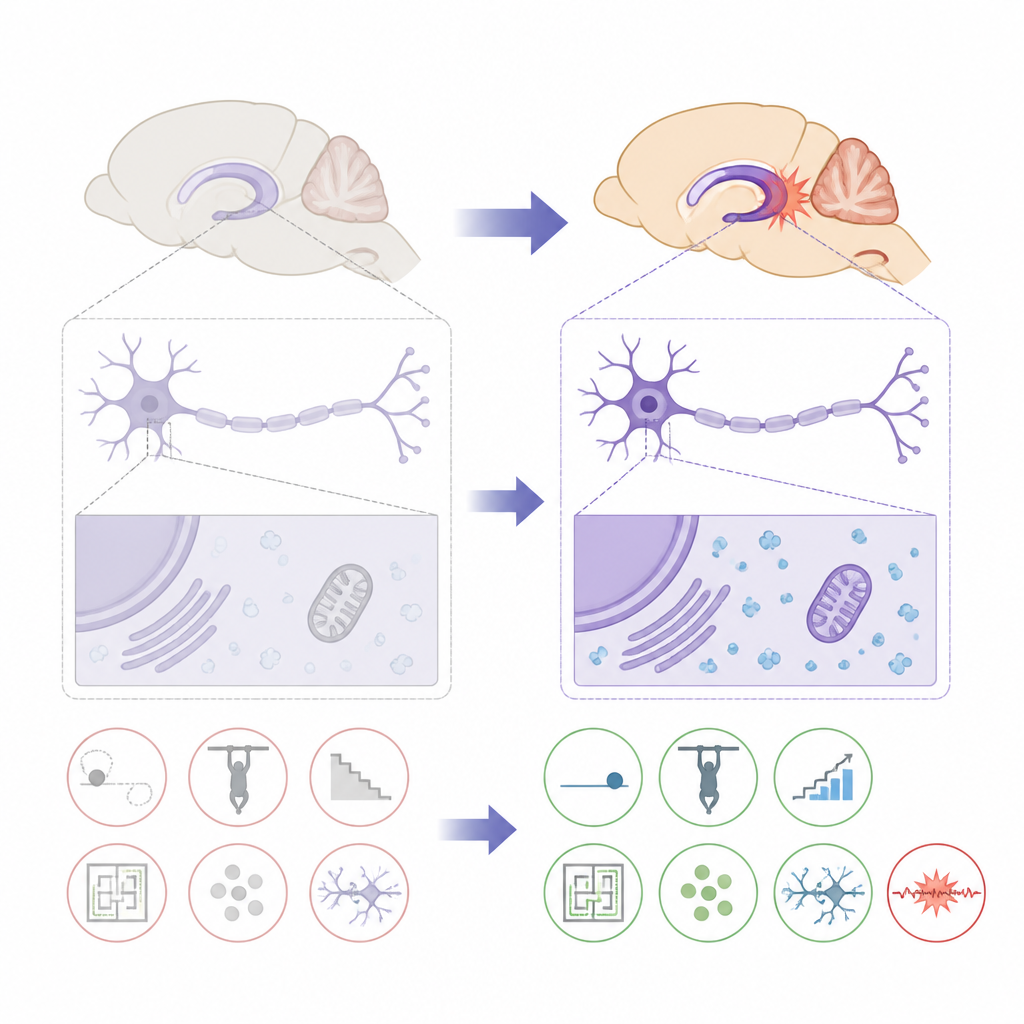
To test how much each form matters, the researchers engineered a new mouse line that produces extra cytoplasmic UBE3A, without increasing the nuclear version. They then crossed these mice with an Angelman model that lacks maternal UBE3A in brain cells. This breeding produced four groups: normal mice, mice with extra cytoplasmic UBE3A, Angelman-like mice, and Angelman-like mice that had only the boosted cytoplasmic version but no nuclear version in neurons. Careful molecular tests confirmed that the added protein was indeed the cytoplasmic form and that it stayed mostly outside the nucleus in many brain regions.
Behavioral rescue without touching the nucleus
The teams in North Carolina and Rotterdam then ran a broad panel of behavior tests that reflect common Angelman features in mice. Angelman-like animals showed the expected problems: poor performance on a motor task that requires walking backward on a rotating rod, reduced movement in an open arena, less digging, and weaker nest building. Remarkably, mice that had only the overexpressed cytoplasmic UBE3A looked normal on all of these measures. Their body weight, another known Angelman readout in male mice, was also corrected. When all behavioral data were combined and analyzed together, the Angelman group stood apart, while the other three groups—including the cytoplasmic-only mice—clustered together. This suggests that many Angelman-like behaviors arise mainly because total UBE3A levels are too low, rather than because the nuclear form has unique roles in those traits.
Seizures reveal a special role for the nuclear form
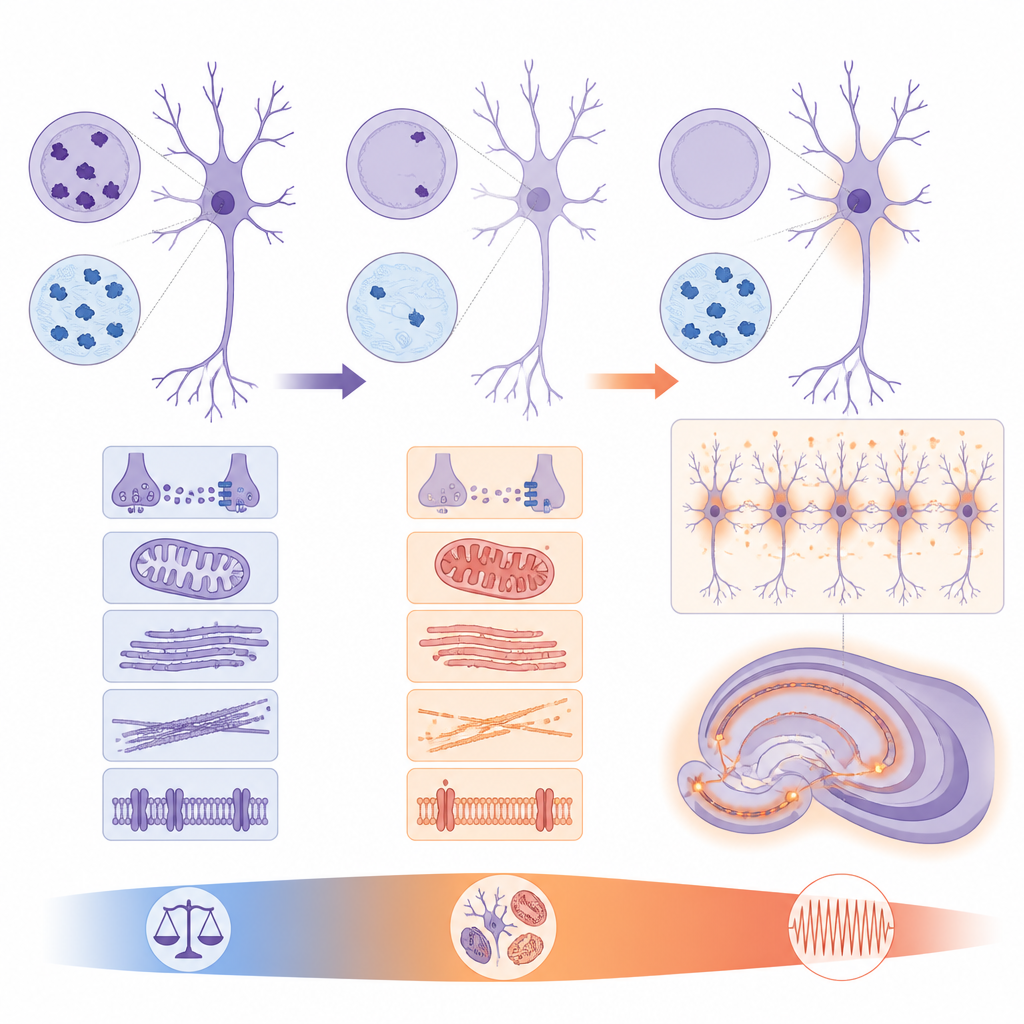
Seizures told a different story. Using a flurothyl kindling protocol, which repeatedly triggers controlled seizures and then tests for lasting brain changes, the researchers examined how each UBE3A form affects epileptogenesis, the process by which the brain becomes more prone to seizures over time. Mice lacking the nuclear-enriched form showed stronger seizure progression and a build-up of dense protective coats, called perineuronal nets, around cells in a key hippocampal region. Removing only the cytoplasmic form did not have this effect. Importantly, Angelman-like mice with boosted cytoplasmic UBE3A still developed heightened seizure sensitivity and the same abnormal tissue changes. Extra cytoplasmic protein, by itself, was not enough to prevent seizure-related brain remodeling.
Balancing benefits and risks of adding UBE3A
The study also uncovered a cautionary note for therapies that increase UBE3A. Mice that overproduced the cytoplasmic form on an otherwise normal background were more likely to die during chemically induced seizures, echoing earlier work in mice that overexpress both forms together. This suggests that too much cytoplasmic UBE3A can make severe seizures more dangerous, even if everyday behavior appears normal. For treatment designers, it means that how much of each form is restored, and where in the cell it ends up, could matter for safety.
What this means for future treatments
In plain terms, this work shows that raising overall UBE3A levels can fix many Angelman-like behaviors even when the nuclear version is absent, but that the nuclear form remains crucial for controlling seizure susceptibility. Gene therapies that restore both forms in a natural balance may therefore be best placed to help with the full range of symptoms, especially epilepsies. At the same time, the harmful effects of excessive cytoplasmic UBE3A underscore the need for careful dosing. Together, these findings give researchers a clearer roadmap for designing safer and more effective UBE3A-based therapies for Angelman syndrome and related conditions.
Citation: Krzeski, J.C., Mientjes, E.J., Judson, M.C. et al. UBE3A isoform-selective and non-selective contributions to Angelman syndrome phenotypes. Mol Psychiatry 31, 3284–3294 (2026). https://doi.org/10.1038/s41380-026-03468-9
Keywords: Angelman syndrome, UBE3A, neurodevelopmental disorder, epileptogenesis, gene therapy