Clear Sky Science · en
Early-life stress impairs development of functional interactions and neuronal activity within prefrontal-amygdala networks in vivo
Why early stress in childhood matters
Stressful experiences in early childhood, such as neglect or unpredictable care, can leave lasting marks on the brain. This study uses mice to look inside two key brain regions that help control emotions, asking how early-life stress changes their communication long before any mental illness appears. Understanding these hidden shifts may explain why some people become more vulnerable to anxiety or depression after difficult childhoods.
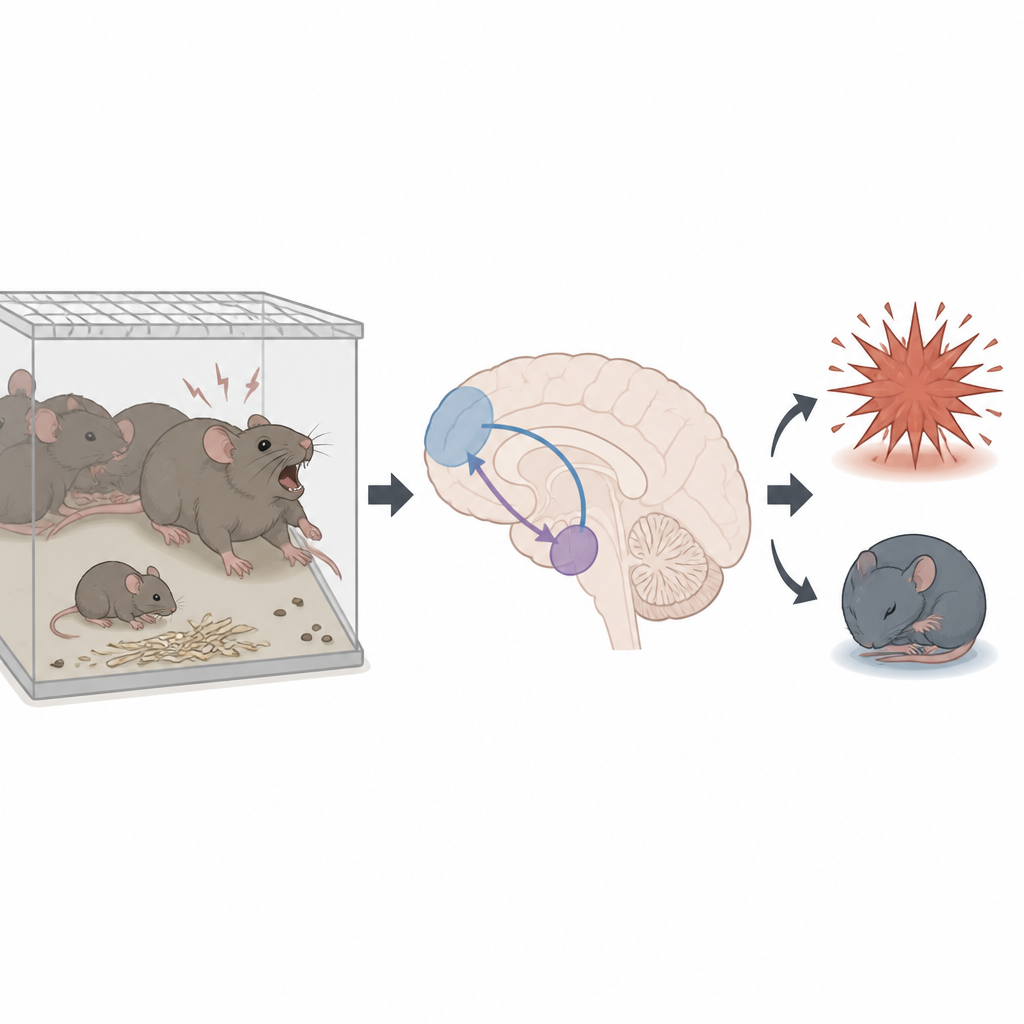
Two brain hubs that shape feelings
The researchers focused on the prefrontal cortex, a front-of-the-brain area important for decision-making and emotional control, and the amygdala, a deeper structure that detects threats and generates fear. In healthy development, these two hubs gradually learn to talk to each other in a flexible way: the amygdala flags what is important, while the prefrontal cortex can either amplify or calm those signals. The team wanted to know how this partnership is altered when young animals grow up under chronic, mild stress that mimics scarce resources and unsettled caregiving.
How the scientists modeled early hardship
To recreate early-life stress, mouse mothers and their litters were given limited bedding and nesting material, and pups were briefly separated from their mothers on several days. This combination makes maternal care more erratic without causing physical injury. When the pups were around toddler age and again in adolescence, the scientists recorded electrical activity directly from the prefrontal cortex and the amygdala. They listened to slow brain rhythms, fast spikes from individual neurons, and the timing of signals traveling between the two regions.
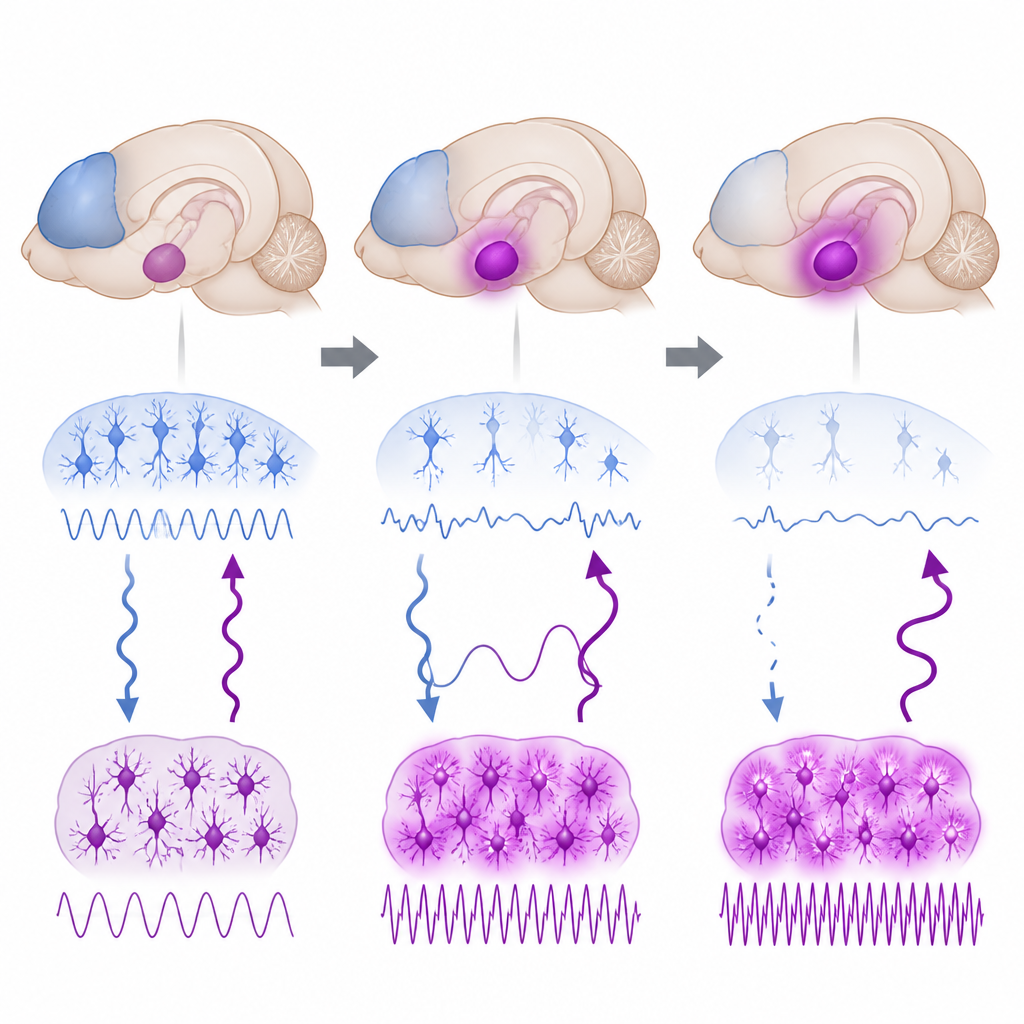
Overactive alarm center, underactive control center
The overall background rhythms in each area looked surprisingly normal, but the fine-scale communication between them was not. In young male mice that had experienced early stress, the prefrontal cortex and amygdala became too tightly locked together at a slow rhythm called low-theta, a kind of overcoupling of their activity. At the same time, neurons in the amygdala fired more often, and a marker of long-lasting activation showed that a subset of mainly non-inhibitory amygdala cells stayed chronically active. In contrast, many prefrontal neurons, especially in layers that send signals to the amygdala, fired less and became less precisely synchronized with local rhythms.
Timing problems and sex differences
The study also revealed that the direction and timing of signals were disturbed. Normally, the amygdala can nudge the prefrontal cortex to fire at certain phases of the ongoing rhythm, and the prefrontal cortex can, in turn, guide amygdala firing to signal safety or danger. After early stress, especially in males, prefrontal spikes were harder to entrain and their preferred timing within the cycle shifted. Amygdala spikes that once lined up neatly with prefrontal rhythms now occurred at almost opposite phases. Females showed similar changes but generally milder, suggesting that developing male circuits may be more vulnerable to this kind of early challenge.
From altered wiring to later emotional risks
Taken together, the findings paint a picture in which early-life stress pushes the emotional brain onto a different developmental path. The amygdala becomes more reactive and persistently active, while the prefrontal cortex grows quieter and less able to coordinate the conversation. This imbalance appears during a narrow window in juvenile life, potentially setting the stage for later problems with fear, anxiety, or mood. By pinpointing when and how the circuit goes off course, this work suggests that early interventions aimed at restoring healthy prefrontal–amygdala communication might reduce the long-term emotional impact of childhood adversity.
Citation: Donati, A., Vedele, F. & Hartung, H. Early-life stress impairs development of functional interactions and neuronal activity within prefrontal-amygdala networks in vivo. Mol Psychiatry 31, 3308–3328 (2026). https://doi.org/10.1038/s41380-026-03448-z
Keywords: early-life stress, amygdala, prefrontal cortex, brain development, anxiety risk