Clear Sky Science · en
Three-phase ScAlN-based PMUT-driven acoustic streaming micropump
Moving tiny amounts of liquid on a chip
Many lab tests are being shrunk onto credit card sized chips, but quietly pushing tiny amounts of liquid through these devices is still a challenge. This study presents a new kind of microscopic pump that uses gentle sound vibrations instead of bulky moving parts to drive slow, well controlled flows of liquid, which is important for handling precious samples such as cells, sweat, or DNA solutions.
Using sound instead of moving pistons
Conventional micro pumps often copy their larger cousins, relying on flexible plates and valves that open and close to push liquid along. These parts take up space, can wear out, and may be hard to combine with standard chip making methods. The researchers turn to sound waves in liquid as an alternative. When high frequency sound ripples pass through a channel, they can nudge suspended particles and even drag the liquid itself, creating a steady flow without any mechanical valves or plungers.
Tiny membranes that vibrate in a pattern
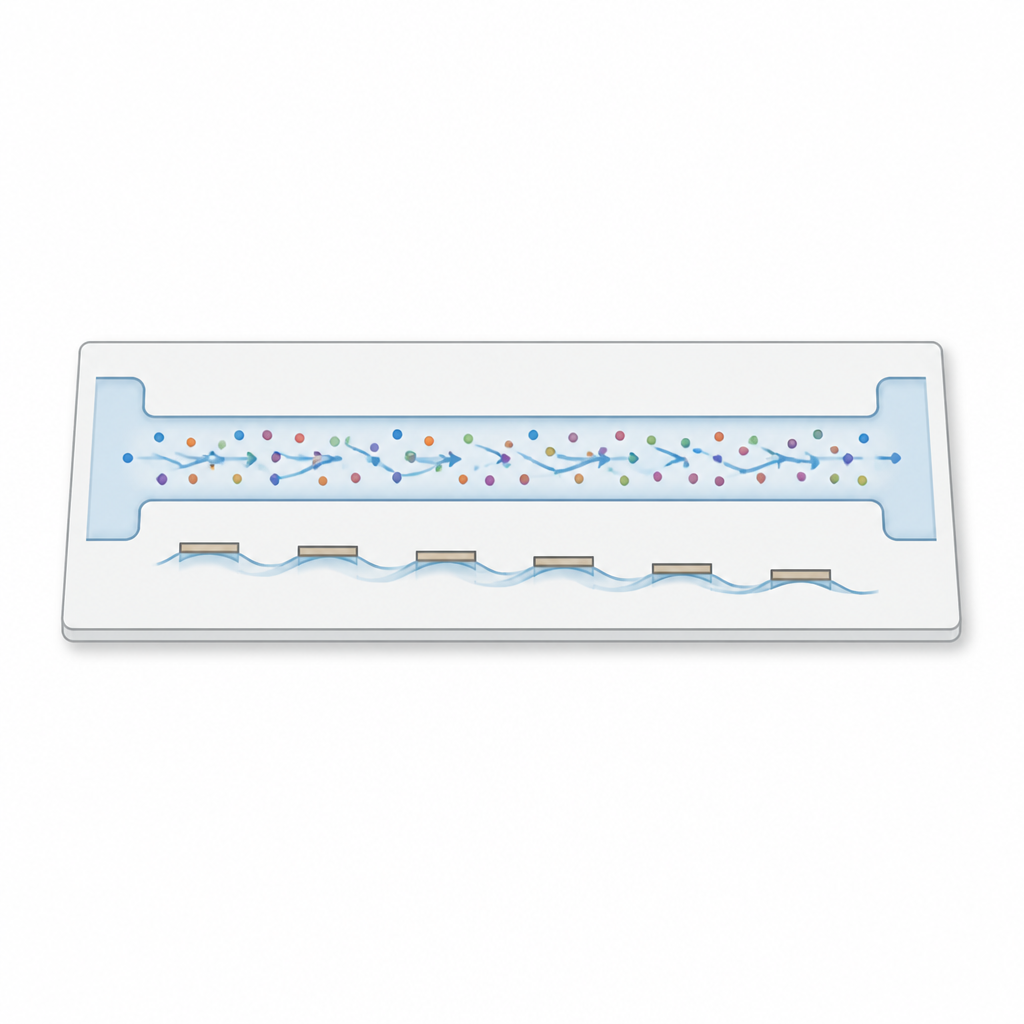
The device at the heart of this work is a row of microscopic drum like membranes called ultrasonic transducers built from a material compatible with standard electronics factories. Each membrane contains a thin layer that changes shape when an alternating voltage is applied, making the membrane vibrate. The team embedded a line of nine such elements inside a soft plastic channel that carries water. Instead of driving all membranes in step, they excite neighboring ones with electrical signals shifted in time by one third of a cycle, so the vibrations appear to travel along the row like a stadium wave.
Turning swirling motion into net flow
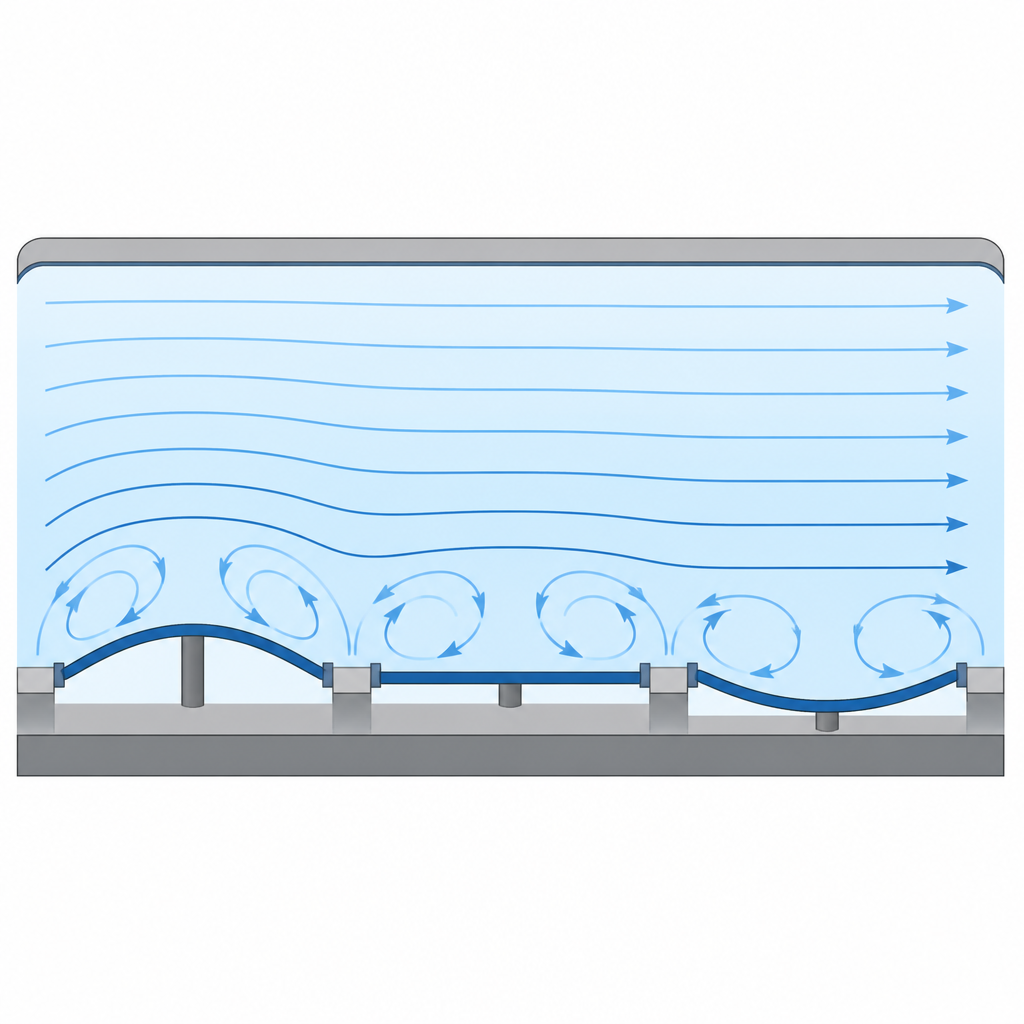
On their own, the vibrations from a single membrane mostly create local whirlpools in the nearby liquid but no overall motion. The clever timing pattern across the array breaks the symmetry of these tiny swirls. Computer simulations and experiments show that near each membrane, small vortices still form, yet when viewed across the whole channel they combine into a slow but steady drift of liquid along the channel length. By tracking fluorescent beads in the water at different heights, the researchers confirmed a forward flow in the middle of the channel and reverse motion close to the vibrating surfaces, matching the simulated streaming patterns.
How strong is the pump and how to improve it
The prototype pump occupies an active area only a little larger than a grain of sand yet can deliver about a tenth of a nanoliter per second at modest driving voltages, in close agreement with numerical predictions. Using the same models, the team explored how design choices affect performance. They found that placing the membranes closer together and adjusting the timing between them could increase flow by up to six times. Changes to the thickness and composition of the vibrating layer are also expected to boost motion, since these tweaks make each membrane flex more for the same input signal.
Why this matters for future lab on a chip systems
The new pump does not match the highest flow rates of larger or more complex devices, but it shines where space is tight and only gentle fluid motion is required, such as in sweat sensors or delicate cell cultures. Because the vibrating membranes are built from a material that can be processed alongside regular microelectronics, the concept opens a path toward chips that both control and analyze tiny liquid samples on the same piece of silicon. In simple terms, the study shows that carefully timed sound driven ripples can act as a compact, controllable on chip pump for very small volumes of fluid.
Citation: Wu, C., Keulemans, G., Jones, B. et al. Three-phase ScAlN-based PMUT-driven acoustic streaming micropump. Microsyst Nanoeng 12, 205 (2026). https://doi.org/10.1038/s41378-026-01339-5
Keywords: acoustic micropump, microfluidics, ultrasonic transducer, lab-on-a-chip, acoustic streaming