Clear Sky Science · en
High-uniformity miniaturized PMUT array with broadband and high-sensitivity for wearable ultrasound imaging
Seeing Inside the Body with a Gentle Patch
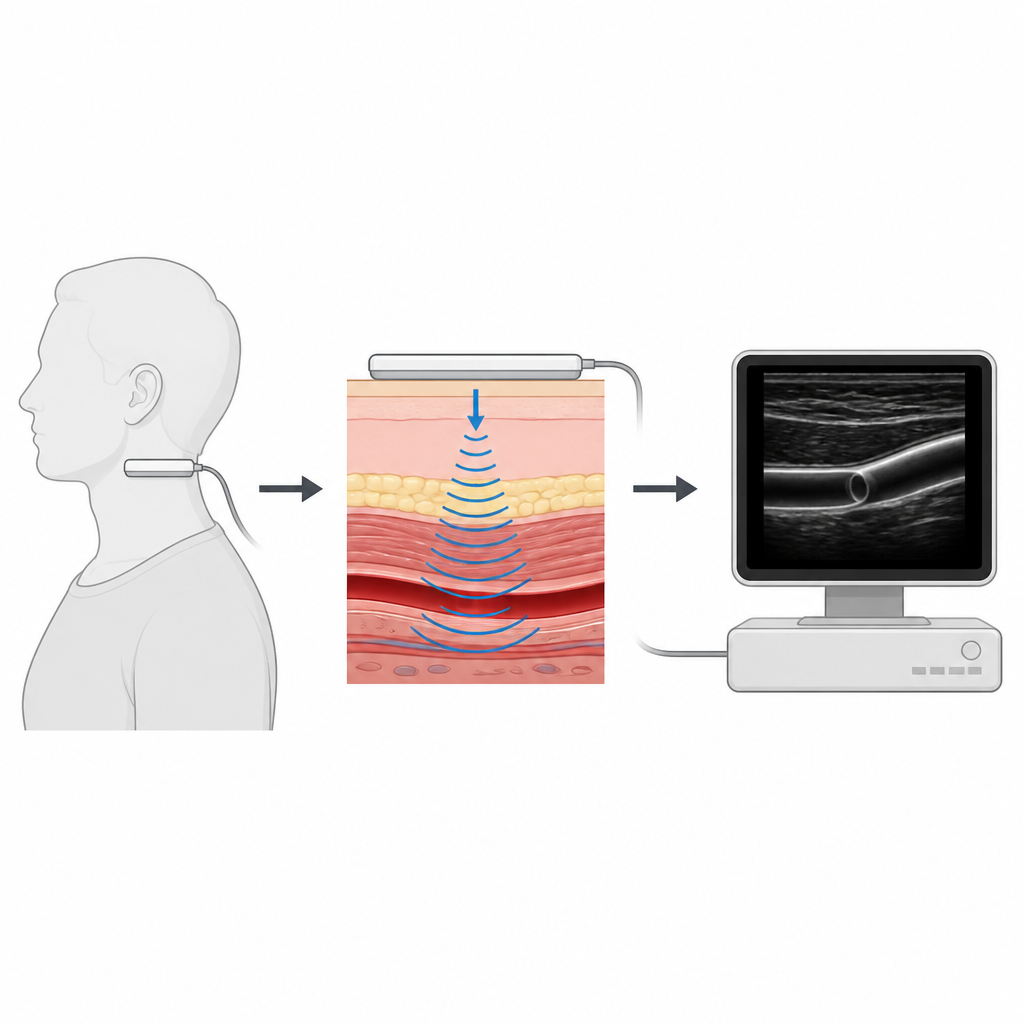
Ultrasound scans are usually done with bulky hand-held probes pressed firmly against the skin. Imagine instead a thin, comfortable patch that quietly watches your arteries and organs all day, without getting in the way. This study describes just such a device: a miniaturized ultrasound patch that can clearly image shallow blood vessels and glands while staying small, cool, and energy efficient enough for long-term wear.
A New Kind of Tiny Ultrasound Cell
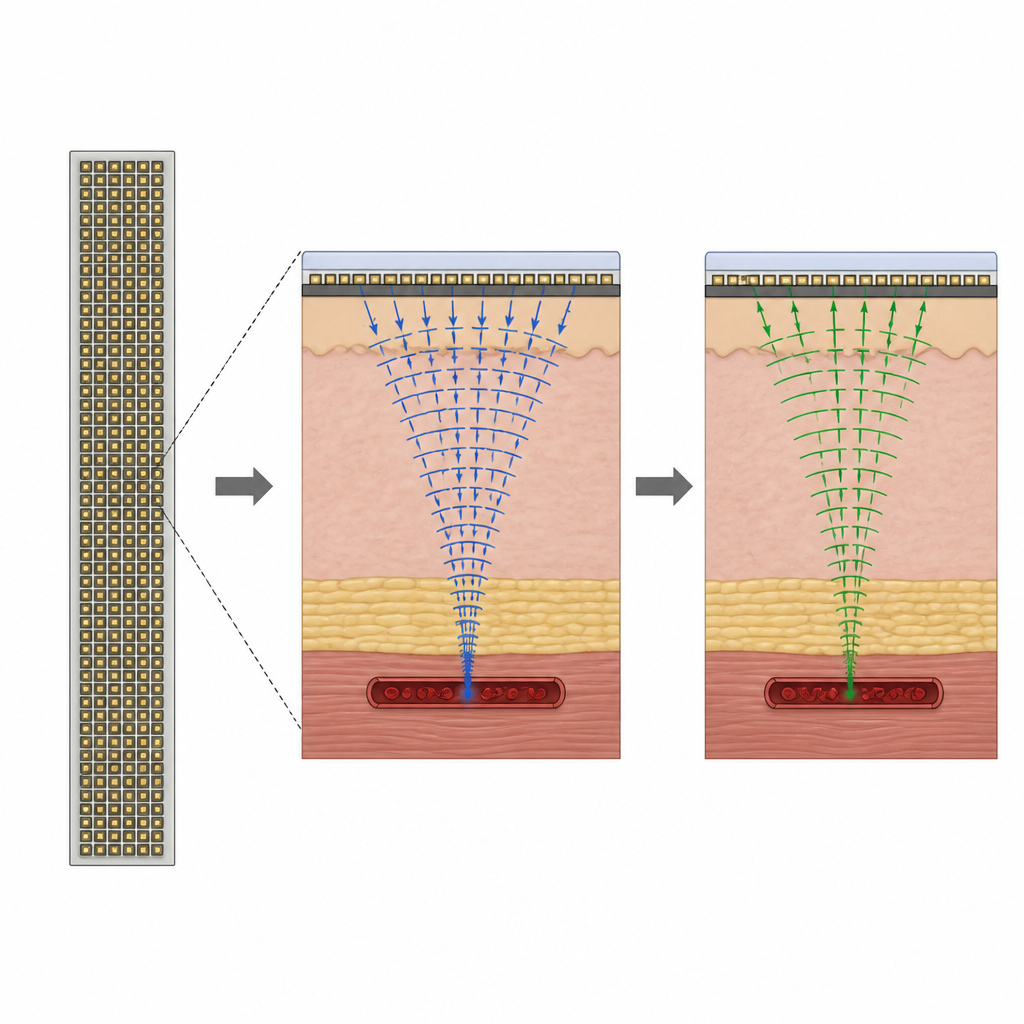
At the heart of the patch are thousands of microscopic “drums” that turn electricity into sound and back again. These drums, called PMUT cells, are built from ultra-thin layers of metal, glass-like material, and a special crystal that responds when voltage is applied. When many of these cells vibrate together, they send and receive ultrasound waves, much like a regular hospital probe, but in a far smaller and lighter format that fits a wearable strip rather than a heavy handheld device.
Solving the Problem of Uneven Sound
For a clear picture, every tiny drum in the array must behave nearly the same. If some vibrate more strongly or out of step with their neighbors, the sound beam becomes fuzzy, and the image loses sharpness and contrast. The team developed a fast mathematical model that predicts how each cell moves and how neighboring cells interact through water or tissue. They discovered that packing the cells closer together greatly improves how evenly they vibrate, even though each individual cell moves a little less. Dense packing boosts the total active area and takes advantage of the way sound from each cell gently “pulls” its neighbors into sync.
More Sound and Broader Tones in a Smaller Space
Using their model, the researchers explored how spacing, layout, and the overall shape of the array affect sound strength and the range of tones it can send and receive. High-quality medical images need both strong echoes for depth and a wide spread of frequencies for fine detail. Their calculations and lab tests showed that smaller gaps between cells increase overall sound output and widen the usable frequency band. With these insights, they designed a long, extremely narrow strip only 1 centimeter by 0.15 centimeter, tuned to about 7 megahertz, a range well suited for imaging structures within a few centimeters of the skin with crisp detail.
A Comfortable Patch that Sees Vessels and Glands
The final device is a 64-channel linear array, where each channel contains many cells working in parallel. It is sealed in soft silicone and mounted so it can rest gently on curved areas of the body such as the neck or the top of the foot. Despite its tiny size and reduced power use, the patch produces images with lateral and depth resolutions around a quarter of a millimeter, enough to distinguish fine structures in shallow tissues. In volunteer tests, it clearly showed major neck arteries, the thyroid gland, and the small artery on the top of the foot. By tracking how the neck artery gently expands and relaxes with each heartbeat, the system could reconstruct a realistic central blood pressure waveform from video frames over time.
What This Means for Everyday Health Checks
In simple terms, the authors have shown how to shrink a sophisticated ultrasound probe into a slim, wearable strip without giving up image quality for shallow targets. By carefully arranging and modeling thousands of tiny sound-making cells, they achieved a device that is uniform, efficient, and comfortable enough for long wear. This approach brings the idea of continuous, high-detail monitoring of key blood vessels and organs closer to reality, opening the door to patches that quietly watch for early signs of heart and vascular disease during normal daily life.
Citation: Xu, X., Yang, W., Wang, Z. et al. High-uniformity miniaturized PMUT array with broadband and high-sensitivity for wearable ultrasound imaging. Microsyst Nanoeng 12, 200 (2026). https://doi.org/10.1038/s41378-026-01331-z
Keywords: wearable ultrasound, PMUT array, medical imaging, artery monitoring, ultrasound patch