Clear Sky Science · en
Real-time facial micromotion tracking enabled by an ultrathin silk fibroin patch
Why tiny face movements matter at night
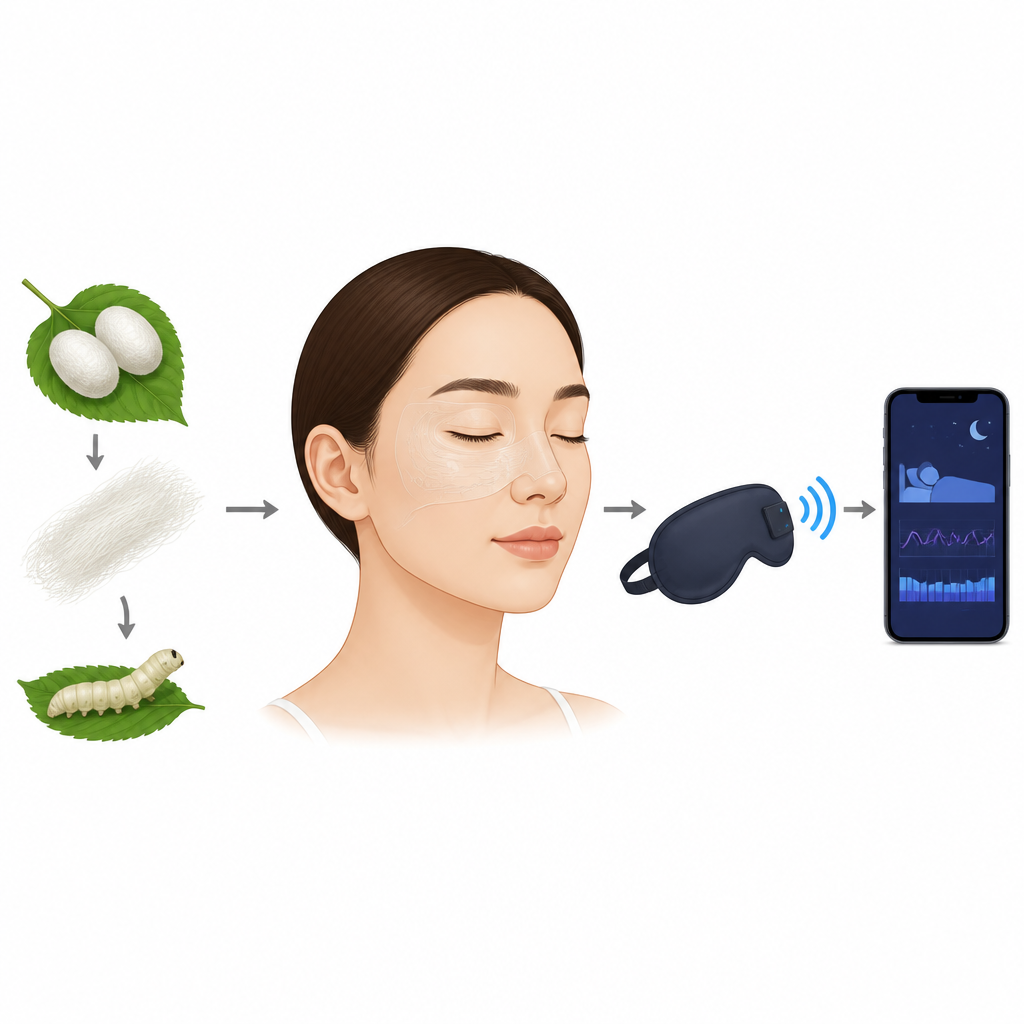
While we sleep, small twitches of our eyelids and subtle flares of the nostrils quietly reveal how well our bodies are resting and breathing. Today these clues are often missed because hospital sleep tests are bulky and uncomfortable, and most home gadgets track only broad signals such as heart rate. This study describes a paper-thin patch made from silk that gently sticks to the skin and turns tiny facial movements into electrical signals, opening a path toward soft, eco-friendly sleep trackers that people can wear all night without noticing.
A soft sensor woven from silk
The heart of the work is a flexible patch built from silk fibroin, the main protein in silkworm silk. Silk is already known for being safe on skin and easy to shape, but its natural electrical response to pressure is usually too weak for precise sensing. The researchers tackled this by carefully redesigning the silk at the molecular level rather than mixing in hard or toxic additives. Their goal was to keep the material fully biocompatible and more environmentally friendly than many plastic-based wearables, while still detecting very gentle motions on the surface of the face.
Boosting the signal inside the silk
To strengthen the silk’s ability to generate electrical charge when pressed, the team blended in glycine, a simple amino acid that is already a major building block of silk. They first formed tiny glycine crystals in a supporting gel and then mixed this with a silk solution. These crystals subtly nudged the silk chains into a more ordered, sheet-like arrangement that is better at converting pressure into charge. At the same time, they added calcium ions to the liquid mixture to adjust how stiff or soft the final film would be, making it flexible enough to bend and stretch with the skin without cracking.
From thin film to working skin patch
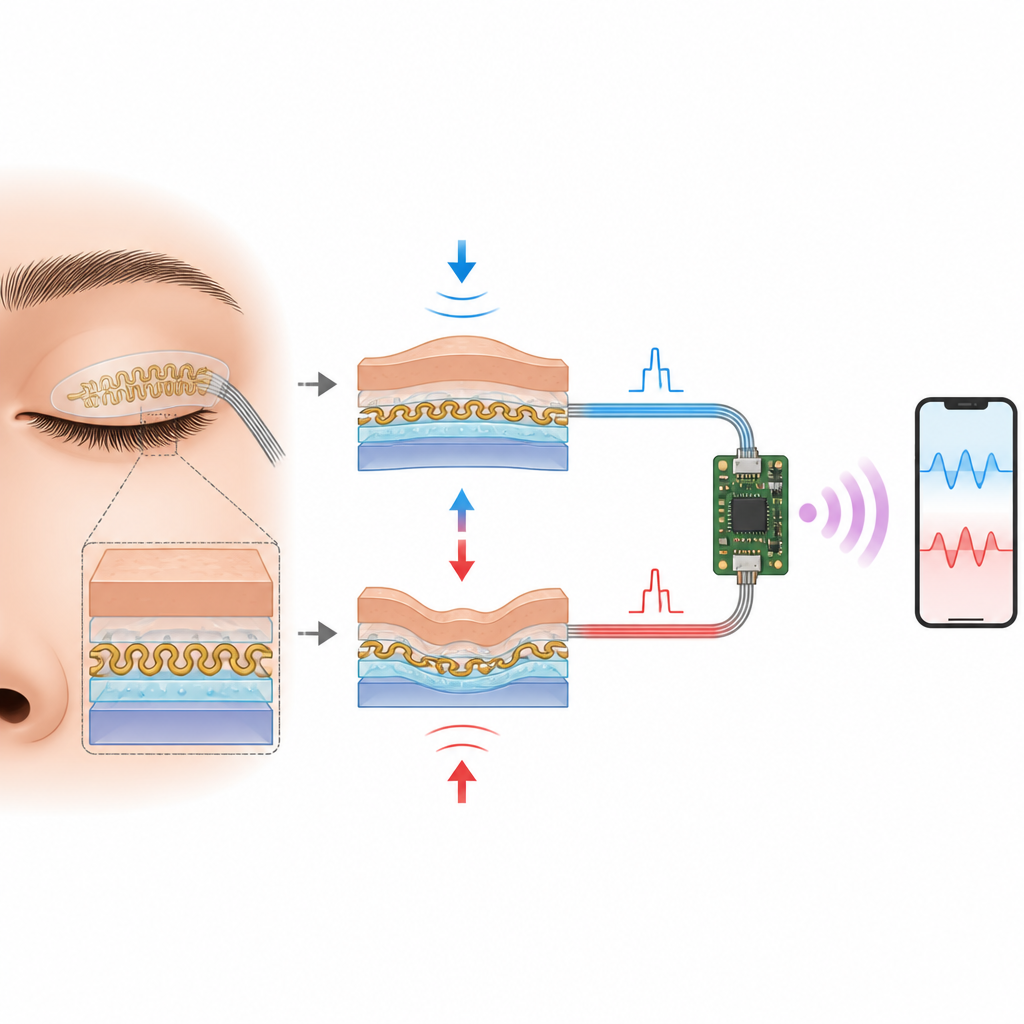
Using standard microfabrication methods, the researchers spun this improved silk blend into an ultrathin film only a few micrometers thick and sandwiched it between two plastic sheets carrying hair-like gold traces in a wavy pattern. These serpentine traces act as electrodes that pick up the electrical pulses created when the film is pressed. Tests showed that the new film produced about ten times more electrical charge than plain silk, responded in less than a tenth of a second, and could sense forces as light as a tiny weight being placed on it. The sensor also held up over hundreds of cycles and worked reliably in humid conditions, and trials on the skin of lab animals showed no redness or irritation after several days of contact.
Listening to breathing and eye movement during sleep
To show how this patch could be used in real life, the team combined two sensors with a coin-sized wireless circuit. One patch sat on the upper eyelid and the other on the side of the nose, both held in place with medical adhesive and connected by thin flexible wires to a small module on a sleep mask or forehead. This module amplified the signals and sent them by Bluetooth to a smartphone. In volunteer tests, the system clearly distinguished slow, normal, and rapid flaring of the nostrils, and it captured changes in eye movement patterns that match the fast-eye stage of sleep. During longer, simulated sleep sessions, the dual-channel setup tracked shifts between falling asleep, deep rest, and waking, based purely on facial micro-motions.
What this means for future sleep tracking
In simple terms, the study shows that silk, when gently restructured and combined with a tiny wireless board, can act as a very thin, comfortable microphone for the smallest movements of the face. It can lie on the skin for hours, feel almost invisible, and turn subtle breathing changes and eye twitches into digital traces that a phone can record. Although more clinical validation is still needed, this fully biocompatible, silk-based patch points toward future sleep monitors that are lighter, greener, and easier to wear than many current devices, helping people and doctors better understand nighttime health without heavy equipment.
Citation: Li, Q., Pan, Z., Zhu, K. et al. Real-time facial micromotion tracking enabled by an ultrathin silk fibroin patch. Microsyst Nanoeng 12, 190 (2026). https://doi.org/10.1038/s41378-026-01327-9
Keywords: wearable sleep sensor, silk fibroin patch, facial micromotion, piezoelectric film, wireless health monitoring