Clear Sky Science · en
Thermally activated excess noise by subgap density-of-states in Si-doped ZnSnO thin-film transistor-type gas sensor
Why tiny gas sensors matter
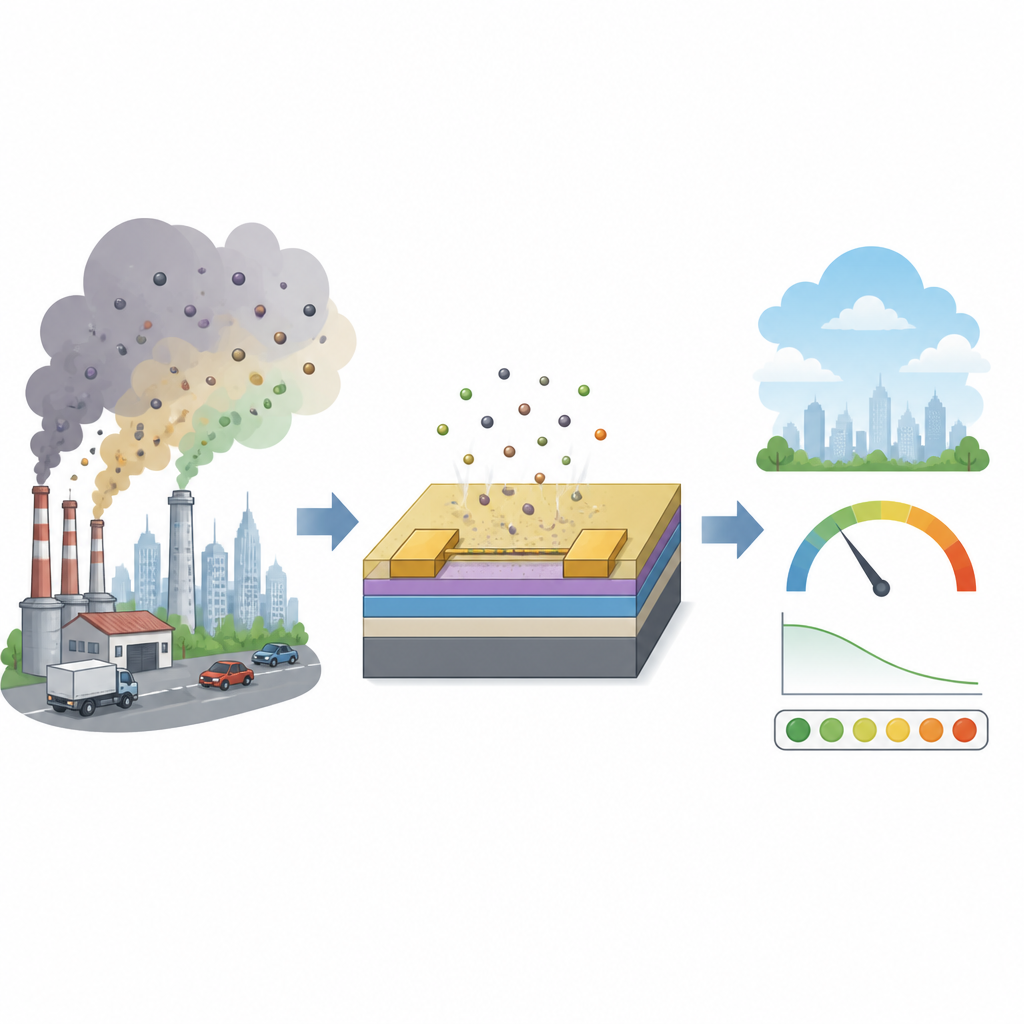
Air quality affects everything from city smog alerts to safety in factories and even medical breath tests. Modern gas sensors are shrinking into thin electronic films that could be built into wearables, phones, and smart buildings. But as these sensors try to detect ever lower gas levels, a subtle problem inside the electronics itself random electronic noise becomes a serious obstacle. This study looks inside a promising kind of thin-film gas sensor to find out where that noise really comes from and how to tame it.
A new kind of gas sensing transistor
The researchers work with gas sensors built from amorphous oxide semiconductors, materials that already power many flat panel displays. In these devices, a thin semiconductor channel made of silicon doped zinc tin oxide sits on top of a gate electrode and insulator, forming a transistor whose surface is directly exposed to air. When target gas molecules such as nitrogen dioxide touch the surface, they pull away electrons from the channel. The transistor then needs a higher gate voltage to switch on, which appears as a shift in threshold voltage and serves as the sensing signal. Silicon is added to the zinc tin oxide to reduce unstable defects, especially oxygen vacancies, so the material stays more stable when the device is heated during operation.
When heat unlocks hidden defects
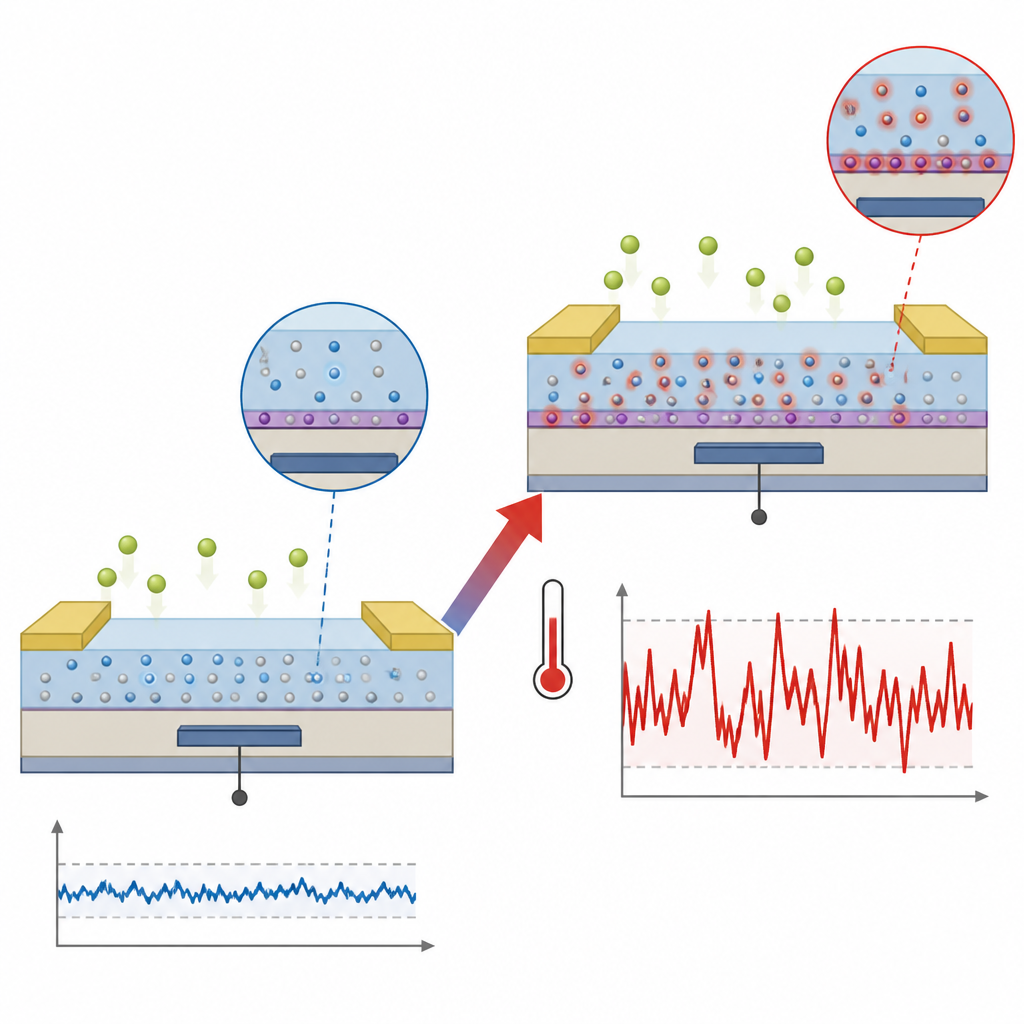
To work quickly and recover between measurements, these sensors are often heated to temperatures between room temperature and about 100 degrees Celsius. The team discovered that warming the devices does more than speed up gas reactions it also wakes up deep electronic trap states hidden inside the semiconductor band gap. By carefully measuring the low frequency flicker noise in the drain current at different temperatures and bias conditions, they show that noise increases strongly at higher temperatures, especially when the transistor is operated at low current. Standard noise models, which assume only simple carrier number or mobility fluctuations, cannot fully explain this behavior. Instead, an energy-resolved analysis reveals that donor like trap states lying roughly a tenth of an electron volt below the conduction band become thermally active and begin exchanging charge with the channel, boosting slow fluctuations.
Mapping the invisible landscape of traps
To connect the electrical behavior to the underlying defects, the authors reconstruct how the electronic Fermi level moves relative to the conduction band as the gate voltage is swept. From this, they extract the distribution of subgap density of states, distinguishing between shallow tail states near the band edge and deeper donor states further below. At room temperature, noise is mainly governed by tail states and follows the usual carrier number fluctuation picture. As the temperature rises, however, the deeper donor states start to emit and capture electrons often enough to matter, especially in low current regimes. Each such event slightly changes the channel charge, and the combined effect of many traps with different time scales produces a pronounced rise in low frequency noise. This energy selective view shows that the number of defects is not changing with temperature instead, their activity is.
Balancing signal and noise in real gas detection
The team then examines how this excess noise affects practical sensing of nitrogen dioxide. They measure how the threshold voltage shifts when the sensor is exposed to gas concentrations down to parts per billion, and how slowly the device responds and recovers. To speed recovery, short negative gate pulses are used to push adsorbed molecules away from the surface. Crucially, the researchers define the sensor signal as the gas induced change in threshold voltage and the noise as the integrated low frequency fluctuation in that threshold. This lets them compute a true signal to noise ratio across different transistor operating regions subthreshold, linear, and saturation at elevated temperature.
Finding the sweet spot for ultra low detection
Although the same device and material are used throughout, the smallest gas concentration it can reliably detect depends strongly on how it is biased. If one looked only at the size of the response, running in the subthreshold region might appear best because current changes rapidly with voltage. However, the study shows that thermally activated excess noise is much stronger there and also in saturation, which severely lowers the signal to noise ratio. In contrast, operating in the linear region above threshold offers a good response while keeping excess noise modest, giving the highest signal to noise ratio and the lowest limit of detection about 0.36 parts per billion of nitrogen dioxide, compared with nearly three times worse performance in other regions. For non specialists, the main message is clear smart choice of operating point and temperature can be as important as the sensor material itself when chasing trace gases in real environments.
Citation: Lee, ST., Lee, J.Y., Cho, Y. et al. Thermally activated excess noise by subgap density-of-states in Si-doped ZnSnO thin-film transistor-type gas sensor. Microsyst Nanoeng 12, 184 (2026). https://doi.org/10.1038/s41378-026-01316-y
Keywords: gas sensor noise, thin-film transistor, amorphous oxide semiconductor, nitrogen dioxide sensing, signal to noise ratio