Clear Sky Science · en
A self-powered microsystem with efficient power management for continuous wireless sensing
Why tiny devices that power themselves matter
The world is filling up with small gadgets that quietly track our health, our cities, and our environment, but keeping all of them fed with fresh batteries is costly and wasteful. This article describes a palm-sized system that powers itself from gentle motion, then uses that energy to sense harmful vapors in the air and send the data wirelessly. It points toward a future where many Internet of Things devices can run for years without battery changes or plugged-in chargers.
Turning gentle motion into useful electricity
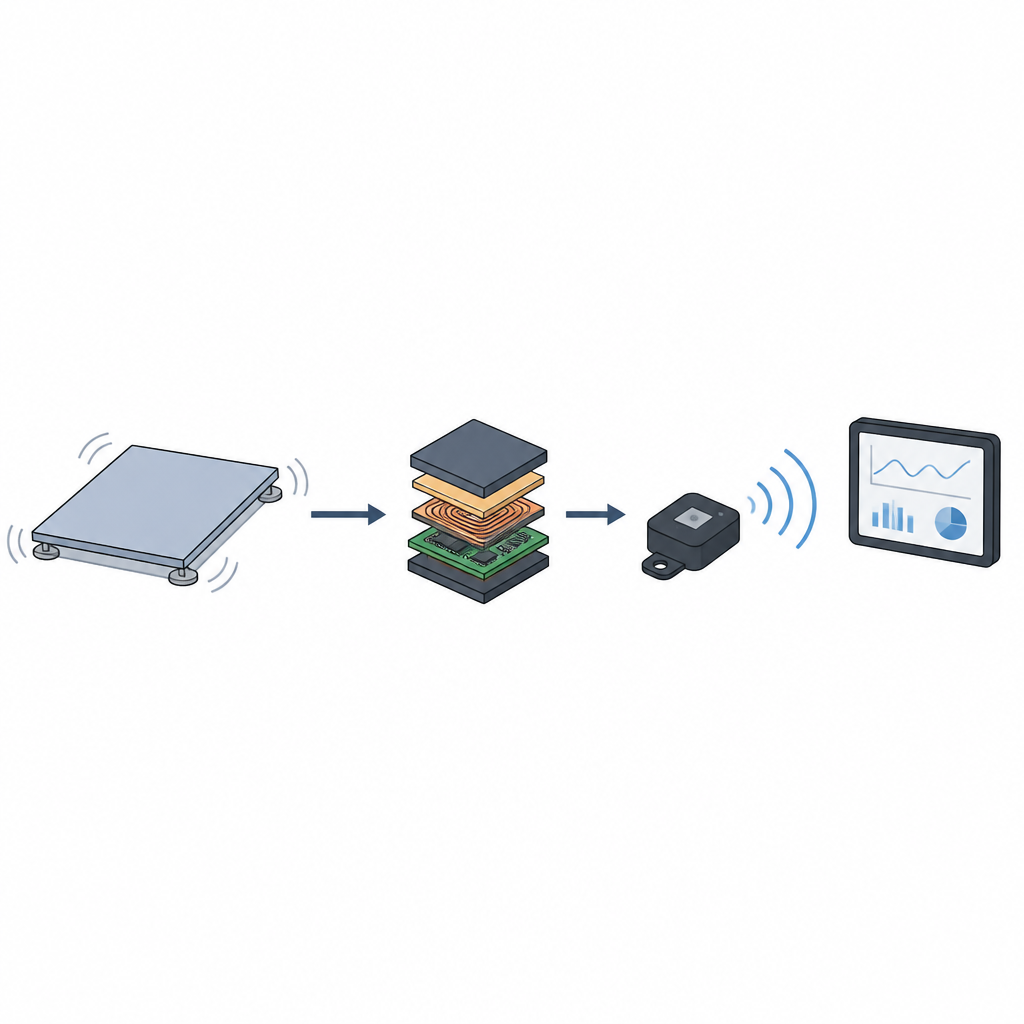
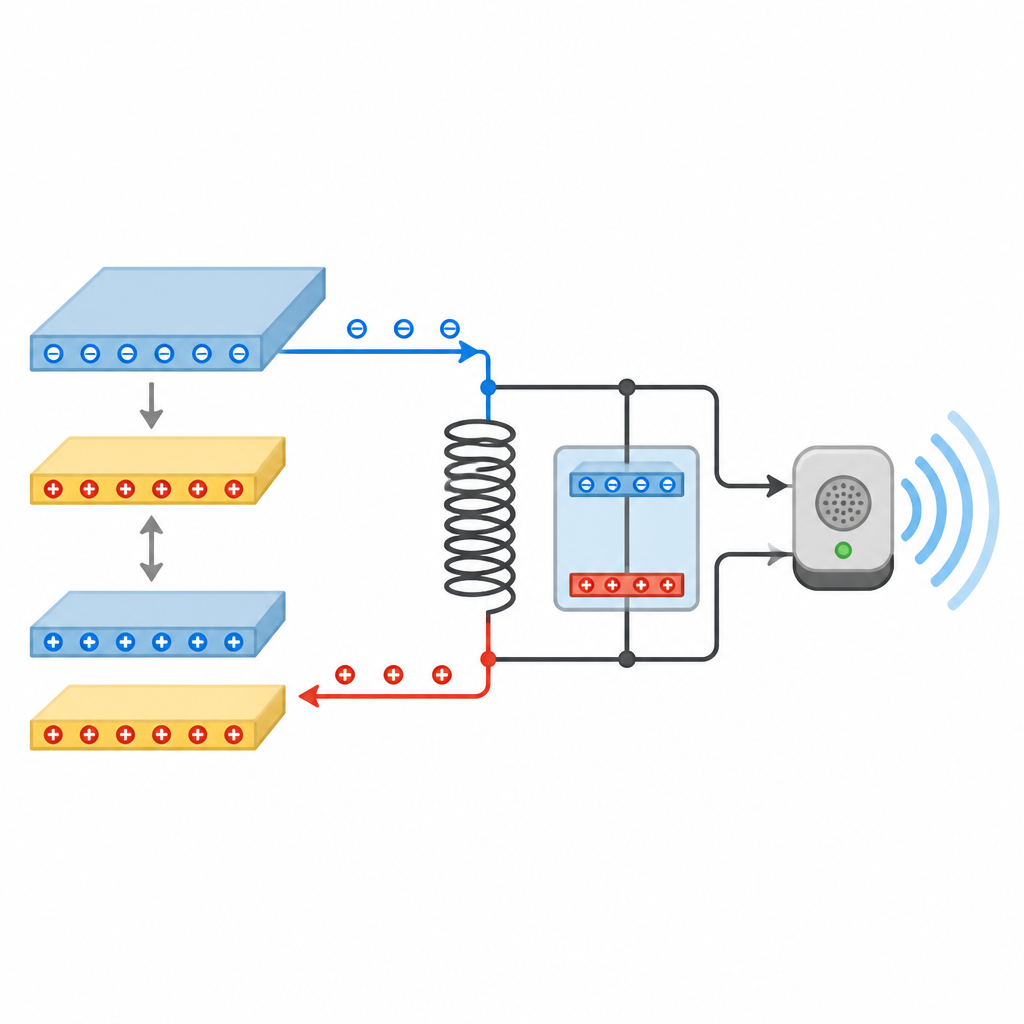
At the heart of the system is a special kind of energy harvester that pulls electricity out of slow, everyday movements, like the sway of a person walking or the vibration of a machine. It uses two thin plastic sheets that touch and separate again and again, trading electrical charge when they meet. Each contact and release produces a sharp electrical pulse with very high voltage but very little current. On its own, this raw output is poorly matched to the needs of modern electronics, which prefer a smooth, low-voltage supply, so most of the harvested energy would normally be wasted.
Smart circuitry that captures more of the trickle
To solve this mismatch, the researchers designed a careful power management circuit that acts like a smart valve on the energy stream. Instead of rectifying every pulse in a simple way, the circuit waits until the harvester’s voltage reaches its peak and then quickly pulls the stored charge into a small transformer and storage capacitor. This timing strategy, called synchronous electric charge extraction in technical terms, greatly increases how much energy is caught on each cycle. Compared with a standard rectifier, the new approach raises the usable power about fivefold, enough to keep a tiny computer and radio running continuously under realistic low-frequency shaking.
Starting from empty and staying alive
Another challenge for a truly self-powered device is what happens when it is completely empty at the beginning. The team added a “cold start” path that first lets the motion-powered generator charge the storage capacitor in a simple, low-efficiency mode until there is just enough voltage for the smarter circuitry to wake up. Once that threshold is reached, the system automatically switches over to the higher efficiency mode. In tests, starting from zero volts, the device built up to the required level in under ten minutes of modest vibration and then maintained a steady supply of roughly one hundred microwatts of power, slightly more than the whole system consumes on average.
Breathing in chemical vapors without burning power
The demonstration task for this self-powered platform is to watch for vapors from common solvents, a group of chemicals that can irritate lungs and, at high exposure, harm long-term health. The sensing chip looks like a tiny comb coated with a thin rubbery film. When vapor molecules soak into this film, its electrical properties change slightly, which the electronics read as a shift in capacitance. Because the sensing element itself uses no heat and no consumable chemicals, it draws virtually no power; only the readout chip and the microcontroller use small bursts of energy when they wake up every few seconds to take a measurement and send it over Bluetooth to a nearby computer.
From lab testbed to future battery-free networks
By combining an efficient motion harvester, a highly tuned power circuit, and an ultra-low-power sensor and radio, the researchers built a compact unit that can sense vapors and continuously broadcast readings using only a single low-frequency mechanical source. The stored energy never falls below what is needed for operation, proving that such a device can run indefinitely as long as motion is available. For non-specialists, the key message is that future environmental and wearable monitors may not need bulky batteries or frequent charging; instead, they can quietly sip energy from motion, cut maintenance costs, and reduce electronic waste while still delivering real-time data about the air we breathe.
Citation: Zhao, X., Xu, Z., Ou, Z. et al. A self-powered microsystem with efficient power management for continuous wireless sensing. Microsyst Nanoeng 12, 178 (2026). https://doi.org/10.1038/s41378-026-01315-z
Keywords: self-powered sensors, triboelectric energy harvesting, wireless gas monitoring, Internet of Things, low power electronics