Clear Sky Science · en
Ultrasensitive, low-input detection of avocado sunblotch viroid via RPA-CRISPR and nanopore-array single-bead fluorescence readout
Why hidden infections in avocados matter
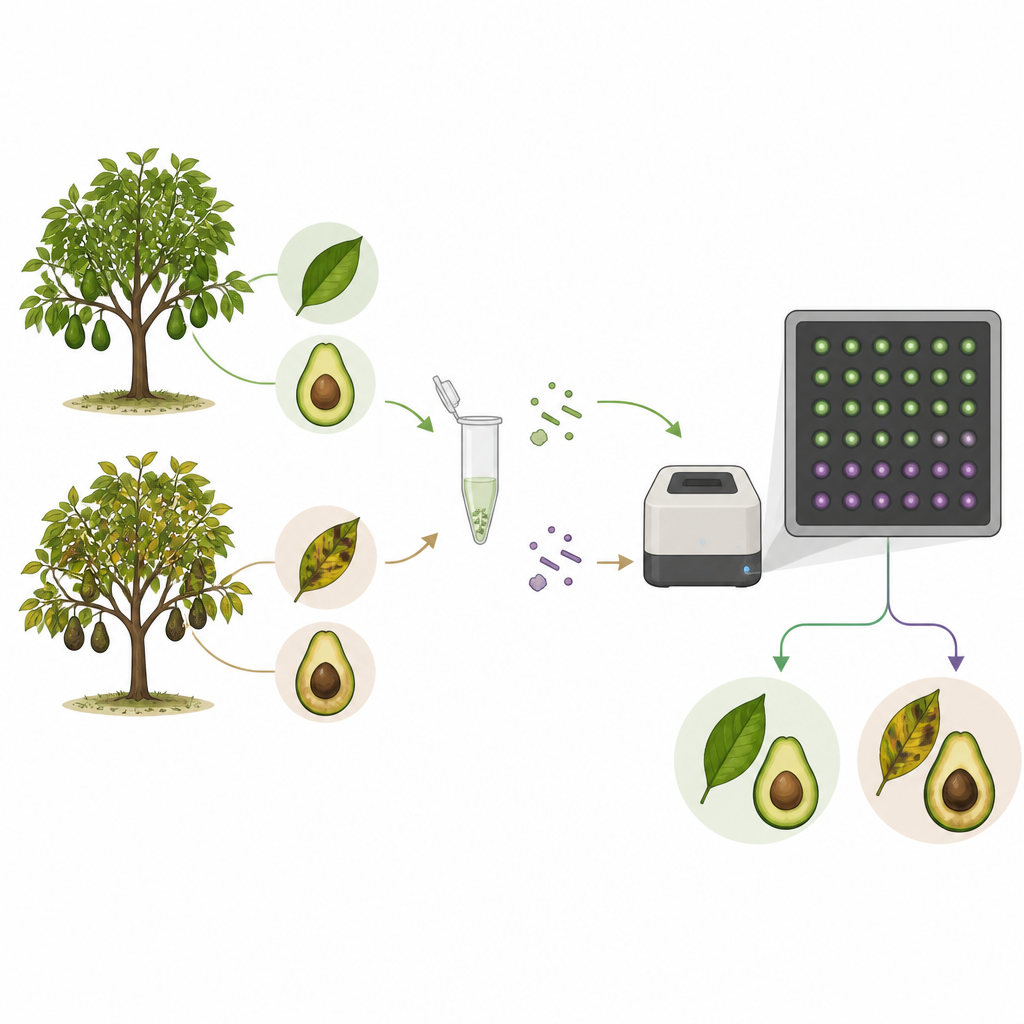
Avocados are a high-value crop, and a tiny infectious RNA called avocado sunblotch viroid can quietly slash yields while trees still look healthy. Growers and inspectors urgently need tests that can catch this stealthy pathogen early, using only small pieces of leaf, flower, or fruit, and without hauling samples back to a fully equipped laboratory. This study introduces a new test that is both extremely sensitive and very frugal with the amount of plant material and chemicals it needs.
A tiny culprit that is hard to spot
Avocado sunblotch viroid is a short loop of RNA that does not code for proteins, yet it can deform fruit, stunt trees, and cut yields by up to half or more. It hides unevenly inside a tree, often at very low levels and without clear symptoms, which makes it difficult to catch with standard lab tests. Conventional methods like gel electrophoresis, traditional PCR, and even some newer approaches either lack the sensitivity to find such low amounts or depend on bulky, power-hungry instruments that are impractical in orchards.
Turning a few molecules into bright beads
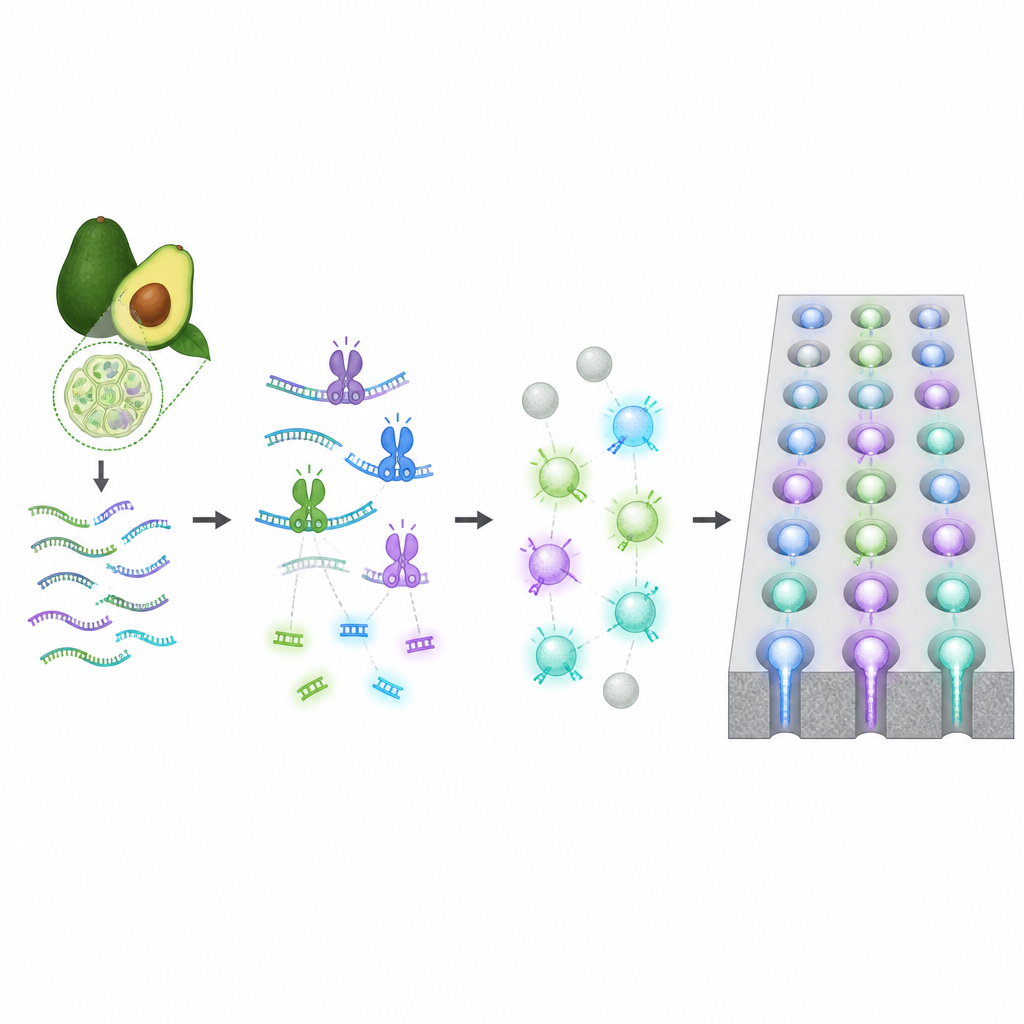
The team combines three modern tricks into one pipeline. First, a warm-water DNA copying reaction called recombinase polymerase amplification makes many DNA copies from the viroid’s genetic material without cycling temperatures like PCR. Second, a CRISPR protein (Cas12a) acts like a programmable molecular sensor: when it recognizes viroid DNA, it starts cutting nearby short probe strands, switching them from dark to fluorescent. Third, these glowing probe fragments stick to magnetic beads, so each bead becomes a tiny light bulb if the target viroid was present in the original avocado sample.
Reading single beads with a chip of tiny pores
Instead of measuring glow from a large liquid volume, the researchers flow a very dilute bead mixture across a chip containing an orderly grid of nanoscale pores. A gentle pressure pushes beads toward the pores, where most pores end up holding a single bead. Under a fluorescence microscope, each occupied pore appears as either a dim dot (plain bead) or a bright dot (glowing bead). By counting how many captured beads shine compared with the total number of beads, the system calculates a “fluorescent bead ratio” that signals whether the sample contains viroid genetic material. This design sharply reduces background noise and works with only 40 nanoliters of bead solution per measurement, which is over 100 times less than typical plate-based tests.
Testing real trees in real orchards
The method was challenged with leaf, flower, and fruit samples collected from avocado orchards in California. Independent droplet digital PCR tests first labeled which samples were truly positive or negative for the viroid. Using a simple decision threshold based on negative controls, the nanopore chip correctly classified all positive and all negative orchard samples, including a particularly low-level case that had been difficult for a previous digital LAMP method. In further dilution tests, the platform consistently detected viroid levels down to about 1.7 copies in each microliter of sample, a sensitivity that rivals the most advanced laboratory assays.
What this means for growers and beyond
To a non-specialist, the key outcome is that this chip-and-bead test can see vanishingly small traces of avocado sunblotch viroid using tiny sample volumes and only simple heating rather than full PCR machines. While the prototype still relies on a laboratory microscope and pressure source, its core components are compatible with compact imaging modules and manual pressure controls, making a portable field device feasible. In the future, the same strategy could be adapted to other plant and clinical pathogens, offering farmers and health workers an ultrasensitive early warning system that fits in a small box instead of a full laboratory.
Citation: Xu, J., Jiang, X., Dashtarzhaneh, M.K. et al. Ultrasensitive, low-input detection of avocado sunblotch viroid via RPA-CRISPR and nanopore-array single-bead fluorescence readout. Microsyst Nanoeng 12, 187 (2026). https://doi.org/10.1038/s41378-026-01312-2
Keywords: avocado sunblotch viroid, plant pathogen detection, CRISPR diagnostics, nanopore array, isothermal amplification