Clear Sky Science · en
Broad pH-resistant microdroplet SERS platform based on Ag@SiO2@PVP NPs for real-time analysis of microbial metabolites
Seeing Microbes at Work
Microbes in fermentation tanks quietly make the medicines, foods, and chemicals we rely on, but their inner workings are hard to watch in real time. This study introduces a small, chip-based sensing platform that can monitor the chemical by-products of microbes even when the surrounding liquid swings from very acidic to very alkaline. By making the detector itself resistant to these harsh changes, the authors bring us closer to smart, data-driven biomanufacturing instead of trial-and-error recipes.
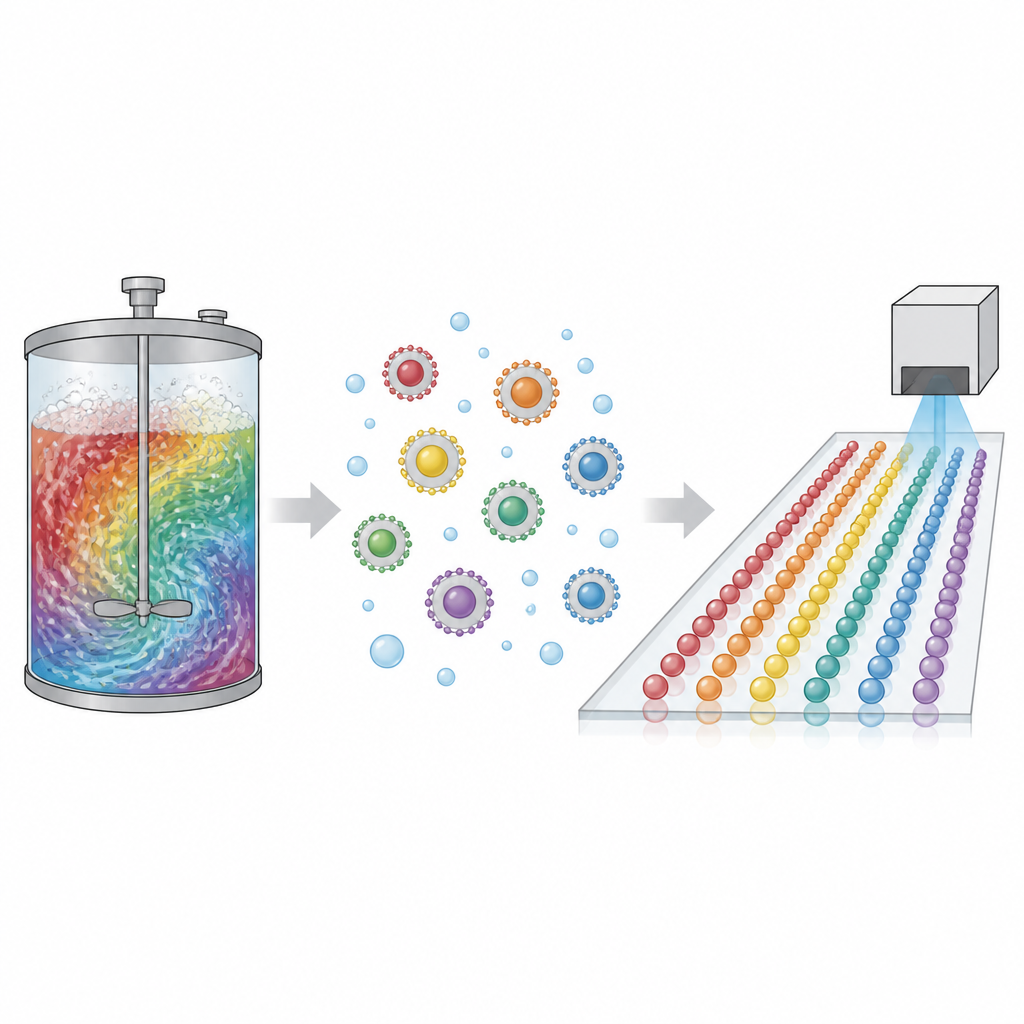
Why Watching Microbes Matters
Modern biomanufacturing aims to turn living cells into tiny factories that reliably produce drugs and other high-value products. To do this well, engineers need to track the small molecules that cells release as they grow and work. Today, this is often done by taking samples to big lab machines, which is slow and breaks the flow of the process. A method called surface-enhanced Raman scattering, or SERS, can read the “vibrational fingerprints” of molecules directly in a liquid, offering fast and detailed information. When combined with droplet microfluidics, which splits liquid into thousands of tiny, well-controlled droplets, SERS has the potential to deliver rapid, high-throughput chemical snapshots of living systems.
The Problem with Changing Acidity
A major obstacle is that many of the best SERS probes are made from silver, which is powerful but fragile. In real fermentation broths, the acidity or alkalinity, measured as pH, can swing widely as microbes grow and consume nutrients. These swings can make silver particles clump together, corrode, or even dissolve, which weakens and scrambles the signal. Attempts to fix this by forcing the pH into a narrow range can disturb the cells and change the chemistry that scientists want to observe. The challenge, then, is to build a sensing system that stays stable without having to “fix” the environment around it.
A Dual-Protected Probe on a Tiny Chip
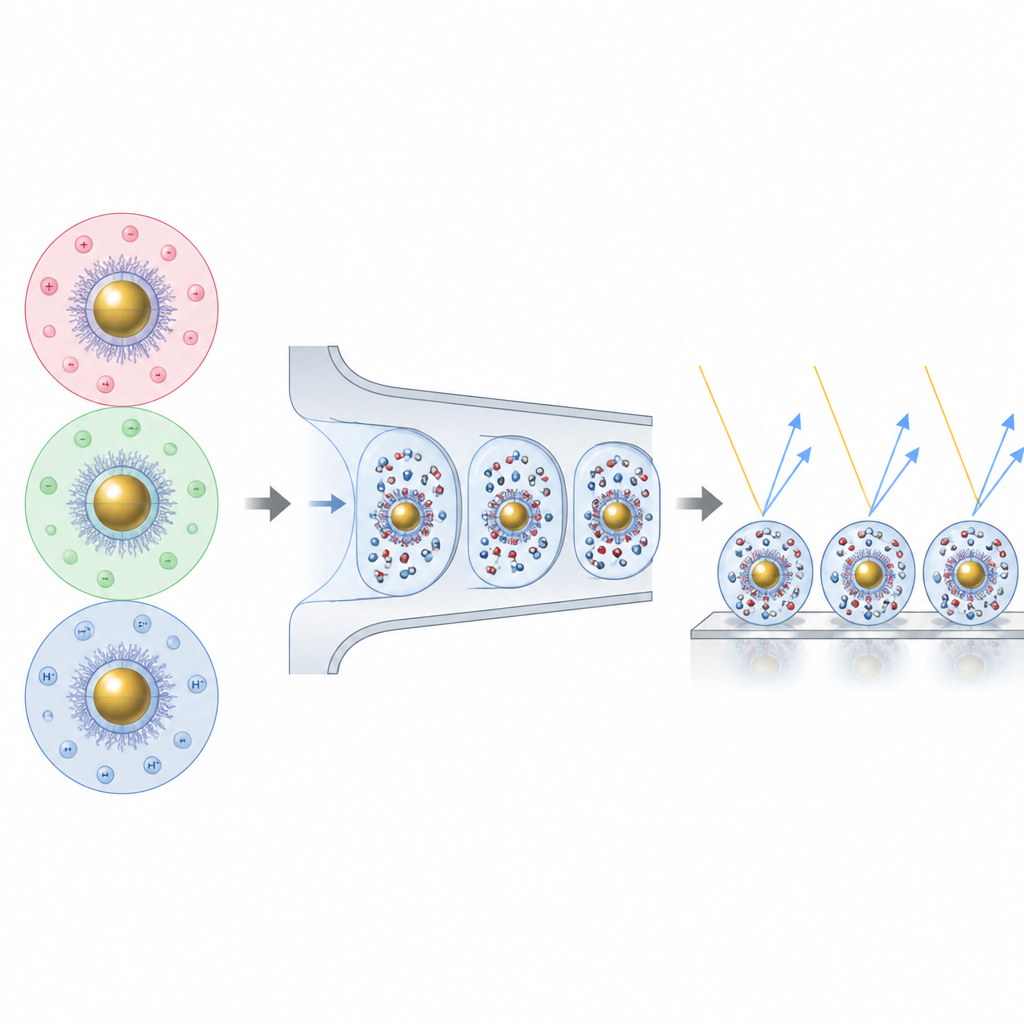
The authors tackle this by redesigning both the sensing particles and the chip that carries them. They start with silver nanoparticles and wrap them in a thin shell of silica, followed by a soft coating of a common polymer called PVP. The silica shell physically separates the silver core from corrosive substances in the liquid, while also adding charge that helps keep particles apart. The outer PVP layer acts like a soft brush, creating a physical barrier that prevents the particles from sticking together, regardless of pH. These “dual-protected” particles, called Ag@SiO2@PVP, remain well dispersed and highly active from pH 3 to 11, a range that spans strong acid to strong base.
A Flow of Tiny Droplets and Light
To put these probes to work, the team builds a microfluidic chip that brings together several functions on one platform. Channels carved into soft silicone guide three water streams containing the sample, the stabilizing PVP solution, and the protected nanoparticles into a herringbone-shaped mixer that quickly blends them. At a T-shaped junction, this mixed stream breaks into a train of uniform droplets carried by an oil phase. These droplets then pass into a specially shaped region that gently traps them in place just long enough for a red laser to shine through the chip and read their SERS signals. A mirror-like base reflects the scattered light back upward, roughly doubling the collected signal without adding complexity.
Putting the System to the Test
The researchers validate the platform using L-DOPA, a small molecule produced by engineered Escherichia coli and used as a drug precursor. Across concentrations from one part in a hundred million to one part in ten thousand, the system records clear SERS fingerprints of L-DOPA at pH 3, 7, and 11. The signal strength follows a neat, nearly identical line versus concentration at each pH, with correlation values above 0.99, showing that the probe’s response is essentially independent of acidity. The limit of detection reaches about ten-billionths of a gram per milliliter, and repeated measurements on many droplets give a variation under 5 percent. Even when the exposure time is cut to just 15 milliseconds, the key peaks remain visible, corresponding to the ability to scan up to 4,000 droplets per minute.
Real Fermentation Broth and Other Molecules
Beyond clean test solutions, the team challenges the platform with real E. coli fermentation broth, a tangled mixture of cells, nutrients, and by-products. Bare silver particles fail in this messy setting, but the protected probes still pick out L-DOPA’s signature across a wide concentration range. The measured signal tracks well with reference values from high-performance liquid chromatography, suggesting at least semi-quantitative use. Continuous monitoring over an hour shows only modest drift. The authors then use the same setup to detect two other microbial products, L-tyrosine and arbutin, again reaching very low concentrations and obtaining clean, linear responses, which hints at broad usefulness.
What This Means for Future Biofactories
In simple terms, this work shows how a cleverly shielded nanoparticle and a well-designed droplet chip can team up to watch microbial chemistry unfold in real time, even under harsh and shifting conditions. Instead of constantly adjusting the environment to protect the sensor, the sensor itself is built to shrug off wide pH swings. This “regulation-free” robustness, combined with high sensitivity and fast throughput, makes the platform a promising tool for turning opaque bioreactors into transparent, data-rich systems, helping engineers tune living factories more precisely and reliably.
Citation: Zhao, H., Liu, J., Yuan, H. et al. Broad pH-resistant microdroplet SERS platform based on Ag@SiO2@PVP NPs for real-time analysis of microbial metabolites. Microsyst Nanoeng 12, 204 (2026). https://doi.org/10.1038/s41378-026-01311-3
Keywords: microdroplet SERS, microbial metabolites, pH resistant sensor, microfluidic chip, nanoparticles