Clear Sky Science · en
A high-throughput modular microfluidic platform for versatile functional assays at single-cell level
Watching single cells in action
Most lab tests lump millions of cells together, hiding how differently each one behaves. This study introduces a tiny “lab on a chip” that can watch and test more than ten thousand individual cells at once as they live, divide, kill cancer cells, and talk to their neighbors. By following single cells over time, the work offers a clearer view of why some cancer cells survive drugs, why immune cells vary in strength, and how dangerous immune side effects may arise.
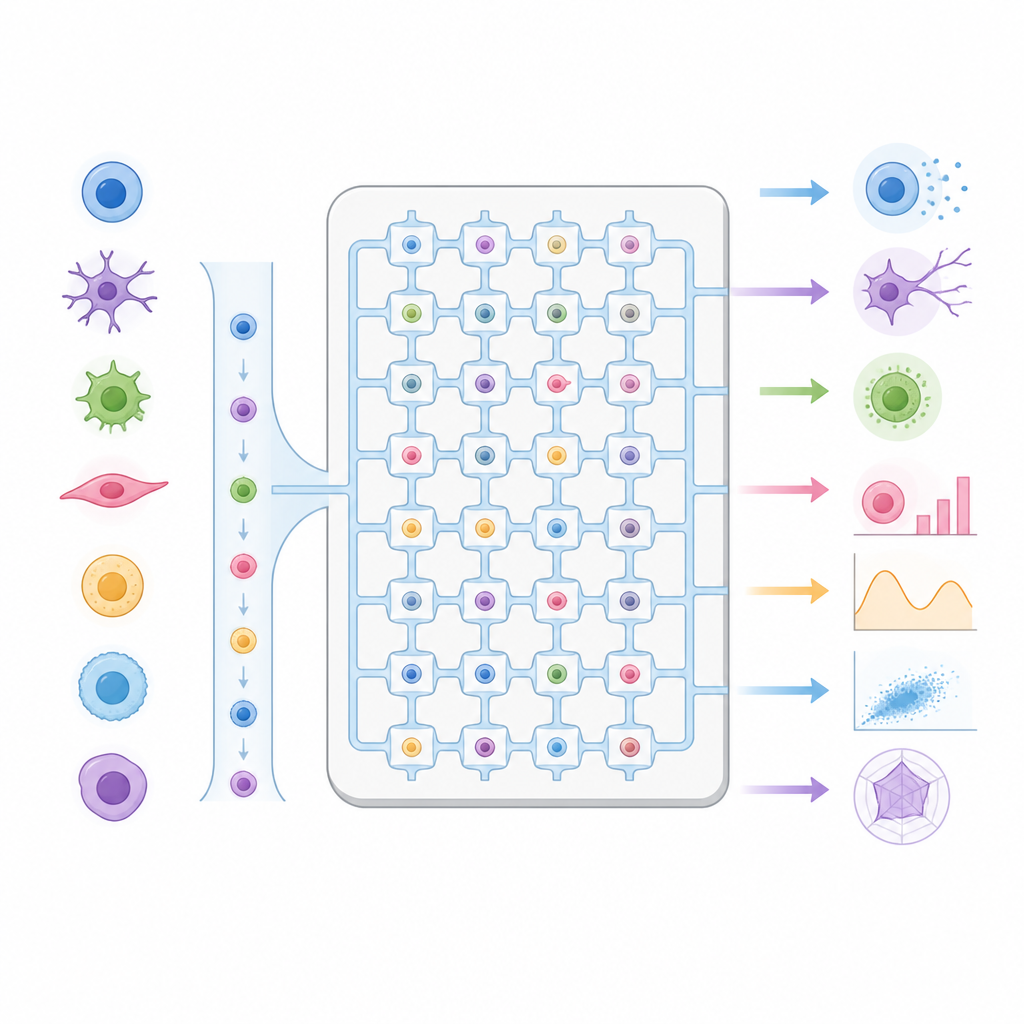
A new stage for single cells
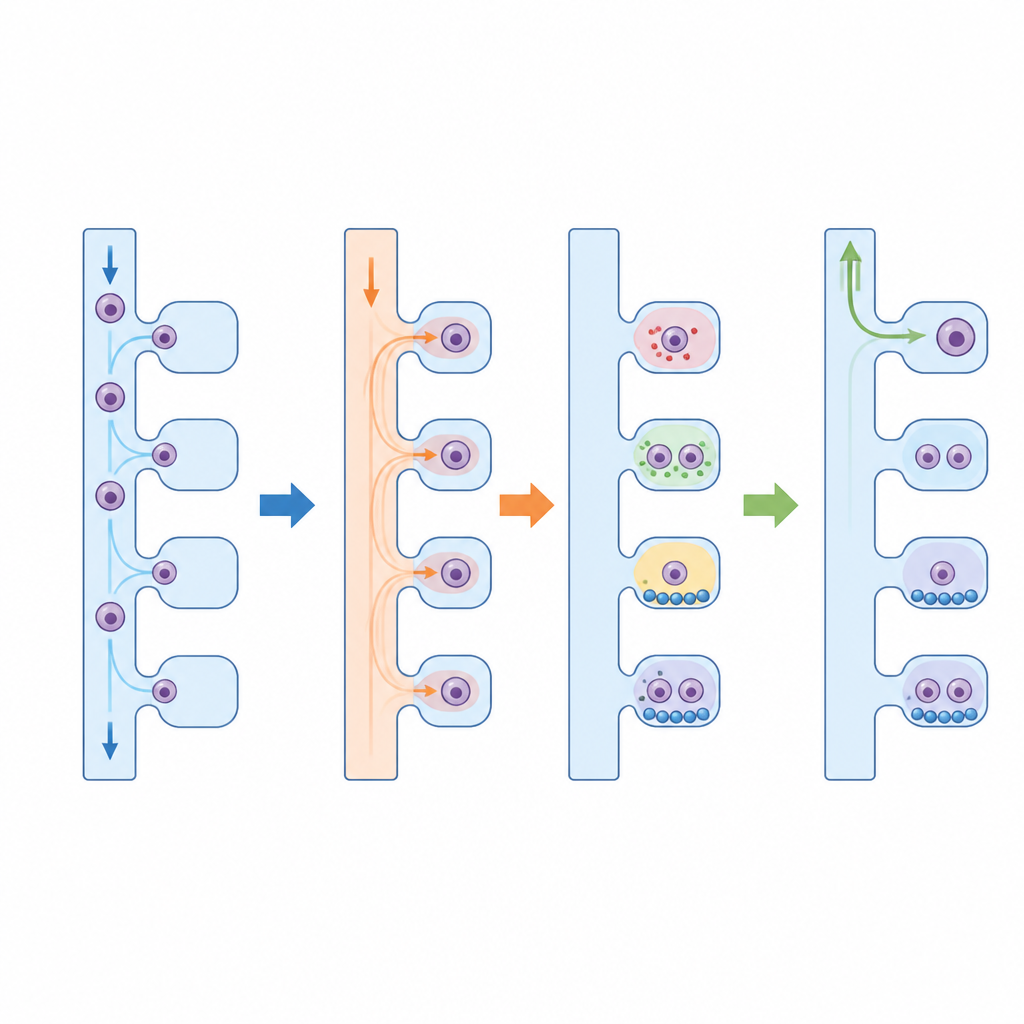
The team built a microfluidic platform called HiSCOPE, made from clear rubber etched with narrow channels and thousands of small chambers. Cells suspended in liquid flow through a channel and are gently caught one by one in cup-shaped traps. A brief spin in a standard centrifuge then nudges each trapped cell sideways into its own dead-end chamber, where there is no continuous flow. Nutrients and signals still diffuse in and out, but the cells are shielded from shear forces that can stress or damage them. Each chip holds 12,800 such assay units, allowing large cell populations to be screened in parallel.
Flexible layouts for many kinds of tests
HiSCOPE is modular: the trapping system stays the same, while the shape and layout of the nearby chambers can be swapped to match the question being asked. The researchers designed chambers that hold single cells, close cell–cell or cell–bead pairs, distant pairs, and pairs separated by a thin barrier that blocks touch but lets molecules pass. By repeating the trapping and spinning steps, they can load two or three different cell types into the same chamber or place a cell next to a tiny bead that captures molecules the cell releases. This makes it possible to study direct contact, long-range communication, and secretion, all at the level of individual cells.
Following cancer cells and immune fighters
To show what the platform can do, the scientists first tracked how single leukemia cells grow and respond to a common drug, imatinib. On drug-free chips, many chambers filled with small colonies as single cells divided over three days. Under drug treatment, most cells died, but a small fraction kept dividing. Using a clever retrieval method that presses on the thin floor of a chosen chamber, the team gently pushed out selected survivors, collected them with a pipette, and grew them in regular plates. Many of these clones later turned out to be only temporarily drug-tolerant rather than permanently resistant, hinting at stress-induced “persister” cells that may help cancers rebound after therapy.
Zooming in on cell combat and immune cross talk
The platform also captured one-on-one duels between natural killer (NK) cells and cancer cells. By pairing single NK cells with single targets in each chamber and filming them over hours, the authors saw rapid kills, delayed kills, serial killing of multiple targets, and complete failures to kill, even under the same conditions. Faster-moving NK cells tended to be better killers. In another set of experiments, beads placed beside immune cells soaked up released cytokines, allowing the team to measure how much each cell secreted. Surprisingly, some NK cells killed without releasing key cytokines, while others released cytokines without killing, revealing a functional mismatch that bulk tests would miss.
Probing dangerous immune side effects
Using chambers that separate two cells with a narrow barrier, the researchers studied how human T cells and macrophages stimulate each other to release inflammatory molecules linked to cytokine storms seen in advanced cell therapies. They compared direct contact with purely molecule-based communication and tested how blocking a specific surface interaction, CD40–CD40L, changed the response. The results showed that strong bursts of inflammatory signals largely depended on direct contact and that different macrophage states responded in distinct ways, underscoring the fine-grained diversity hidden inside a mixed immune cell population.
Why this matters for future medicine
By combining gentle single-cell handling, many chamber designs, and the ability to recover chosen live cells, HiSCOPE turns a simple chip into a powerful observatory for cell behavior. It can track how individual cells grow, die, attack, and signal over time, then link those behaviors to later genetic or molecular analysis. For non-specialists, the key message is that diseases like cancer and immune disorders are driven by rare and varied cells, not by averages. Tools like this platform make those hidden players visible, offering a path toward more precise diagnostics, better-tailored therapies, and safer immune treatments.
Citation: Shao, N., Mai, J., Godin, B. et al. A high-throughput modular microfluidic platform for versatile functional assays at single-cell level. Microsyst Nanoeng 12, 183 (2026). https://doi.org/10.1038/s41378-026-01310-4
Keywords: single-cell analysis, microfluidic chip, drug resistance, immune cell function, cytokine signaling