Clear Sky Science · en
Analysis and dynamic modeling of firing synchronization in electrically interconnected dual-compartment neuronal networks
Why this brain study matters
Our brains work by letting many small networks of nerve cells talk to each other. This study shows how scientists can wire together tiny brain-like networks grown in a dish, watch how their activity becomes more synchronized, and use math to understand how this shared activity arises and lingers even after the connection is cut.
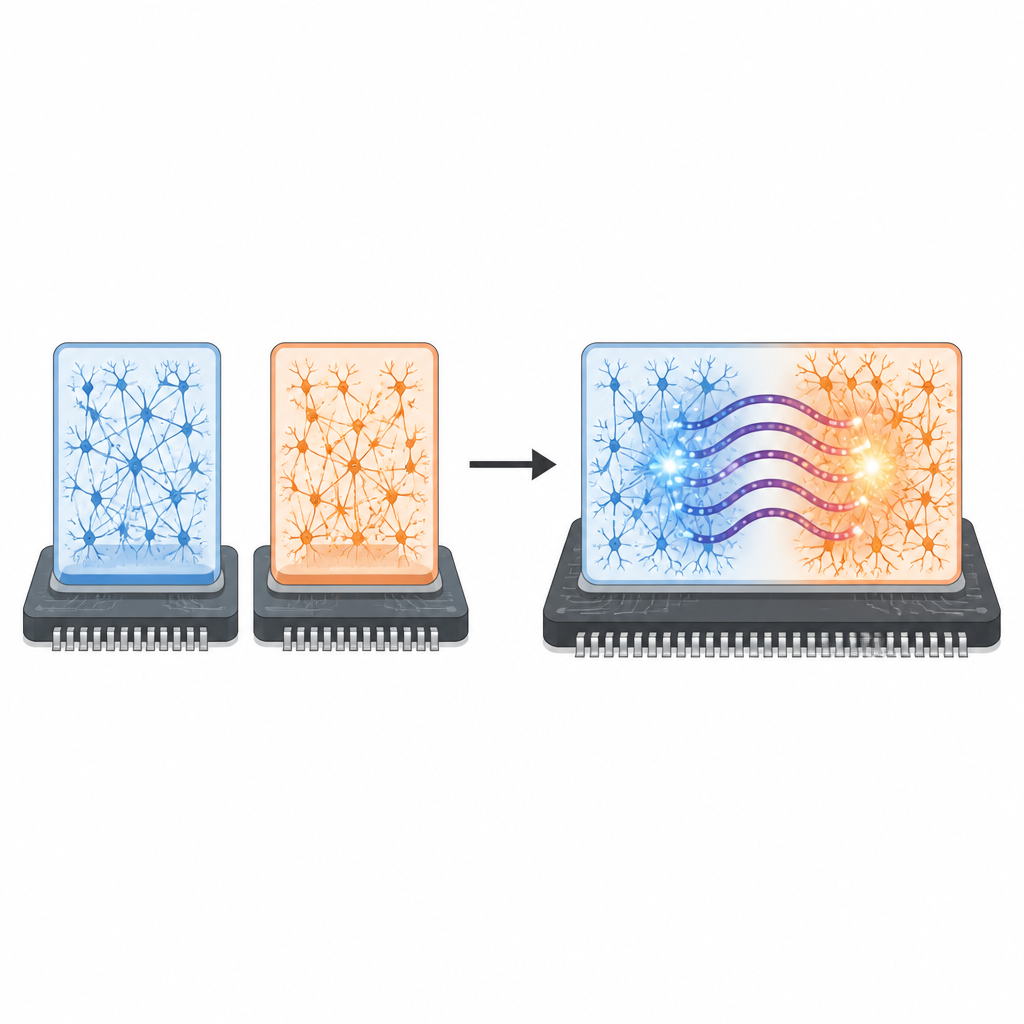
Building a tiny wired brain lab
The researchers created a special chip that houses dozens of separate groups of nerve cells, each in its own small square chamber. Under each chamber sit metal pads that listen to electrical activity, similar to microphones listening to a crowd. Crucially, the chip also includes a controllable switching circuit that can electrically link chosen pairs of chambers on demand. This setup lets the team start with fully separate networks, then flip a switch to connect them, and later disconnect them again, all while recording their electrical chatter in detail.
Measuring how networks fire together
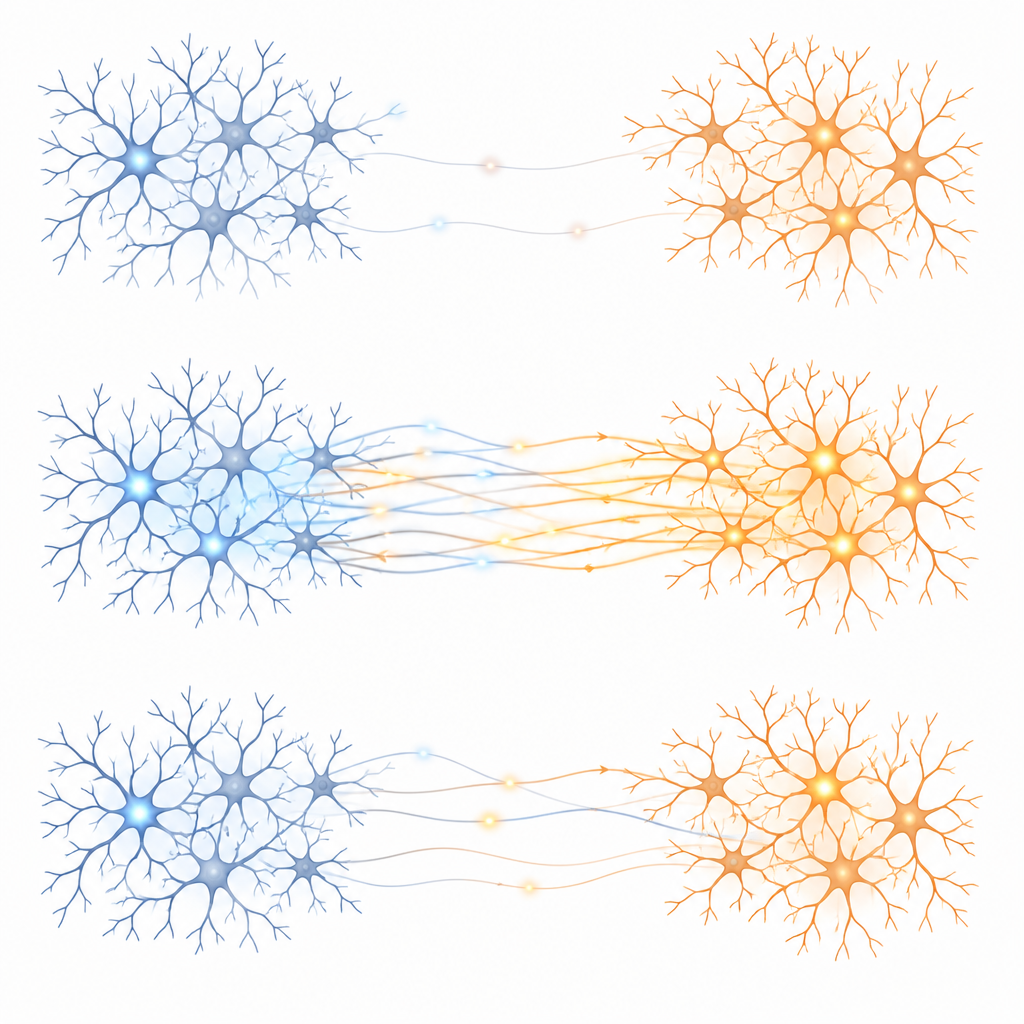
To see what changes when two networks are linked, the team compared three phases: before connection, during connection, and after disconnection. They focused on how precisely the bursts of electrical spikes line up in time, how similar the overall firing patterns are, and how well the rhythms of slow background signals stay in step. Across all five tested pairs of networks, electrical connection made the spikes more tightly aligned, the activity patterns more strongly correlated, and the slow waves more phase locked. In other words, the two groups began to behave less like strangers and more like partners sharing a common beat.
A surprising after-effect of cutting the link
One might expect that once the electrical bridge is removed, each network would simply return to its original independent state. Instead, the researchers found that the shared timing did not vanish completely. All three measures of coordinated activity dropped from their peak values after disconnection, but they stayed clearly higher than at the start. This lingering synchrony hints that the networks adjusted their internal state while they were linked. Short-term changes in the strength of existing connections, shifts in chemical conditions around the cells, or reorganization of their collective rhythms may help hold on to some of that shared pattern even after the external wiring is gone.
Using math to link hardware and brain behavior
To bridge their hardware experiments with theory, the team built a simplified mathematical model based on widely used equations that describe how groups of exciting and calming nerve cells interact. They added a coupling term that stands in for the artificial electrical path between two networks and adjusted its strength. As they increased this model coupling, the simulated networks shifted smoothly from independent behavior toward stronger but still incomplete synchrony, closely mirroring the real data. The model also captures how some effective coupling can remain even after the physical link is removed, offering a conceptual way to describe the observed residual effect as the system settling into a new, partially shared state.
What the findings mean for future brain technologies
For a general reader, the key message is that brain-like networks can be guided into more coordinated behavior using simple, programmable electrical links, and that this brief enforced partnership leaves a trace in how the networks later act. The work provides both a physical platform and a mathematical language to study how separate neural populations become functionally joined and how their cooperation can be tuned. Such insights may inform future brain-computer interfaces, rehabilitation tools, and synthetic neural systems by showing how to nudge distributed networks into working together without erasing their individual identities.
Citation: Lu, C., Jiang, L., Jia, Q. et al. Analysis and dynamic modeling of firing synchronization in electrically interconnected dual-compartment neuronal networks. Microsyst Nanoeng 12, 196 (2026). https://doi.org/10.1038/s41378-026-01309-x
Keywords: neuronal networks, electrical coupling, synchronization, brain-computer interface, neural plasticity