Clear Sky Science · en
Mechanically-triggered self-powered triboelectric sensor platform with arbitrary-to-constant mechanical input conversion
Why turning motion into power matters
From wearable health trackers to smart homes, tiny sensors are quietly spreading into every corner of daily life. Many of these devices must run for long periods in places where changing batteries is annoying or impossible. This study introduces a small gadget that can power and run environmental and gas sensors using simple motion, like moving a handheld strip up and down, while keeping the sensing signals steady and easy to interpret even when the motion itself is irregular.
A clever way to tame messy motion
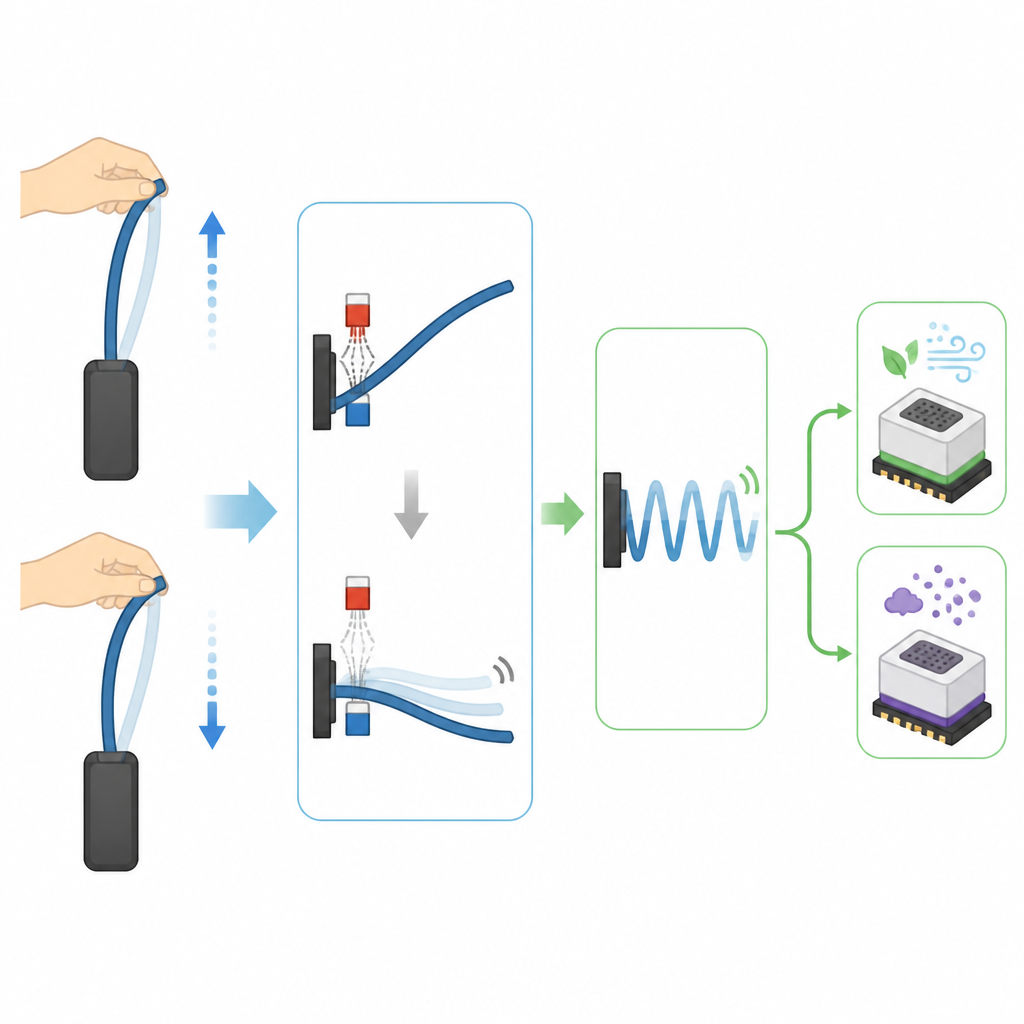
Most self-powered sensors based on rubbing surfaces together produce electricity that depends not only on what they are sensing, such as humidity or gas, but also on how they are moved. In the real world, hand motion and other ambient vibrations are uneven and slow, which scrambles the readings. The researchers tackled this problem using a mechanical trick. They built a flexible strip with a thin bending beam, or cantilever, that is held down by magnets until the motion reaches a set level. Once that happens, the stored elastic energy is suddenly released, and the beam vibrates at its own natural frequency with a nearly fixed size of motion, no matter how exactly the user moved the device.
How the self-powered strip works
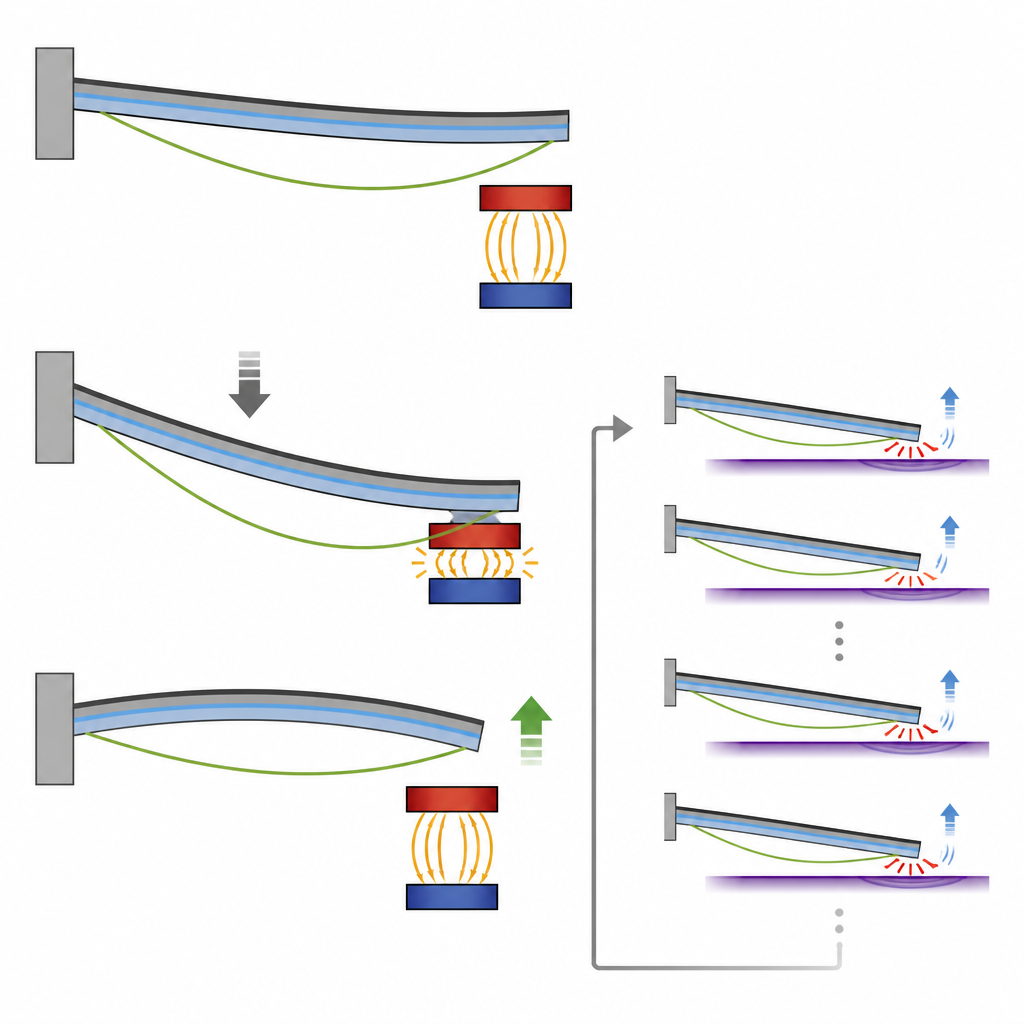
The device has two main parts: a flexible base and the cantilever assembly. A small magnet at the free end of the cantilever lines up with another magnet in the base, creating a latch that holds the beam flat. On the cantilever sits a carefully shaped sagging film coated with different materials on the facing surfaces. When the user bends the base by hand but not quite enough, the whole structure moves slowly together and little electrical signal is produced. Once the bending crosses a threshold, the cantilever snaps free from the magnetic latch and begins a fast vibration at about 50 cycles per second, while the base itself may be moving at less than one cycle per second. During each swing, the sagging film presses into and then pulls away from the cantilever surface several times, which drives the flow of electrical charge.
From mechanical motion to steady electrical signals
This repeated contact and separation takes advantage of the triboelectric effect, where two materials become oppositely charged after touching and peeling apart. The team tuned the thickness and slack of the sagging film, and the size of the magnets, so that the contact force stays in a comfortable range and the electrical output is stable. Tests showed that, once triggered, the peak-to-peak output voltage changed by less than about ten percent even when the input motion varied widely in distance and speed. The internal vibration also converts low-frequency motion into a much higher frequency response, which makes the cantilever’s own behavior dominate over the messy, slow motion of the person holding the device. As a result, the useful signal comes mainly from the well-controlled vibration stage, while smaller, irregular spikes from the beam snapping back to the latch can be ignored or filtered out.
Two example sensors: humidity and ammonia
To show that the mechanical platform can host different kinds of self-powered sensors, the researchers built two versions that sense humidity and ammonia gas. For the humidity sensor, they used a layer of electrospun plastic fibers whose surface was treated to attract water. As the air gets more humid, thin layers of water form on these fibers and allow some of the stored surface charge to leak away, which lowers the output voltage. The device showed a nearly linear drop in voltage from 30 to 90 percent relative humidity, while still keeping the reading stable when the hand motion changed. For the ammonia sensor, they coated a film of a conducting polymer that changes its electrical resistance when it absorbs ammonia. This change alters how easily charge can move in the triboelectric circuit, again shifting the output voltage in a predictable way over a wide range of gas levels.
What this means for everyday sensing
In plain terms, the authors have built a small, motion-powered base unit that can accept different sensing films on top and still give clean, repeatable readings even when the person using it moves in an uneven way. By solving a mechanical problem rather than relying on special new materials, the design can be adapted to many kinds of environmental and chemical sensors. This approach could make it easier to build portable, battery-free devices that monitor humidity, gas leaks, air quality, or other conditions during daily activities, while keeping the signals simple enough to trust.
Citation: Ko, HJ., Kim, W., Lee, S. et al. Mechanically-triggered self-powered triboelectric sensor platform with arbitrary-to-constant mechanical input conversion. Microsyst Nanoeng 12, 171 (2026). https://doi.org/10.1038/s41378-026-01306-0
Keywords: self-powered sensor, triboelectric nanogenerator, humidity sensing, ammonia gas sensor, wearable electronics