Clear Sky Science · en
Length-based separation of Arthrospira (Spirulina) platensis trichomes via the self-alignment effect of helical filaments in a straight microchannel
Why tiny spirals in tubes matter
Spirulina is best known as a vivid green health supplement, but in the lab it is a tiny spiral-shaped organism with big potential for food, fuel, plastics, and pollution clean up. This study shows a simple way to sort these spiral filaments by their length using only flowing water in a narrow channel. Because filament length tracks how Spirulina grows and responds to its surroundings, this gentle sorting method could help scientists pick out different life stages or stress responses without dyes or complex machines.
Spirals that tell a growth story
The microbe studied here, Arthrospira platensis, often called Spirulina, grows as flexible helical chains of cells a few hundred micrometers long. These filaments grow by cell division and then sometimes break into shorter pieces. Earlier work showed that properties like stiffness and gliding motion depend on filament length, and that unusually short filaments move in distinct ways. Yet existing cell sorters mainly look at size, brightness, or simple shape, not at the subtle behavior of long spiral filaments in flow. The authors set out to find a passive way to sort Spirulina purely by length using straightforward microfluidic hardware.
A straight path that guides different spirals
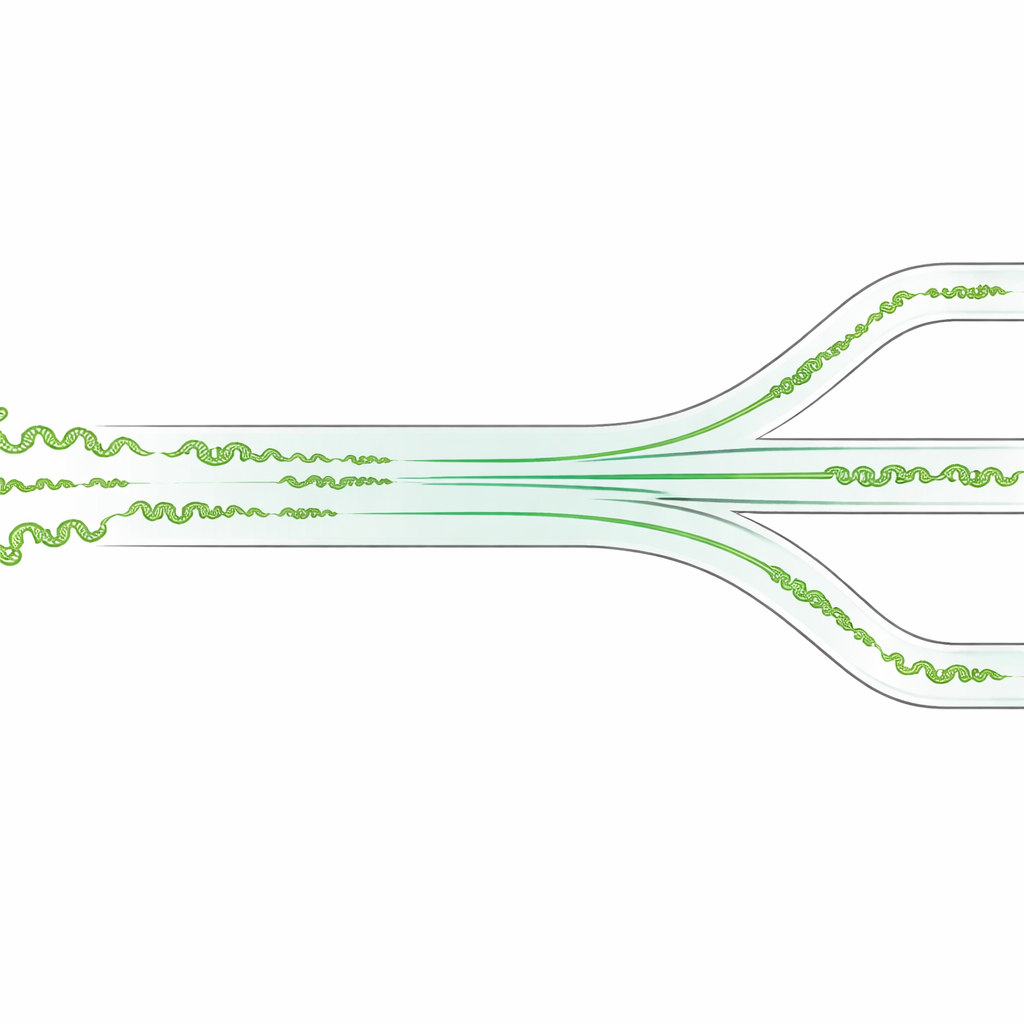
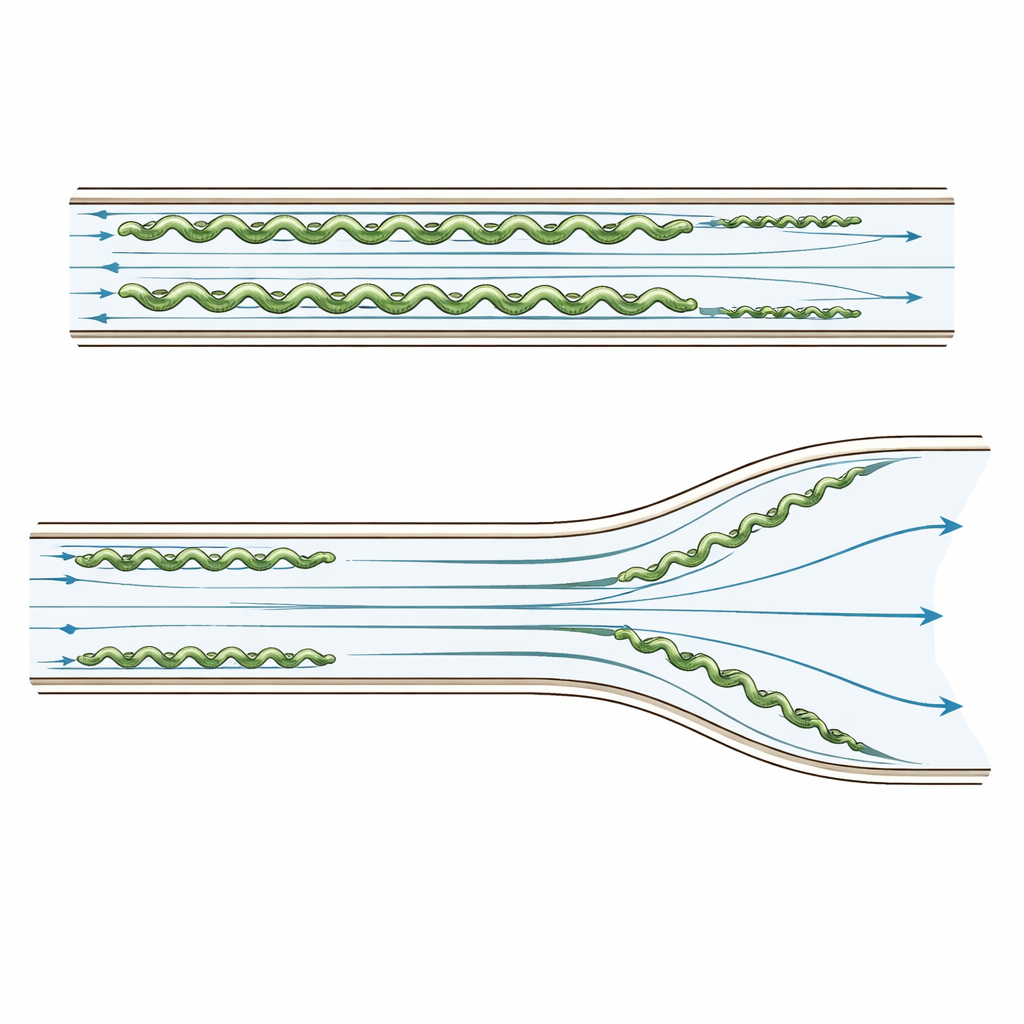
The team built a microfluidic device with four main parts: an inlet, a long straight channel, an expanding region, and several outlets. The straight channel is narrower than the average filament length, which forces each spiral to interact strongly with the channel walls and the internal flow pattern. High speed video revealed five repeating ways that filaments traveled here, ranging from unstable wiggling to stable shapes that either touched both walls, touched one wall, or stayed away from them. Shorter filaments were more likely to slide along one wall, while longer ones tended to bend into C shaped curves that spanned the width. The authors call this tendency for helical filaments to settle into preferred positions and angles the self alignment effect.
From hidden flow patterns to clean sorting
What happens after the straight channel is the key to sorting. As the flow enters a widening section, any slight sideways offset between filaments is stretched out, so that those near the center keep heading straight and those near the walls peel off toward the sides. By linking the measured flow patterns in the straight section to where each filament emerged in the outlets, the authors showed that long filaments were steered mainly to the central outlet, while short ones were guided to the outer outlets. At a particular flow rate, expressed by a Reynolds number of 40, the separation was strongest. For a threshold of 300 micrometers, camera based counting predicted purities above 85 percent for both short and long groups, and collected samples confirmed purities around 77 to 84 percent.
How flow shapes the spirals
To better understand why the self alignment arises, the researchers combined computer simulations with further experiments. Simulations of fluid motion in channels of different widths showed how the speed and shear rate vary across the cross section. Long filaments experience uneven forces along their length, which can bend them into shapes that mimic the curved flow profile. By changing channel width and flow strength, the team mapped out several distinct motion patterns, including oscillating motion in very narrow channels and nearly straight, crosswise orientations in wide ones. The useful self aligned patterns that lead to clean length based sorting appeared only within a moderate window of flow rate and confinement, which points to practical design rules for future devices.
What this means for Spirulina and beyond
In everyday terms, the study shows that simply pushing spiral shaped microbes through a well designed narrow tube can cause them to line up differently depending on how long they are, and that this natural ordering can be turned into a sorter with several exits. Because filament length in Spirulina is tied to growth stage and environmental history, this tool could help biologists study how different subgroups respond to light, salt, or pollutants, and help engineers pick filaments with the right shape for making fuels, bioplastics, or tiny helical templates for advanced materials. The authors note that the same principle should also apply to other helical microbes or flexible coils, suggesting a general, label free way to separate tiny spirals by how long they are.
Citation: Hara, K., Isozaki, A. Length-based separation of Arthrospira (Spirulina) platensis trichomes via the self-alignment effect of helical filaments in a straight microchannel. Microsyst Nanoeng 12, 164 (2026). https://doi.org/10.1038/s41378-026-01302-4
Keywords: Spirulina, microfluidics, cell sorting, helical filaments, cyanobacteria