Clear Sky Science · en
Elastic rebound engineering via leaf venation mimicry: boosting droplet spreading for high-performance triboelectric nanogenerators
Turning Raindrops into Useful Power
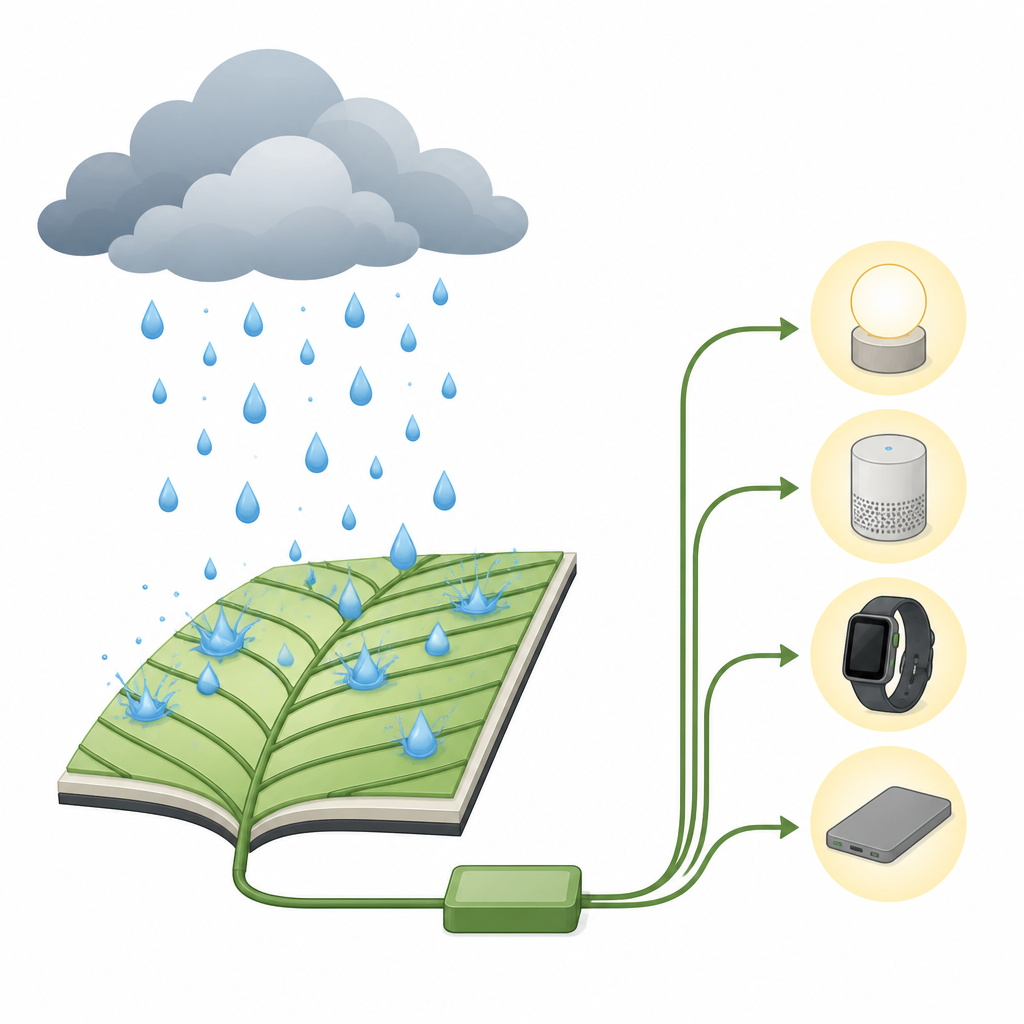
Imagine if every raindrop that hit a rooftop, greenhouse, or crop leaf could help power nearby sensors and small devices. This study explores exactly that idea, showing how copying the vein patterns of natural leaves can greatly improve tiny generators that harvest electricity from falling water droplets. By learning from the way real leaves guide and spread raindrops, the researchers design artificial “leaf” devices that squeeze far more electricity out of each drop, pointing toward new ways to power scattered electronics in fields, forests, and cities.
Why Leaf Patterns Matter
Plant leaves have evolved intricate networks of veins that do more than just move water around. Their alternating stiff veins and softer tissue help raindrops spread out instead of bouncing or splashing away. The team first tested real leaves from four plant species as the base of droplet-powered generators. They found that leaves with moderately spaced veins helped droplets spread the most and produced the highest voltages. In particular, one leaf type with veins several millimeters apart clearly outperformed smoother or very densely veined leaves. This confirmed that vein spacing strongly affects how a droplet flattens and spreads, which in turn controls how much electric charge can be collected.
Building an Artificial Leaf Generator
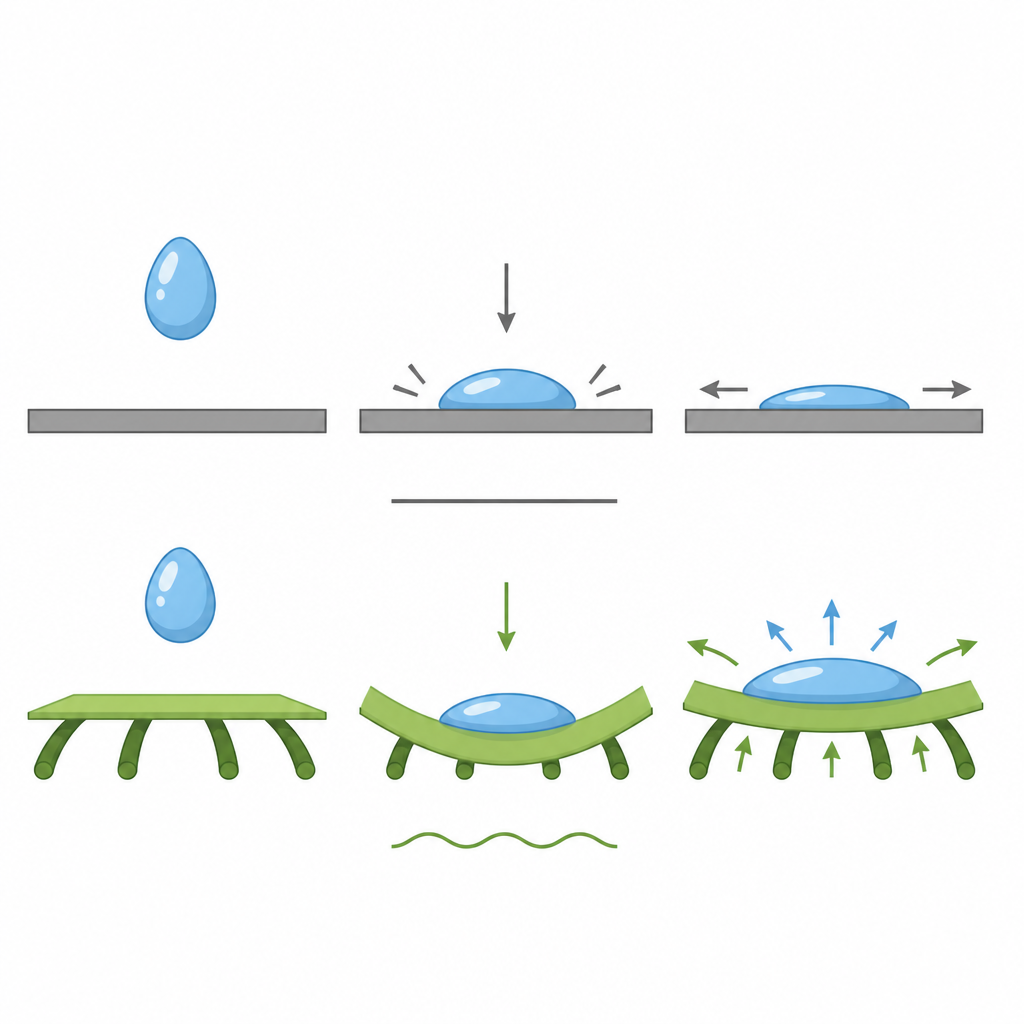
Real leaves, however, dry out, deform, and quickly lose performance, which makes them impractical for long-term devices. To solve this, the researchers built an artificial leaf droplet energy generator using 3D-printed plastic ribs covered by a thin flexible film and metal coatings. This design mimics the soft tissue stretched over stiff veins in a natural leaf. When droplets fall onto this structure, the film first bends down, then springs back, helping the water spread farther across the surface. Comparing this device with a standard flat generator under the same conditions, they observed striking gains: the artificial leaf more than doubled voltage and current and produced over two-and-a-half times more transferred charge, even though both surfaces had similar static wetness behavior.
Tuning the Shape for Maximum Effect
The team then systematically adjusted the geometry of their artificial leaf to see which shapes worked best. They varied the tilt of the whole device, the height from which droplets were released, the width and spacing of the veins, and the droplet size itself. The best results came when the spacing between veins closely matched the droplet diameter, and when the device was placed at a moderate angle. Under these conditions, droplets spread the most and the generator delivered the highest output. High-speed videos revealed why: if the veins are too close together, the surface behaves almost like a rigid plate and spreading is limited; if they are too far apart, the film absorbs too much energy and the droplet is damped. At just the right spacing, the bending and rebound of the film give energy back to the droplet, pushing it to spread farther than it would on a hard surface.
A New Way to Think About Droplet Energy
To capture this behavior, the researchers developed a physical model that links droplet speed, film stiffness, and the vein pattern to the maximum spreading area. The model highlights a “rebound-dominant” regime, where the flexible surface does not simply cushion the impact but actively feeds elastic energy back into the droplet. In this regime, spreading is enhanced instead of suppressed, which directly boosts charge generation. This is the first experimental demonstration of such rebound-enhanced spreading for droplet energy harvesting, and it suggests a new design rule: instead of just choosing better materials, engineers should tune the structure of the surface to control how it moves under impact.
From Single Drops to Real-World Use
Finally, the team showed how these artificial leaves can be stacked like a small vertical garden of devices. In a three-layer setup, the same droplet hits one device after another as it falls, delivering a sequence of voltage pulses. Although each layer produces slightly less than the one above, the total power is much higher than any single layer alone, and even the lowest layer still beats a conventional flat generator. With simple circuits, one device can light arrays of small lamps or charge capacitors that then run gadgets such as thermometers, calculators, fans, or even a laser strong enough to pop a balloon. For a layperson, the key message is that by copying how leaves handle rain and carefully shaping flexible surfaces, it is possible to turn gentle, scattered water drops into a steady trickle of useful electricity for sensors and small electronics in fields, greenhouses, and other places where plugging into the grid is difficult.
Citation: Sun, Z., Zeng, X., Zhou, A. et al. Elastic rebound engineering via leaf venation mimicry: boosting droplet spreading for high-performance triboelectric nanogenerators. Microsyst Nanoeng 12, 176 (2026). https://doi.org/10.1038/s41378-026-01299-w
Keywords: droplet energy harvesting, triboelectric nanogenerator, leaf-inspired design, rainfall energy, flexible surfaces