Clear Sky Science · en
Suppressing laser-power noise with a multifunctional liquid crystal polarization grating in miniaturized optically pumped magnetometers
Listening to the Brain’s Quietest Whispers
Many of the most important signals in our bodies are incredibly faint magnetic fields, created by the firing of brain cells and the beating of the heart. Measuring these whispers usually calls for room‑sized machines cooled with liquid helium. This paper describes a new way to build much smaller, cheaper, and more stable magnetic sensors that could one day make high‑resolution brain and heart imaging more accessible outside of specialized labs.
Why Tiny Magnetic Sensors Matter
Magnetic sensing is crucial in fields as diverse as mapping the Earth’s crust, hunting for new physics, and diagnosing neurological or heart disease. Today’s gold‑standard machines rely on superconducting devices that must be kept a few degrees above absolute zero, which makes them expensive and hard to move. Optically pumped magnetometers, by contrast, work at or near room temperature. They use laser light and a small glass cell of alkali atoms to “pump” the atoms into a special state that is extremely sensitive to magnetic fields. Because these sensors can sit close to the scalp or chest, they promise sharper views of brain and heart activity. The challenge has been to shrink them while keeping them quiet and precise.
The Problem with Bulky Optics and Noisy Lasers
Conventional designs for these optical magnetometers use a single laser beam that both prepares the atoms and probes their response. To do this properly, the light must be shaped into a very specific swirling polarization, usually achieved with several stacked glass elements that need careful alignment. These bulky parts take up space, complicate assembly, and are easily disturbed by temperature changes or small mechanical shifts, which in turn upset the polarization and intensity of the light. On top of that, even tiny jitters in the laser’s power show up directly in the sensor’s output, masking the very weak magnetic signals from the body. Existing methods to tame this noise often add yet more hardware, fighting against the goal of miniaturization.
A Flat, Smart Grating that Does Two Jobs at Once
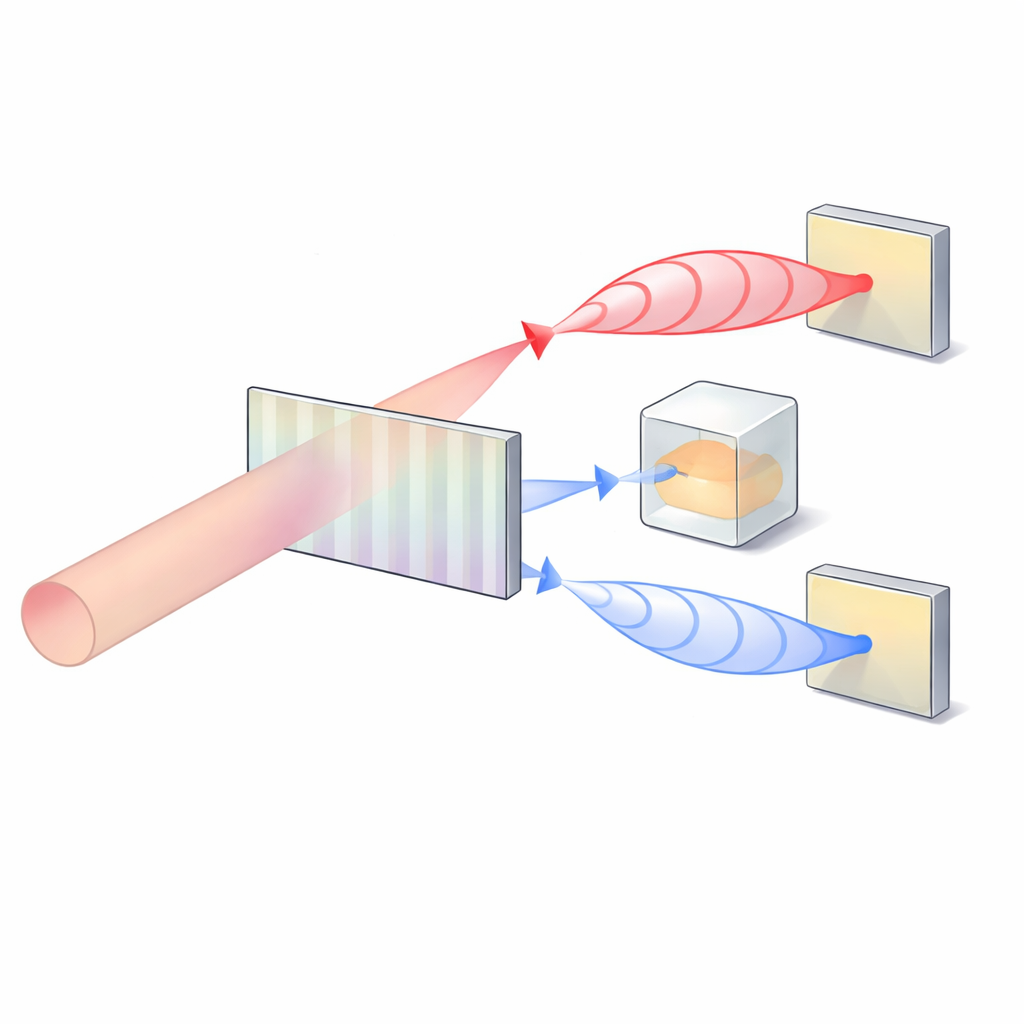
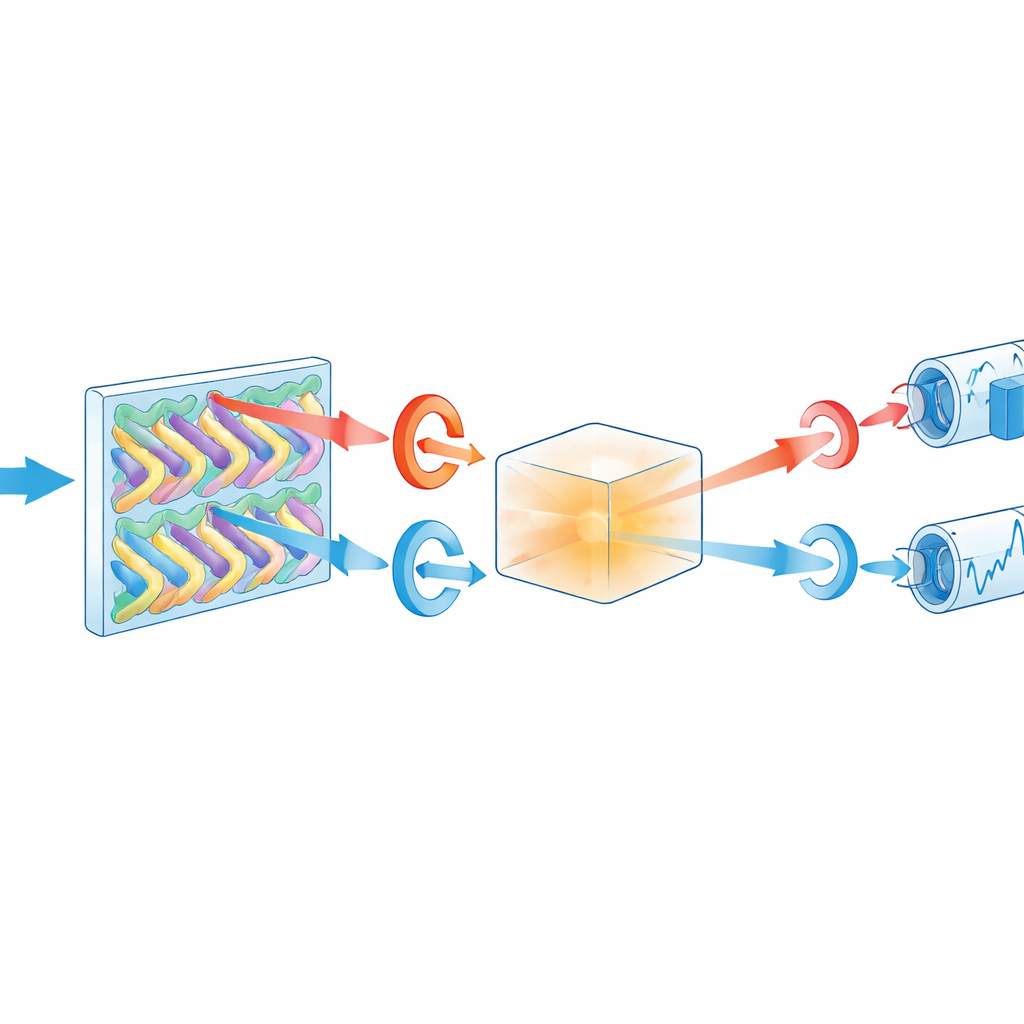
The authors tackle both issues at once using a single flat liquid‑crystal polarization grating. This wafer‑like element consists of liquid‑crystal molecules whose orientation slowly twists in a repeating pattern across the surface. When linearly polarized laser light passes through, the grating converts it very efficiently into two beams of circularly polarized light that peel away from each other at a sizable angle. One beam travels through a tiny cube containing rubidium atoms and emerges carrying information about the magnetic field; the other serves as a clean reference. Because the grating both shapes the polarization and splits the beam, it replaces several conventional optics in one ultra‑thin layer. The team shows that it converts light at the key wavelength with over 95% efficiency and nearly ideal circular polarization, and that its performance barely changes as the input polarization, temperature, or angle of the beam drifts.
How the New Design Quiets the Noise
The heart of the new sensor is a differential readout scheme enabled by this smart grating. After the grating, one circularly polarized beam pumps the rubidium atoms, whose spins align and then precess in response to an external magnetic field, slightly changing how much light passes through the cell. A detector measures this transmitted beam. The second, identical beam bypasses the cell and hits a separate detector. Because both beams originate from the same laser, any fluctuation in laser power shows up in both detectors at nearly the same time. By electronically subtracting the two signals, the common laser noise largely cancels out, while the true magnetic signal—present only in the beam that passed through the atoms—remains. Experiments in a carefully shielded environment show that the single‑ended mode of this new sensor already matches or slightly beats a traditional design. When operated in differential mode, its sensitivity improves by about 28%, reaching 8.6 femtotesla per square‑root hertz, all in a probe just four cubic centimeters in volume.
From Lab Prototype to Future Wearable Scanners
The study concludes that liquid‑crystal polarization gratings offer a practical path to smaller, cheaper, and more reliable quantum magnetometers. The device’s flat, robust structure can be made using mature, high‑throughput liquid‑crystal manufacturing, offering an advantage over more exotic nanofabricated optics. By simultaneously simplifying the optical train and cutting down laser noise, the new architecture balances efficiency, stability, and cost in a way that is well suited to arrays of sensors placed around the head or body. With further refinements, such as electrically adjustable balancing and beam steering, this approach could underpin next‑generation portable brain and heart imaging systems, bringing ultra‑sensitive magnetic measurements closer to everyday clinical use.
Citation: Cui, Z., Xiao, X., Wei, Z. et al. Suppressing laser-power noise with a multifunctional liquid crystal polarization grating in miniaturized optically pumped magnetometers. Microsyst Nanoeng 12, 161 (2026). https://doi.org/10.1038/s41378-026-01297-y
Keywords: optically pumped magnetometer, biomagnetic imaging, liquid crystal polarization grating, quantum sensor, magnetoencephalography