Clear Sky Science · en
Yeast-powered microfluidic pump based on a four-parameter fermentation model
Turning Bread Yeast into a Tiny Engine
Most people know baker’s yeast as the ingredient that makes bread rise. This study shows that the same everyday organism can quietly power tiny pumps for lab-on-a-chip devices. By using the gas that yeast naturally releases during fermentation, the researchers built a simple, low-cost pump that can move small amounts of fluid without wires, batteries, or bulky machinery. Such a biological pump could help run portable diagnostic tools, classroom experiments, or instruments in places where electricity is scarce or unreliable.
How Yeast Becomes a Source of Push
When yeast feeds on sugar, it produces carbon dioxide gas. In this work, the team trapped yeast and sugar water inside a sealed chamber connected to a small piston. As fermentation progressed, gas slowly built up, pushing the piston and driving liquid from a reservoir into connected microfluidic channels. The ingredients are familiar and inexpensive: instant dry yeast, table sugar, and water, all packaged into a hand-sized device. Because the yeast is kept in a separate chamber from the working liquid, the pump can power delicate tests without contaminating the samples.
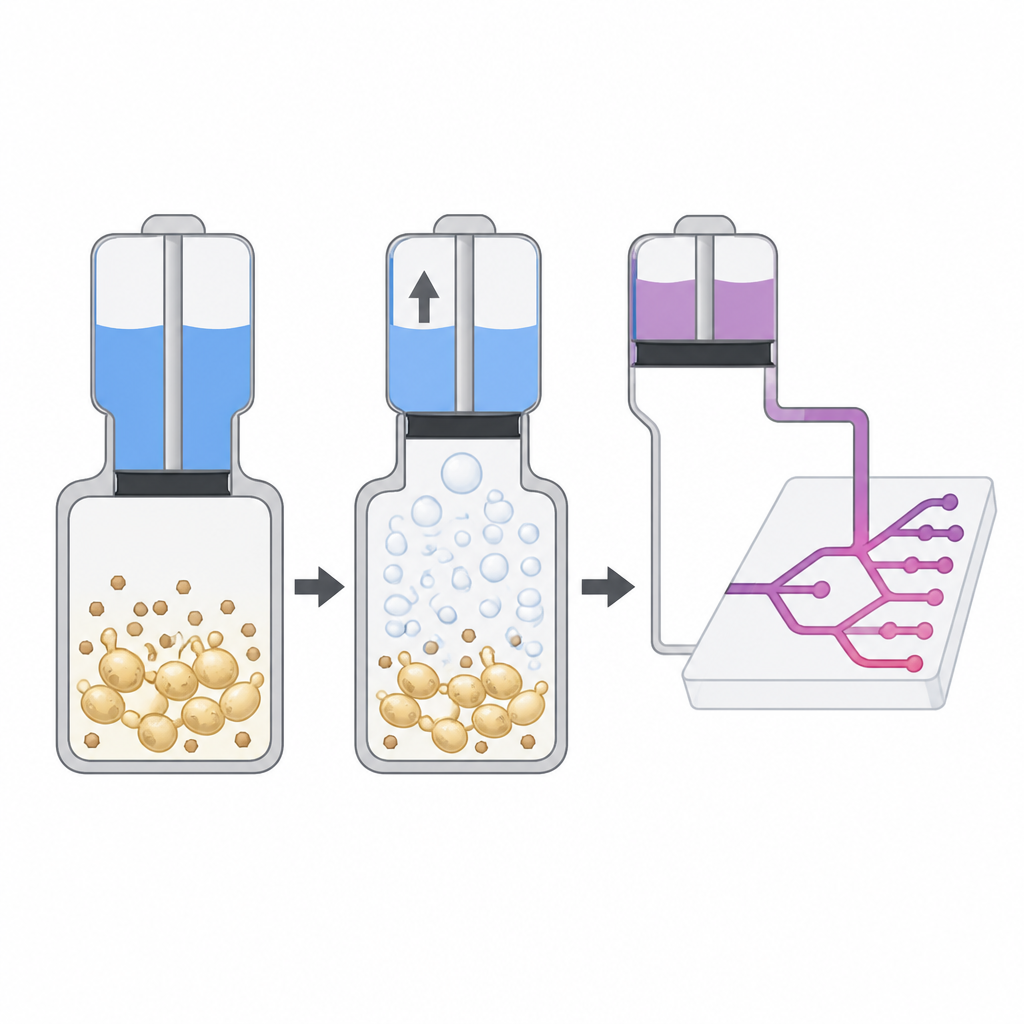
Tuning the Pump with Yeast and Sugar
The researchers explored how the amount of yeast and the sugar concentration shape the pump’s behavior. They defined three simple operating stages: a startup period while the yeast wakes up and the liquid becomes saturated with gas, a stable period with nearly steady flow, and a decline period as easy fuel runs out and byproducts build up. Adding more yeast made the pump work faster but shortened how long it could run, because the fuel was used up more quickly. Changing the sugar level mainly stretched or shortened the total run time while only modestly affecting the peak flow rate. This separation means users can choose yeast mass to set how fast the pump pushes, then adjust sugar to decide how long it will keep going.
Capturing a Complex Process in a Simple Curve
Although yeast metabolism is complex, the team showed that the pump’s gas output over time can be accurately captured with a compact mathematical description. They built a model that combines smooth growth and decay curves to represent the startup, stable, and decline phases. After testing a more detailed six-parameter version, they found that a leaner four-parameter form matched the total gas volume better and was easier to use. They then went a step further, expressing those hidden parameters directly in terms of only two knobs that an experimenter cares about: yeast mass and sugar concentration. Within a practical range, this two-parameter view lets users predict how hard and how long the pump will run, using only recipe-like inputs instead of advanced calculations.
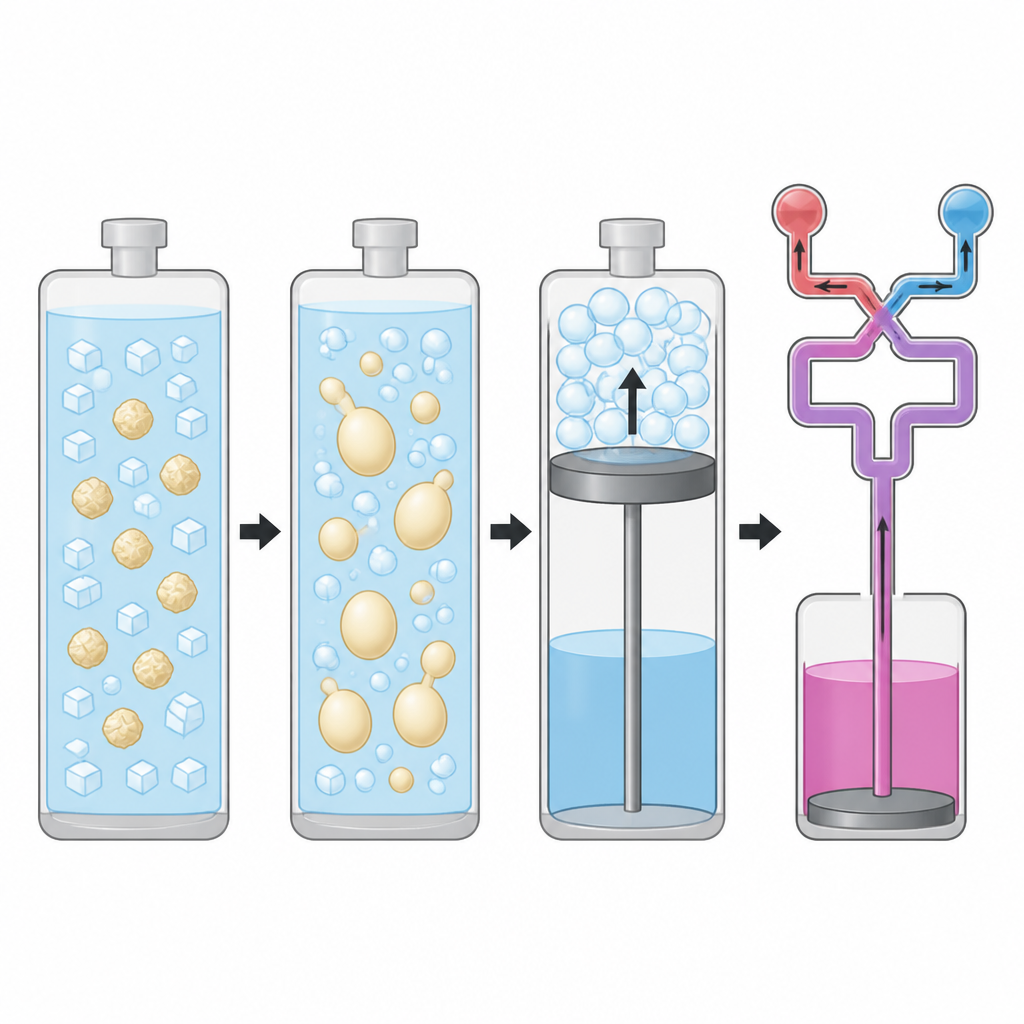
From Proof of Concept to Real Microfluidic Tasks
To show that the yeast pump can do useful work, the authors powered the formation of tiny oil droplets in a microchannel, a common operation in lab-on-a-chip systems. The yeast-generated pressure was far higher than what the small channels required, leaving ample margin for more complex setups. The same biological power source was also adapted into alternate designs, including a version that replaces the piston with a gas-permeable membrane and another that pulls fluid in by suction rather than pushing it out. These variations highlight how flexible the basic idea is once the yeast and gas are safely confined.
Why a Yeast-Powered Pump Matters
This study turns a familiar kitchen organism into a controllable, self-contained power unit for microfluidic devices. By pairing a simple sugar solution with instant yeast, the authors created a predictable source of gentle, long-lasting pressure that can be tuned using only two recipe parameters. Because the pump is compact, cheap, and untethered from electrical outlets, it could support portable diagnostic chips, educational kits, and experiments in space or remote environments. In short, yeast is not just for baking; it can also serve as a reliable tiny engine for moving fluids in the miniature laboratories of the future.
Citation: Kim, J., Kim, K., Baeck, S. et al. Yeast-powered microfluidic pump based on a four-parameter fermentation model. Microsyst Nanoeng 12, 182 (2026). https://doi.org/10.1038/s41378-026-01294-1
Keywords: yeast fermentation, microfluidic pump, passive pumping, lab-on-a-chip, biological actuator