Clear Sky Science · en
Closed-crown packaging system for stable, long-term neural recording in group-housed mice
Why protecting tiny brain sensors matters
Many studies of brain disorders in people rely on watching how brain cells fire in mice as the animals move, explore, and interact. But the hardware that records these signals is fragile, especially when mice live together and tug or chew on one another’s head-mounted devices. This paper introduces a new protective "closed-crown" housing that shields delicate brain probes so scientists can record brain activity for weeks while mice live in normal social groups instead of in stressful isolation.
How brain recordings are usually done
To listen to brain cells, researchers implant hair-thin probes into regions such as the hippocampus, a deep brain area involved in memory and mood. These probes connect by tiny cables to outside electronics that capture electrical spikes. Standard setups leave connectors and cables partly exposed above the skull in an "open crown" of dental cement. That is workable when a mouse lives alone, but in shared cages, cage mates can bite or pull the cables, breaking connections, contaminating the hardware, and abruptly ending experiments. To avoid this, many labs single-house implanted mice, which removes natural social contact and can itself change brain and behavior.
A protective crown on the mouse’s head
The team designed a light plastic housing that fully covers the probe connector and cable like a helmet. This closed crown is 3D printed in two versions: a sliding-lid style for quick access and a screw-cap style that locks more firmly for rougher conditions. Inside the lid they place a tiny near-field communication (NFC) tag, similar to what is used in contactless cards. By simply bringing a smartphone close to a mouse, researchers can identify that animal without ear punches or ink marks. The crown’s inner space also leaves room for future add-ons, such as wireless transmitters or power coils, all while keeping the total weight under about one gram so normal movement is preserved. 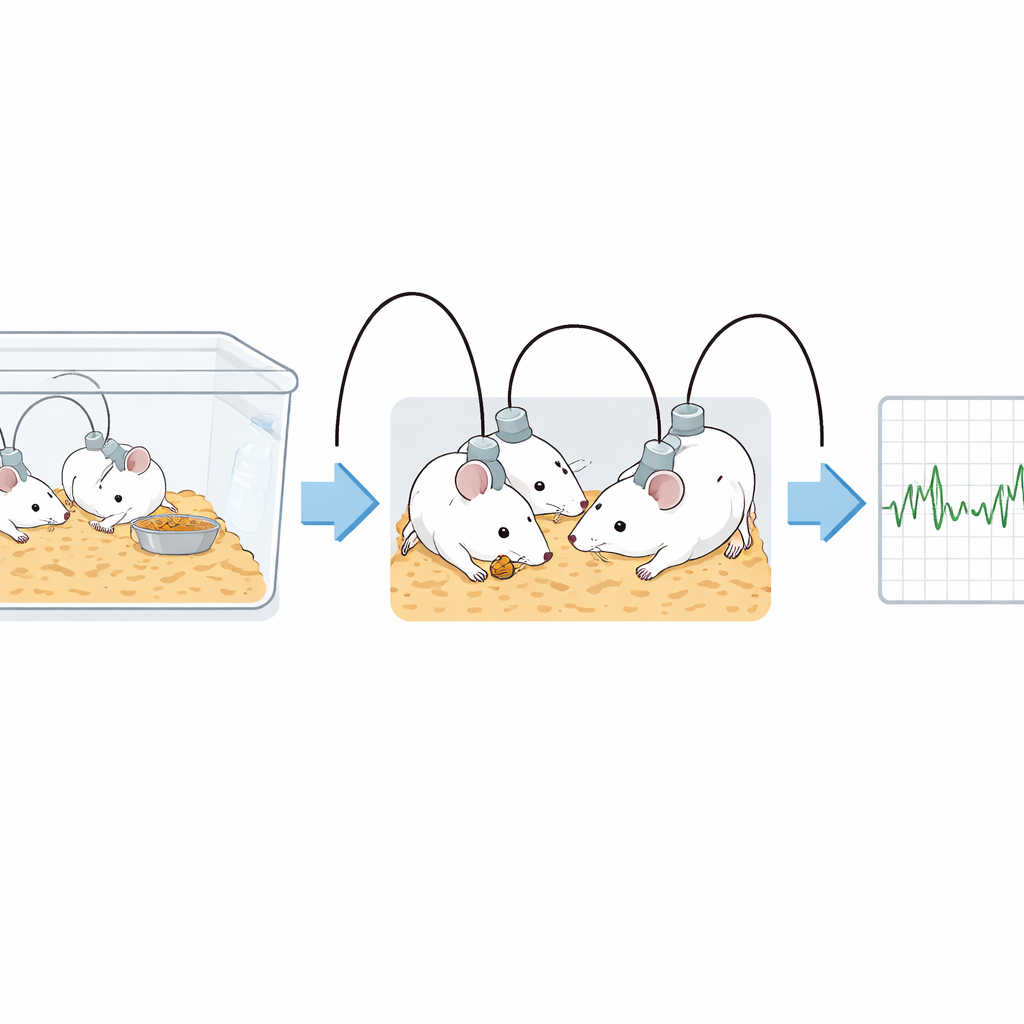
Smarter cables and better electrodes
Alongside the crown, the authors improved key parts of the recording hardware. The metal contact sites on the probe are coated with a rough "black" form of platinum that increases the effective surface area. This change lowers electrical resistance by one to two orders of magnitude at the frequencies important for nerve signals, helping the system pick up clear spikes from single cells with less noise over many weeks. They also swapped the usual thick plastic-coated cable for an ultra-thin, highly flexible version made with a special insulating layer. Mechanical tests showed that this new cable withstands more twists and tens of thousands of bending cycles while keeping its electrical resistance almost unchanged, meaning it can move with the animal without straining the probe inside the brain.
Testing in real social living conditions
To see how well the system works in practice, the researchers implanted the probes into the hippocampus of mice and then compared three head setups under group housing: the standard open crown, an open crown temporarily covered with medical tape, and the new closed crown. In shared cages, exposed or taped cables were quickly chewed, pulled loose, or broken, sometimes within hours, making further recording impossible. In contrast, mice with the closed crown showed no visible damage to cables or connectors. Electrical measurements confirmed that contact resistance remained stable over weeks. Neural spikes from the same locations in the hippocampus could still be detected several weeks after implantation, even though some gradual decline in signal strength occurred over time due to the brain’s normal tissue response, not because of mechanical failure.
Do the crowns change how mice behave?
Because social and emotional measures are central to many brain studies, the team ran standard behavioral tests to make sure the crown itself did not stress the animals. In an open field test that measures movement and anxiety-like behavior, mice wearing the crown moved just as far and explored the central area as much as mice without implants. When the researchers compared group-housed versus isolated mice, both with and without crowns, it was isolation rather than the device that altered behavior. Isolated mice showed more signs linked to anxiety, such as avoiding open areas, and spent more time focusing on a stranger mouse in a social test, consistent with pent-up social drive. Group-housed mice wearing crowns behaved like normal group-housed controls, suggesting that living with other mice remains natural despite the headgear. 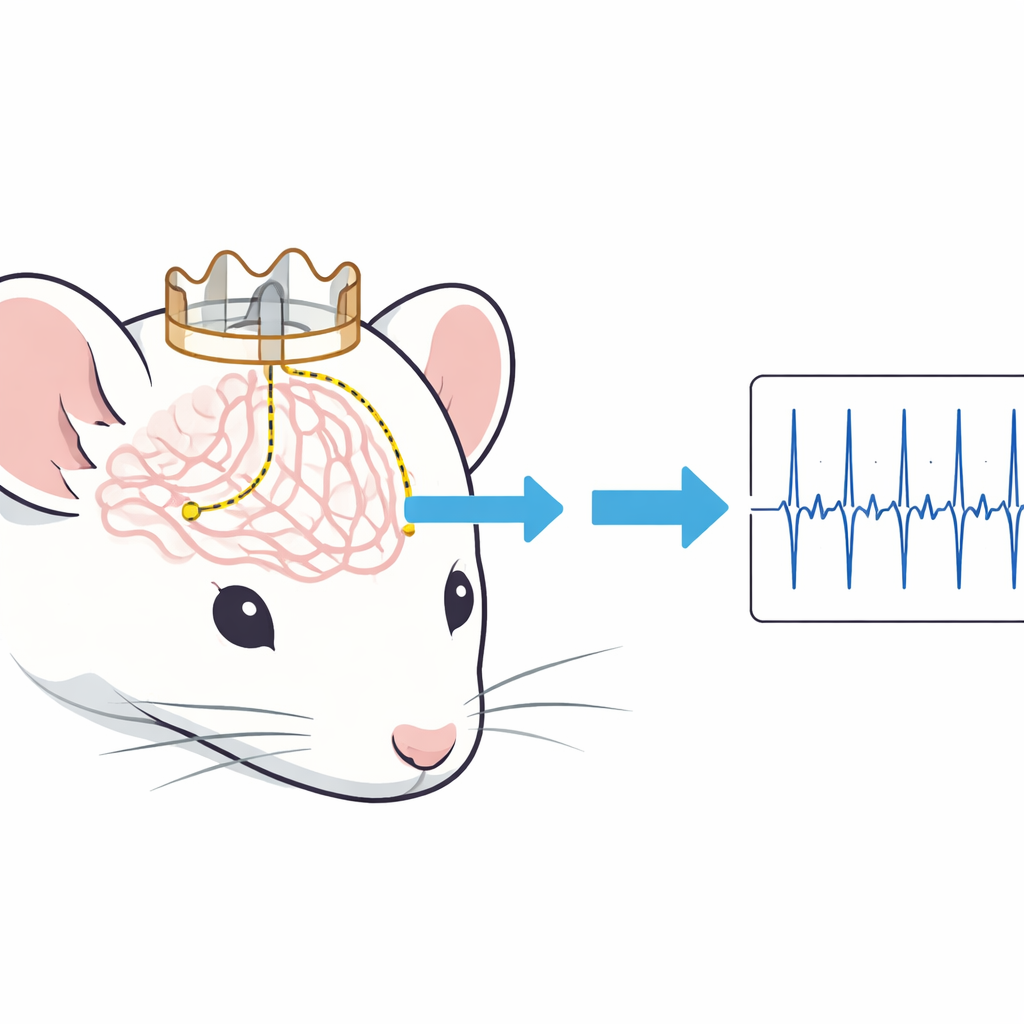
What this means for brain and behavior research
This study shows that a small protective crown and flexible cable system can guard brain-recording hardware from chewing and impacts while leaving social life and movement largely unchanged. That means researchers can follow brain cell activity for weeks as mice live in realistic social settings, instead of relying on isolated animals whose behavior may be distorted by loneliness. In the long run, such stable, socially compatible recording setups should help scientists better understand how changes in social environment shape brain circuits involved in depression, anxiety, and other neuropsychiatric disorders, and could inform the development of more effective treatments.
Citation: Hong, Y., Kim, G., Lee, H. et al. Closed-crown packaging system for stable, long-term neural recording in group-housed mice. Microsyst Nanoeng 12, 168 (2026). https://doi.org/10.1038/s41378-026-01293-2
Keywords: neural recording, group-housed mice, brain implants, social behavior, neuropsychiatric research