Clear Sky Science · en
All-sapphire-based high-temperature pressure sensor system with in situ temperature compensation: innovative cavity design, fabrication, and APSC-FFT algorithm
Measuring Pressure Where Few Sensors Survive
Inside nuclear reactors and jet engines, temperatures soar high enough to soften metal and fry electronics, yet engineers still need to know exactly what the pressure is doing to keep these machines safe and efficient. This paper presents a new kind of pressure sensor made almost entirely from sapphire crystal that can keep working reliably in these brutal conditions, measuring both temperature and pressure at once and staying stable even after being heated to 1500 °C.
Why Extreme Machines Need Better Senses
Modern energy and aerospace systems push materials to their limits. In gas-cooled nuclear reactors, the coolant gas can reach around 800 °C at pressures near 1 megapascals, while inside aero‑engine combustion chambers, temperatures can exceed 1300 °C. Conventional electrical pressure sensors struggle here: their electronic properties drift, and electromagnetic noise can spoil the readings. Even temperature sensors such as thermocouples and infrared methods lose accuracy across the full range. The work described in this paper tackles this challenge with an optical approach that is naturally immune to electrical interference and better suited to harsh, corrosive, and very hot environments.
A Sapphire Chip That Reads Light Instead of Voltage
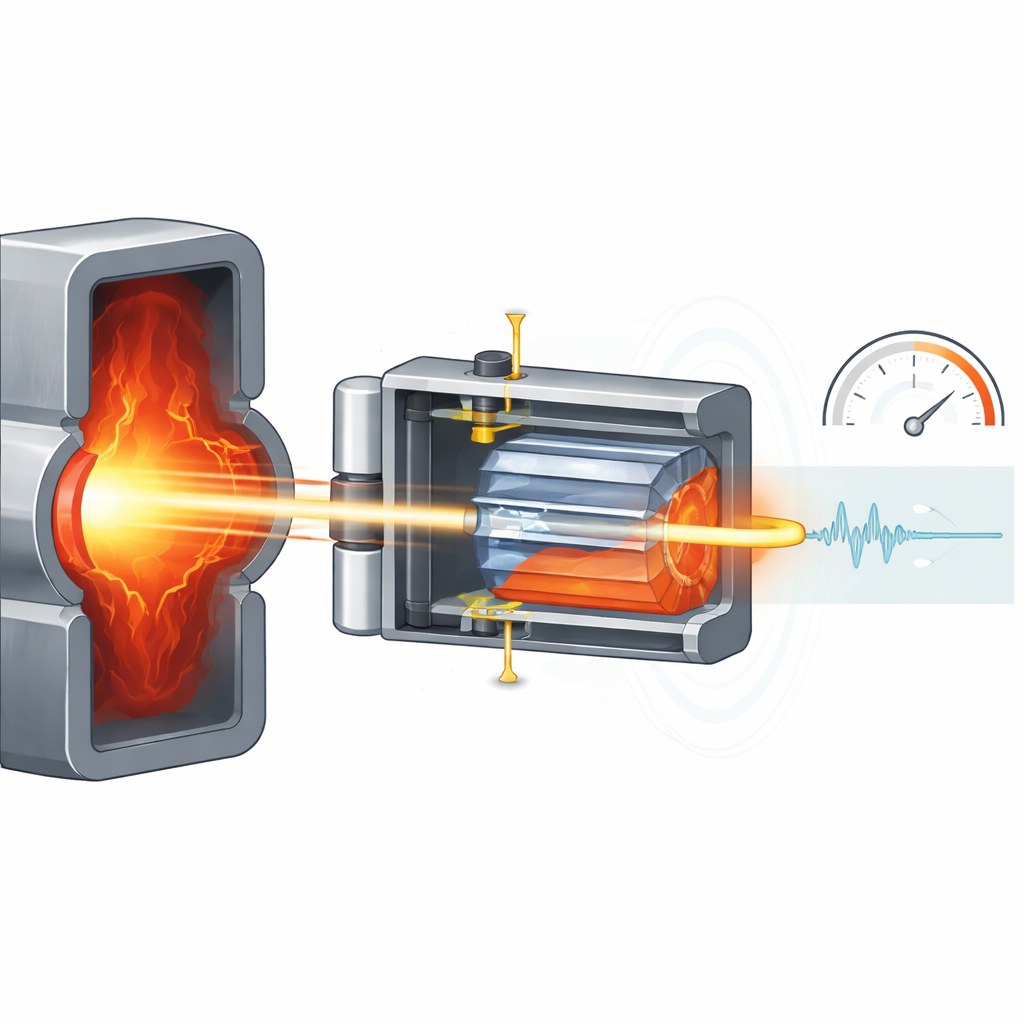
The heart of the device is a tiny chip carved from a single piece of sapphire and bonded to a sapphire diaphragm that flexes when pressure changes. Light from a broadband source travels down an optical fiber, passes through a small lens, and enters this chip. Inside, it bounces between carefully spaced, mirror-like sapphire surfaces to form what physicists call Fabry–Perot cavities—essentially microscopic optical echoes whose spacing controls which colors of light interfere constructively. By analyzing the reflected spectrum, the system can deduce the exact distances between surfaces inside the chip, which in turn reveal both temperature and pressure.
To tease apart these two quantities, the researchers designed a composite cavity structure. One cavity is formed entirely within a rigid sapphire layer and hardly responds to pressure but expands with temperature, acting as an in‑situ thermometer. A second cavity spans an air gap between the rigid sapphire and the flexible diaphragm, so its length changes with both pressure and temperature. By calibrating how each cavity length responds to known conditions, the system can separate the two influences and compensate the pressure reading for temperature shifts automatically.
A Smart Diaphragm for Cleaner Optical Signals
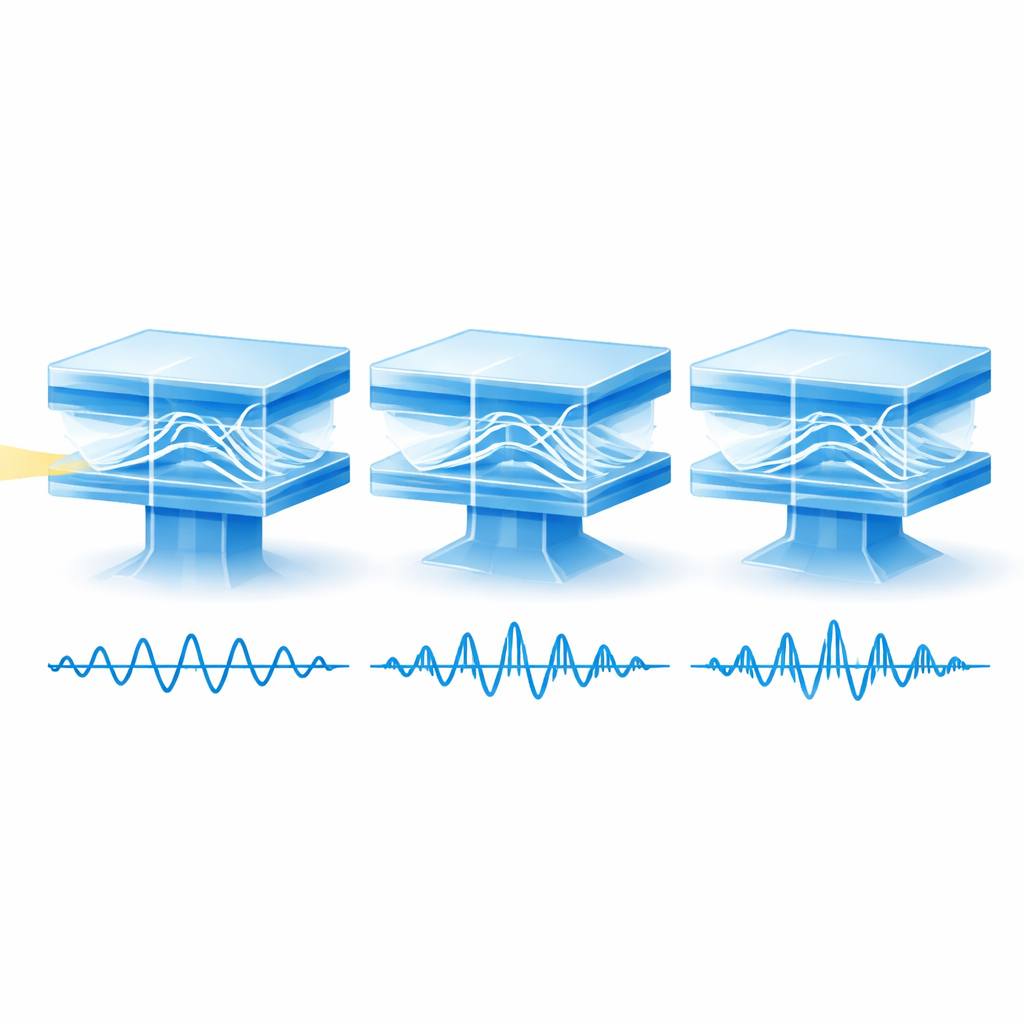
A key mechanical innovation is the shape of the pressure-sensitive diaphragm. Many pressure sensors rely on a flat membrane, which bows strongly under load. While that boosts sensitivity, it also bends unevenly across the illuminated spot, blurring the optical interference pattern and degrading measurement accuracy. Here, the team introduced a central pedestal—a small raised platform—on the diaphragm where the light is focused. The diaphragm still flexes enough to be sensitive, but the pedestal itself deforms very little. Simulations show that this design keeps variations in the air gap over the light spot small, preserving high contrast in the spectrum and improving the precision with which cavity lengths can be extracted.
Precision Carving and Bonding at Extreme Heat
Building such a structure in sapphire is far from trivial. The researchers refined a wet chemical etching process that could sculpt cavities and the pedestal into the crystal while keeping the surface extremely smooth; roughness on the order of just 13 nanometers helps the internal surfaces act as good optical mirrors. They etched the sapphire in three carefully controlled steps to define the pressure-sensitive region, the reference cavity, and the pedestal. Then they directly bonded the etched diaphragm to a sapphire substrate at very high temperature and pressure, first forming temporary hydrogen bonds at 200 °C and then locking the pieces together with strong covalent bonds above 1000 °C. Tests showed that the resulting chips remained intact and optically stable after being held at 1500 °C for a day and cooled back down.
Smarter Signal Processing for Finer Detail
Even with an excellent chip, extracting tiny changes in cavity length from the reflected spectrum requires careful mathematics. The authors developed an adaptive peak-shift correction algorithm built on the fast Fourier transform, a standard tool for converting the spectrum into a form where cavity lengths appear as peaks. Because real measurements are finite and discretely sampled, these peaks tend to broaden and distort, which can shift the estimated cavity length by many nanometers. The new algorithm repeatedly fine-tunes how the spectrum is resampled in “wavenumber” space so that the Fourier peaks become symmetrical. This self-correction step brings the inferred cavity lengths into near-perfect alignment with their true values, cutting typical errors by about two orders of magnitude while keeping the processing fast enough for real-time sensing.
Proving It Works in Harsh Conditions
The finished sensor, packaged in a metal housing with a gold-coated fiber and quartz lens, was tested across temperatures from 28 to 800 °C and pressures from 0 to 1.2 MPa. After calibration, the system achieved temperature measurement errors below 0.13% of the full range and pressure errors below 0.18% of full scale, with excellent repeatability and long-term stability over 120-hour tests at both low and high temperature. Importantly, even after high‑temperature annealing at 1500 °C, the cavity lengths and optical signals returned to essentially the same values, showing that the sapphire chip itself can tolerate temperatures well beyond those encountered in typical reactors or engines.
What This Means for Future Engines and Reactors
For non-specialists, the core message is that the authors have built a tiny, crystal-based “eye” that can watch pressure and temperature deep inside some of the hottest parts of energy and aerospace systems, without falling apart or losing accuracy. By combining rugged sapphire mechanics, clever cavity design, and a refined data-processing algorithm, the sensor can deliver precise readings where traditional devices fail. As packaging and fiber materials catch up to the chip’s inherent heat tolerance, this technology could become a key tool for making next-generation reactors and jet engines safer, more efficient, and easier to monitor in real time.
Citation: Tan, J., Qin, F., Wang, N. et al. All-sapphire-based high-temperature pressure sensor system with in situ temperature compensation: innovative cavity design, fabrication, and APSC-FFT algorithm. Microsyst Nanoeng 12, 159 (2026). https://doi.org/10.1038/s41378-026-01290-5
Keywords: high-temperature pressure sensor, sapphire optical sensor, Fabry-Perot cavity, extreme environment monitoring, MEMS wet etching