Clear Sky Science · en
Flexible microscale tactile display with liquid-to-gas phase-change actuator array
Feeling the Digital World on Your Skin
Touch is a powerful way we understand the world, yet most digital devices speak only to our eyes and ears. This study introduces a fingertip-sized tactile display that can recreate detailed touch sensations, such as the feeling of a tiny insect walking across your skin. By making this device thin, flexible, and energy efficient, the researchers move us closer to virtual reality and wearable gadgets that let you truly feel what you see.
A Tiny Screen for Your Sense of Touch
The device is essentially a flexible patch covered with a closely spaced grid of microscopic bumps. Each bump can gently rise and fall against the skin, much like individual pixels of a display, but for pressure instead of light. The bumps are smaller than a millimeter, similar in size to the most sensitive touch receptors in the fingertip. This fine spacing lets the system deliver detailed patterns of pressure, so users can sense shapes, edges, and textures rather than just simple on or off vibrations.
Making Motion from Liquid and Heat
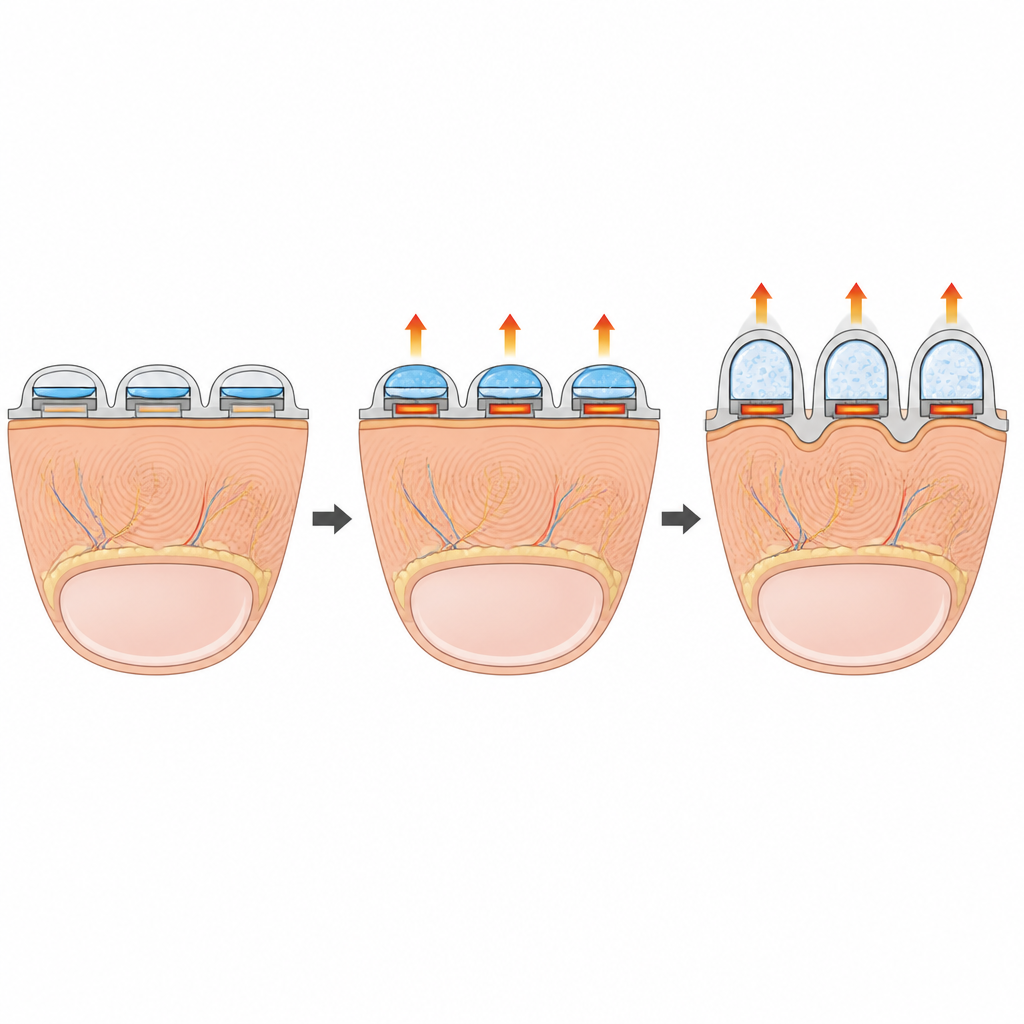
At the heart of each bump is a tiny chamber filled with water sealed under a stretchy rubber-like membrane. Beneath the chamber sits a microscopic metal heater printed on a thin plastic film. When the heater warms the water, part of it turns to vapor and expands, pushing the soft membrane upward to form a small dome that presses on the skin. When the heater is turned off, the vapor cools and condenses back into liquid, the dome flattens, and the pressure disappears. By simply changing how much power is sent to the heater, the team can smoothly adjust how far each bump rises and how strongly it presses.
Small Size, Fast Response, and Safe Touch
Shrinking these liquid-filled chambers to the microscale gives the device important advantages. Because each chamber is tiny, it heats up and cools down quickly, allowing the bumps to move in a fraction of a second. The researchers measured displacements up to about half a millimeter while using only a few hundred milliwatts of power per bump. This motion is large enough for the fingertip to clearly feel static pressure and graded differences in force. Careful tests showed that neighboring bumps hardly affect each other, that the device works reliably when bent around curved surfaces like a finger, and that the outer surface stays only mildly warm, making it comfortable and safe for skin contact.
From Lab Bench to Virtual Ladybug
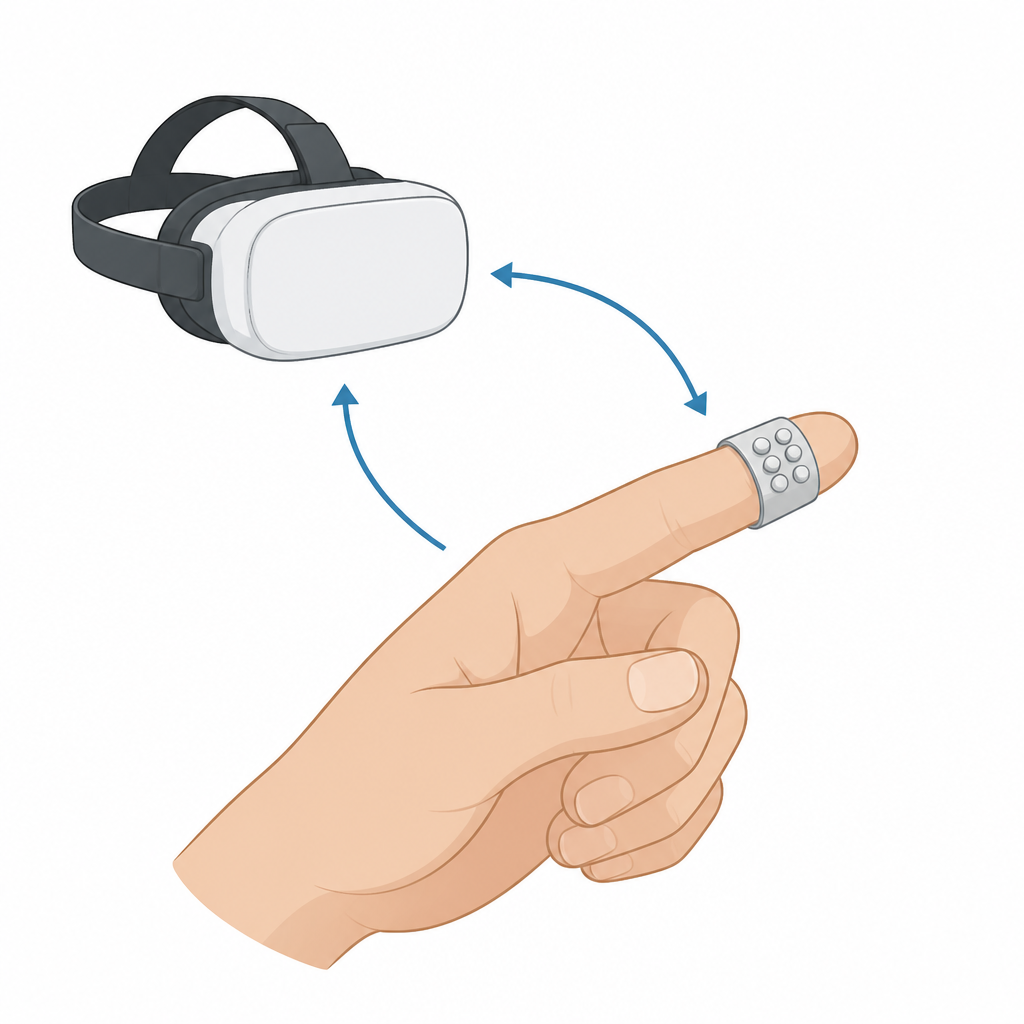
To show what these capabilities mean in practice, the team built arrays of up to 36 bumps on a thin plastic strip and attached them to a fingertip. They then linked the strip to a virtual reality headset displaying a ladybug walking across a finger. By turning specific bumps on and off in timed patterns that matched the insect’s steps, they recreated the feeling of tiny legs moving along the skin. Volunteers reported that synchronized touch made the scene feel more real and immersive compared with visuals alone, suggesting that such arrays can meaningfully enhance virtual experiences.
What This Could Mean for Everyday Devices
This work demonstrates that a very thin, flexible patch can deliver rich, controllable touch sensations using simple ingredients: water, heat, and soft rubber. The display can bend around a fingertip, respond in under a second, and produce forces and motions the skin can easily detect, all while using modest power. For non-specialists, the takeaway is that future headsets, gloves, and wearables may not just show and play sound, but also press back in lifelike ways, making digital objects feel more like things you can actually touch.
Citation: Sim, S., Bae, K., Hwang, K. et al. Flexible microscale tactile display with liquid-to-gas phase-change actuator array. Microsyst Nanoeng 12, 185 (2026). https://doi.org/10.1038/s41378-026-01288-z
Keywords: tactile display, haptic interface, flexible actuator, virtual reality touch, phase change