Clear Sky Science · en
Implementation of reservoir computing using coupled microelectromechanical drum resonators via sideband-pumped phonon–cavity dynamics
Smart tiny drums that learn from vibrations
Imagine if a sensor could not only detect a signal, but also learn from it and make predictions on the spot. This paper shows how a pair of microscopic vibrating “drums” on a chip can act as a simple learning machine, opening a path toward gadgets that sense, process, and decide without sending data to distant computers.
Turning vibrations into computation
The work builds on a branch of machine learning called reservoir computing, designed to handle information that unfolds over time—such as spoken words, heartbeats, or seismic signals. Instead of training a large network of artificial neurons, reservoir computing feeds an input signal into a complex physical system whose internal dynamics naturally mix and remember past inputs. Only the final output stage is trained, which greatly cuts energy and hardware costs. The authors use micro‑electro‑mechanical systems (MEMS): tiny mechanical parts that can vibrate millions of times per second while being driven and read out electrically. MEMS are already widely used as sensors in smartphones and cars, and their natural nonlinear vibrations and finite “ring‑down” times make them well suited as physical reservoirs.
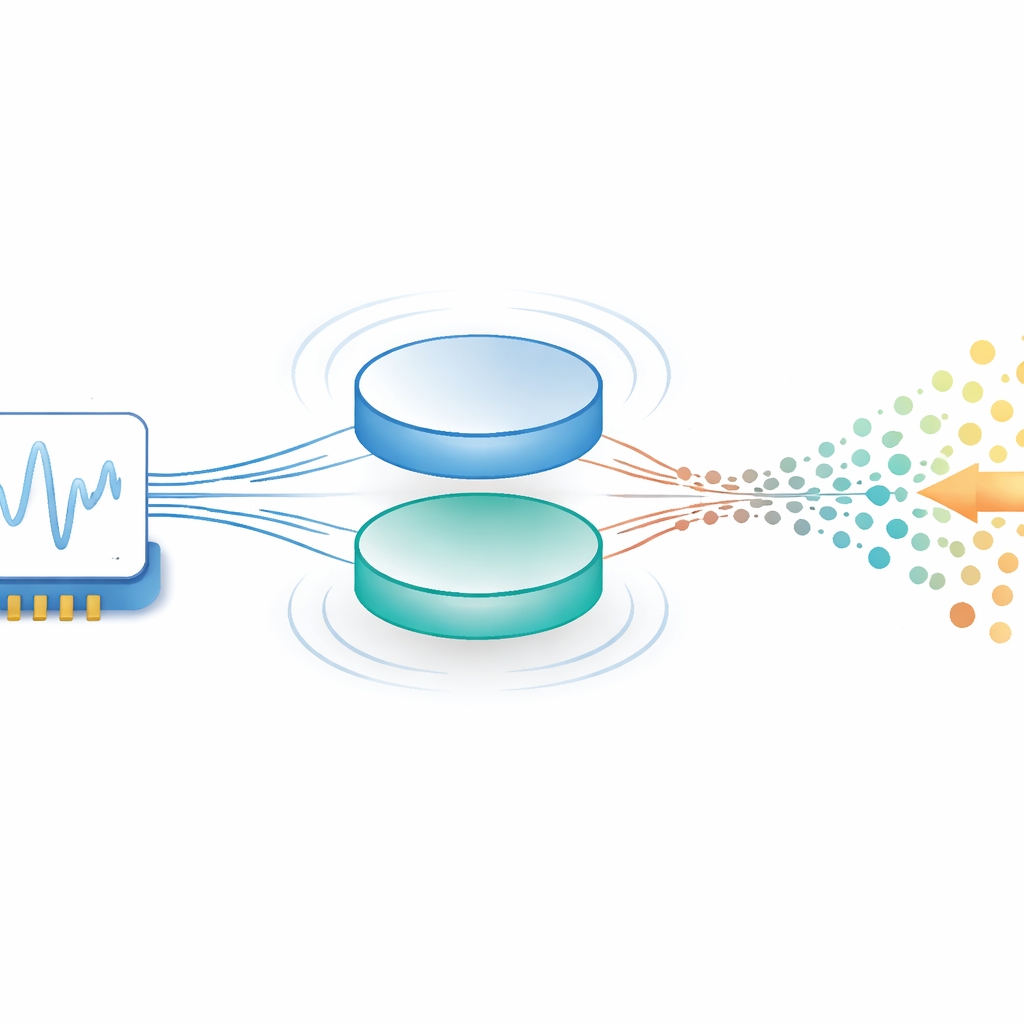
A pair of coupled drums on a chip
The device at the heart of this study is a “double‑drum” resonator: two circular membranes, one of silicon nitride and one of aluminum, stacked with a tiny gap between them. Each drum has its own vibration frequency in the megahertz range, and they are linked electrically through the changing capacitance across the gap. A microwave circuit is used to drive and monitor their motion with great sensitivity. To implement reservoir computing, the authors treat this physical structure as a single node and then create hundreds of so‑called virtual nodes by feeding different time slices of the input through a delay loop. The delay is implemented digitally on a field‑programmable gate array (FPGA), which sends a delayed version of the drum motion back to modulate the drive, so the current state always depends on both the present input and recent past vibrations.
Using a pump tone to stir rich dynamics
The key innovation lies in how the two drums are coupled. Borrowing ideas from optomechanics, the researchers apply a strong “pump” drive at a special frequency that lies on a sideband of the higher‑frequency drum. This pump effectively acts as a phonon bus, shuttling mechanical energy between the two drums. When a weaker “probe” drive excites one drum, the pump converts part of that motion into vibrations of the other drum and then back again, creating interference patterns that strongly depend on drive strength and frequency detuning. By carefully tuning the pump amplitude, the team generates pronounced nonlinear responses: small changes in drive can cause amplified or suppressed vibrations. These nonlinearities are exactly what reservoir computing needs to mix input information into a higher‑dimensional space while still retaining a fading memory of previous inputs.
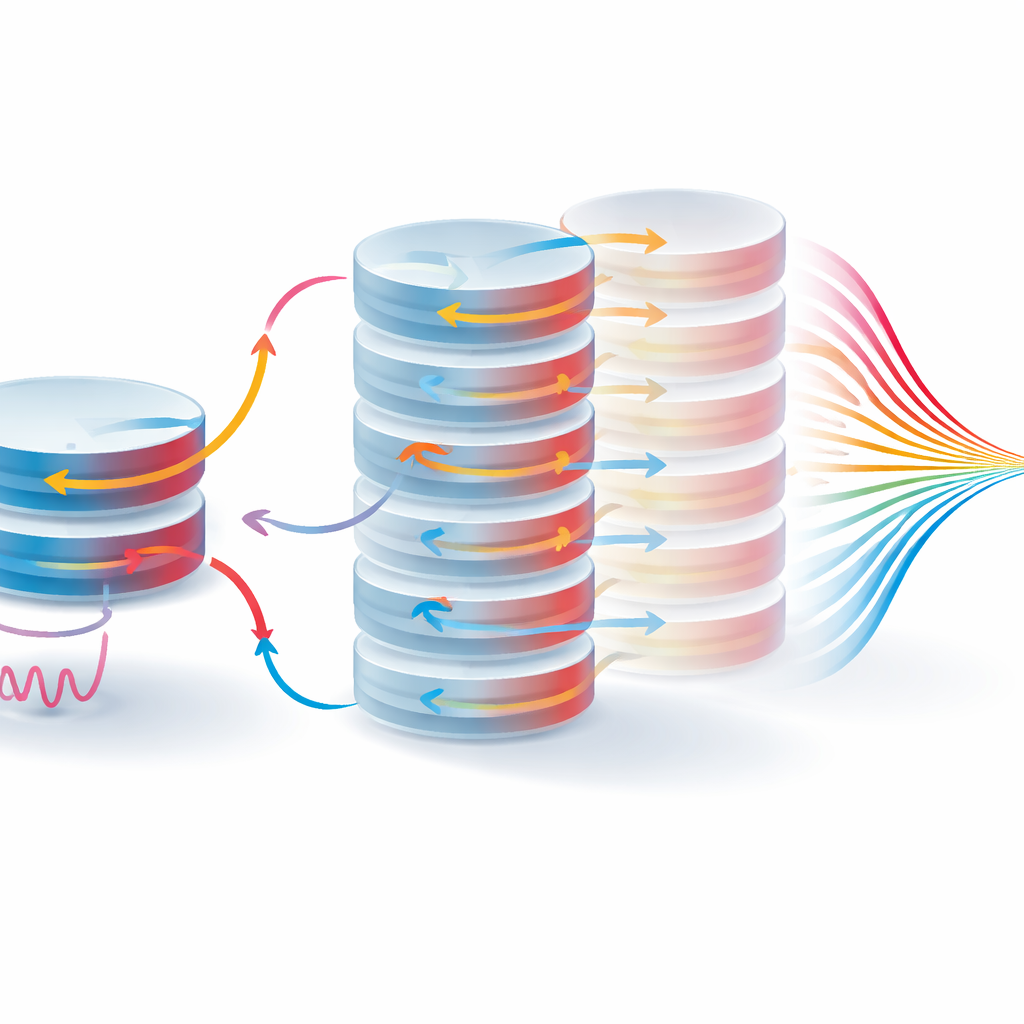
Testing memory and prediction abilities
To quantify how well the tiny drum system computes, the authors subject it to two standard benchmarks. The first, called a parity task, checks whether the system can remember and nonlinearly combine several past binary inputs, revealing its short‑term memory capacity. By operating in strongly nonlinear pump regimes, especially where interference peaks are sharp, the double‑drum reservoir correctly solves parity tasks up to several time steps back and achieves memory capacities comparable to earlier single‑resonator MEMS reservoirs. The second benchmark, known as the NARMA task, is more demanding: it requires reproducing a time series whose current value depends on a long and nonlinear history of inputs and outputs. Here, the new platform performs moderately but not yet as well as some slower, lower‑frequency MEMS systems, largely because the aluminum drum’s vibrations decay quickly and add noise, limiting how far back in time the system can effectively remember.
Why these tiny learners matter
Even with these limitations, the platform demonstrates impressive efficiency. The coupled drums occupy only a few tens of micrometers on a side and require femtojoules of electrical energy per input to reach the nonlinear regime, with overall power consumption in the nanowatt range. Crucially, the sideband‑pumping scheme does not demand perfectly matched drum frequencies and can link resonators that are physically separated, simplifying fabrication and scaling. The authors envision future chips where one drum (or set of drums) serves as a sensitive detector—for example, of acceleration, pressure, or light—while another drum performs on‑the‑spot reservoir computing on the measured signal. In this way, a single compact MEMS platform could both sense and “think,” reducing data transfer, saving energy, and enabling smarter, more autonomous devices.
Citation: Farah, T., Flis, L., Laly, P. et al. Implementation of reservoir computing using coupled microelectromechanical drum resonators via sideband-pumped phonon–cavity dynamics. Microsyst Nanoeng 12, 163 (2026). https://doi.org/10.1038/s41378-026-01287-0
Keywords: reservoir computing, MEMS, neuromorphic hardware, vibrational sensors, edge AI