Clear Sky Science · en
Development of a novel radially-distributed spiral bilayer thermopile infrared sensor with enhanced responsivity
Sharper Heat Vision for Everyday Devices
From smart thermostats to touchless medical thermometers, many gadgets rely on invisible heat patterns to sense the world. This paper explores a new tiny heat sensor that can see infrared light more clearly without needing expensive cooling hardware, paving the way for sharper, cheaper thermal cameras in homes, hospitals, and factories.
Why Small Heat Sensors Struggle
Modern infrared cameras are being pushed to show more detail while staying small and affordable. To pack more pixels onto a chip, each sensing unit must shrink, but this usually weakens the signal and makes the image noisier. Traditional designs also waste some of the incoming heat because it is not spread evenly across the sensing elements, and they can be difficult and costly to manufacture in large numbers using standard chip-making tools.
A New Spiral Path for Heat
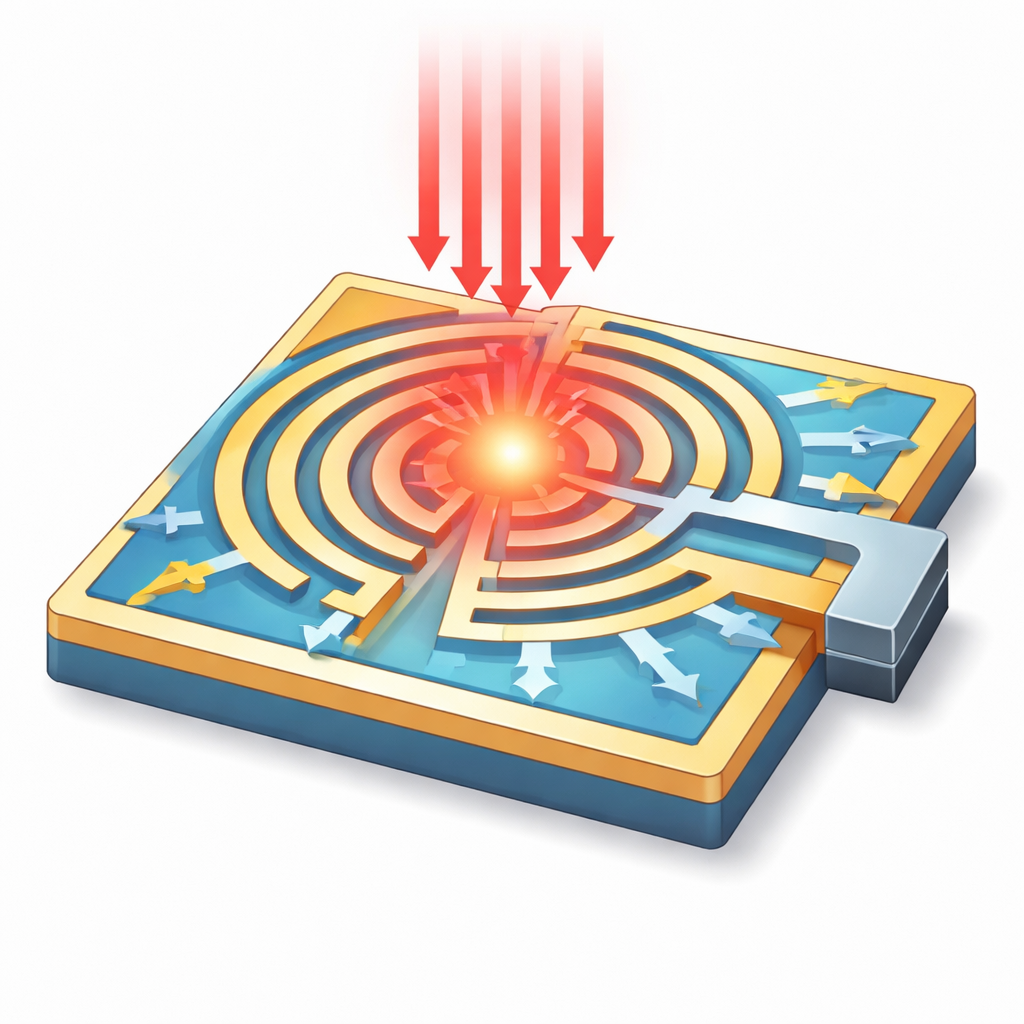
The researchers designed a new kind of infrared sensor called a thermopile, which turns heat differences directly into voltage. Their twist is to arrange the sensing “legs” in spiral shapes that spread out from the center of a thin circular membrane. Each leg is built as two stacked layers of different materials, separated by an insulating film. This vertical stacking allows many more leg pairs to be squeezed into the same area, while the spiral shape forces heat to travel a longer path from the warm center to the cooler edge, making the temperature difference stronger and the electrical signal larger.
Balancing Heat Flow and Uniformity
Using computer simulations, the team tested how strongly the spiral should curve to get the best performance. They found that tighter spirals lengthen the heat path, lowering heat leakage and boosting the temperature gap between the hot and cold ends of each leg. The round membrane and radial layout also help every leg experience nearly the same temperature pattern, so no part of the sensor is underused. Compared with older rectangular layouts, the new circular spiral design spreads heat more evenly and avoids hot and cold spots that could strain the structure over time.
From Chip Fabrication to Real Measurements
The sensor chips were built with widely used manufacturing steps that are compatible with standard CMOS processes, including depositing silicon and metal films, patterning them into spiral legs, and etching away silicon to leave a suspended membrane. The finished chip was mounted in a small metal package with an infrared window and tested in front of a controlled heat source. Measurements showed a smooth and predictable output as the source temperature changed, confirming that the sensor can read temperature from a distance with good stability and repeatability.

Stronger Signals with a Small Trade Off
When the spiral design was compared with a more conventional non-spiral version of the same size, the improvements were clear. The new sensor produced about forty percent more voltage per unit of incoming heat and showed a noticeable gain in its ability to detect weak signals above background noise. This came with only a modest increase in response time by a few thousandths of a second, which is still fast enough for most imaging and monitoring tasks. To a lay reader, the takeaway is that by carefully shaping how heat travels through a tiny structure, the researchers have created a more sensitive, still practical heat-sensing pixel that can help future infrared cameras see finer detail without a jump in cost.
Citation: Xia, Y., Meng, X., Lv, Y. et al. Development of a novel radially-distributed spiral bilayer thermopile infrared sensor with enhanced responsivity. Microsyst Nanoeng 12, 169 (2026). https://doi.org/10.1038/s41378-026-01278-1
Keywords: infrared sensor, thermopile, thermal imaging, MEMS, heat detection