Clear Sky Science · en
Development of micro dual temperature–heat flux sensing probe using Pt Thin film for transient heat measurements up to 1400 °C.
Measuring Extreme Heat on Future Flight Surfaces
When spacecraft or high-speed aircraft scream through the atmosphere, their outer skin is blasted by intense heat in just fractions of a second. Knowing exactly how much heat those surfaces endure is vital for keeping engines, fuel tanks, and protective coatings from failing. This paper presents a new kind of tiny heat-sensing probe that can survive temperatures higher than many lava flows and respond fast enough to track sudden thermal shocks, offering a powerful tool for designing safer high-speed vehicles.
Why Extreme Heat Is So Hard to Measure
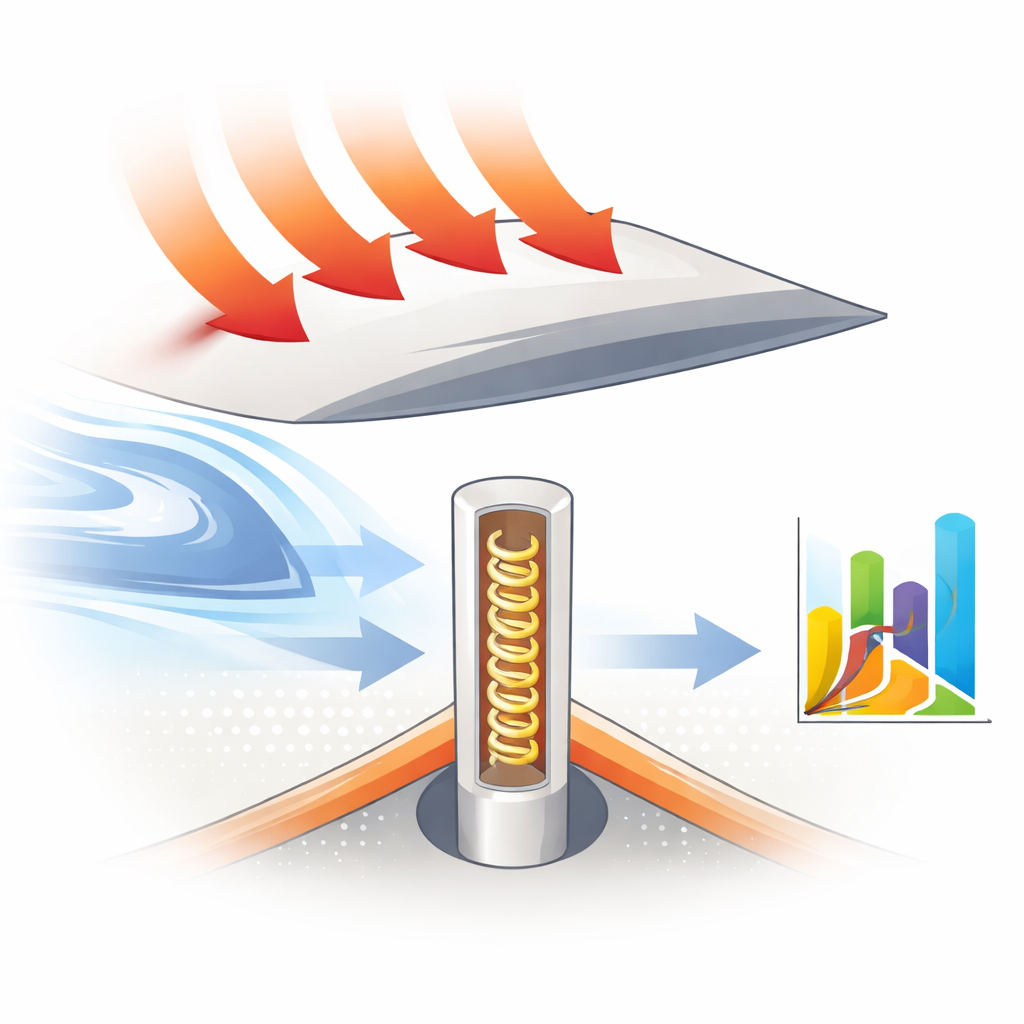
Surfaces on hypersonic test models, turbine blades, and combustion chambers can briefly exceed 1000 °C while being sandblasted by high-speed gases. Traditional heat flux sensors—devices that measure how quickly heat flows into a surface—struggle in this environment. Classic designs are relatively large, which disturbs the airflow around them, and their materials can oxidize or soften, making readings drift or fail. Many current sensors top out below about 1200 °C and react over milliseconds or longer, which is too slow and too fragile for the sharp, intense heat spikes seen in modern wind tunnel tests and engine research.
A Tiny Pillar Built to Take the Heat
The researchers designed a miniature probe based on a platinum (Pt) thin film wrapped onto a 2-millimeter-wide alumina (aluminum oxide) pillar. Alumina was chosen because it is electrically insulating, mechanically strong, and can withstand temperatures up to roughly 1600 °C. Inside this ceramic pillar, the electrical leads are hidden in narrow channels, which protects the wiring from hot, erosive gases and reduces electrical noise. On the outside, the platinum layer is patterned in an S-shaped path to increase its length, boosting sensitivity to temperature changes while remaining confined to a tiny footprint.
A Protective Skin That Prevents Film Breakdown
One of the major challenges for metal films at very high temperatures is that the surface can slowly clump into islands, like water beading on glass, which ruins their electrical behavior. To prevent this, the team used electrohydrodynamic jet printing—a precise, ink-like spraying method—to coat the platinum with a custom alumina protective layer. After high-temperature treatment, this coating turns into a dense, stable crystal form called alpha-alumina. Microscopy and X-ray measurements showed that the coated platinum film stays smooth and well-bonded even after being heated up to 1400 °C, while an unprotected film develops voids and rough patches at lower temperatures.
How the Probe Turns Heat into Signals
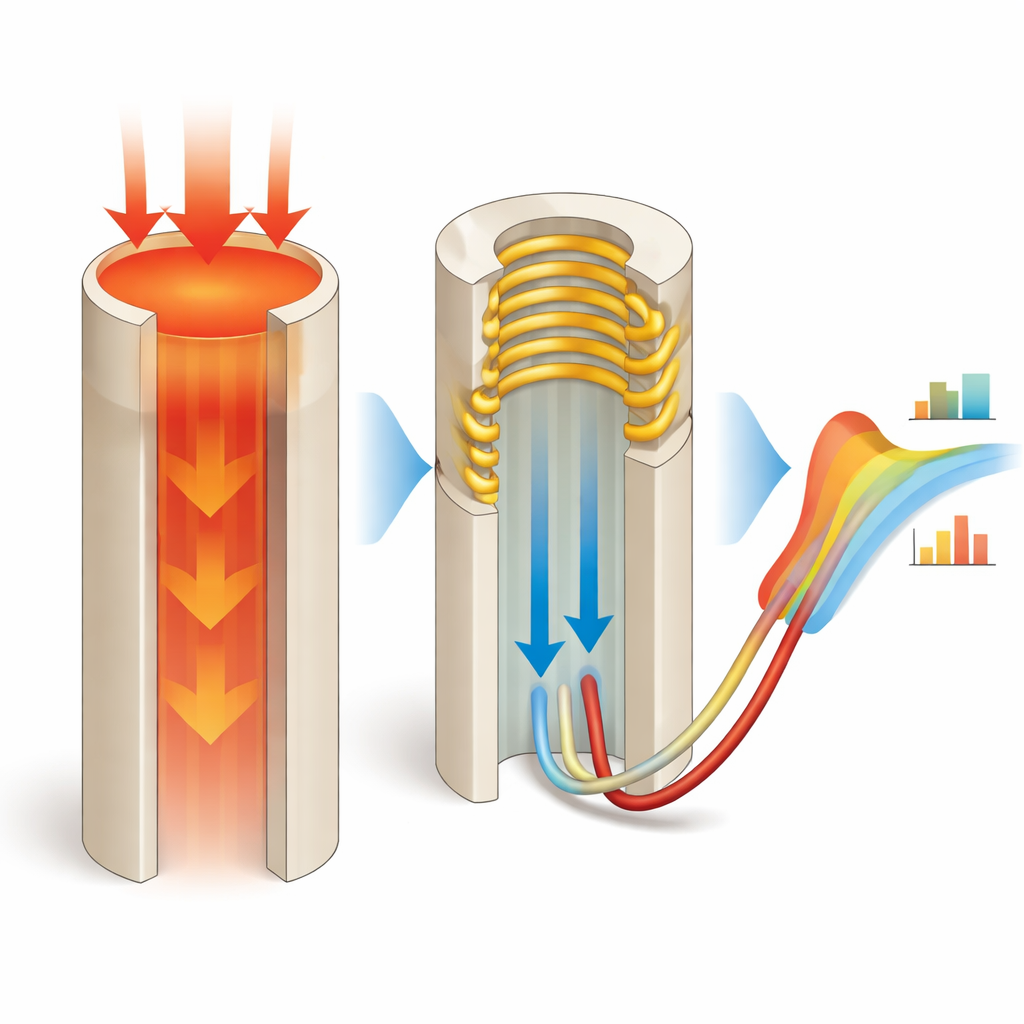
The new sensor works in two complementary ways. First, as the platinum film heats up, its electrical resistance rises in a predictable, nearly linear fashion. By feeding a constant current through the film and tracking the voltage change, the temperature at the surface can be calculated with high precision. Second, using a well-known heat conduction model, the time history of that voltage can be converted into the time history of heat flux—the rate at which energy is pouring into the surface. Computer simulations confirmed that the probe’s layered structure produces a clean, almost linear relationship between incoming heat and output signal, while compressive stress in the film, maintained by the alumina layers, helps keep the platinum stable at high temperatures.
Putting the Sensor to the Test
The team then subjected the probe to a battery of experiments. In a furnace, the resistance of the platinum film tracked temperature from room temperature up to 1000 °C with excellent linearity and repeatability, and the protected version survived up to about 1440 °C—roughly 50 percent higher than unprotected films. Laser-based tests compared the new probe with a commercial heat flux sensor and showed good agreement: at the highest tested power, the new device measured about 71 kW per square meter of heat flux with less than 1.7 percent full-scale error and repeatability better than 0.6 percent. A rapid heating setup, mimicking sudden thermal loads, revealed that the probe can respond in about 0.2 milliseconds and withstand heat fluxes above 3.5 megawatts per square meter, with temperature errors under 1 percent when checked against an infrared thermometer.
What This Means for Future High-Speed Flight
In simple terms, this work delivers a very small, very tough, and very fast thermometer that not only measures temperature but also how violently heat is slamming into a surface. Because it can survive close to 1500 °C, react in microseconds, and be made in arrays on tiny pillars, it is well suited for mapping the thermal loads on hypersonic vehicles and engine components with fine detail. This capability should help engineers design more reliable thermal protection systems and test new materials under realistic, extreme conditions, bringing safer high-speed flight closer to reality.
Citation: Wang, H., Kong, M., Wang, H. et al. Development of micro dual temperature–heat flux sensing probe using Pt Thin film for transient heat measurements up to 1400 °C.. Microsyst Nanoeng 12, 158 (2026). https://doi.org/10.1038/s41378-026-01274-5
Keywords: heat flux sensor, hypersonic wind tunnel, platinum thin film, high temperature measurement, alumina ceramic